Updated
Claude Certified Architect Foundations: exam and study guide
Foundations (CCAR-F) tests how you design agentic systems with Claude. This guide covers the exam format and a study plan: what to learn, what to build and how to check your work in each of the five domains.
Claude Certified Architect Foundations is Anthropic’s exam for engineers and architects building with Claude Code, the Agent SDK, the API and MCP. If you can start an agent but struggle when a tool fails or a session grows long, begin with those exercises. The table below connects the CCAR-F scope to resources and practical tasks.
What the Claude Certified Architect certification is
I passed CCAR-F on July 15, 2026 with 833/1000. My account of taking the exam describes that sitting. Here I separate my experience from the organizer’s current rules so you can prepare for your own appointment.
Foundations covers decisions when building a system: dividing work, calling tools, checking results and keeping context. The official guide recommends roughly six months of practical experience with these technologies. That is guidance, not a formal prerequisite or a promise of readiness after six months.
There are four tracks to choose from. The comparison of Claude certifications by role helps you decide whether your work fits Architect, Developer or Associate. Each exam has its own scope.
The five exam domains
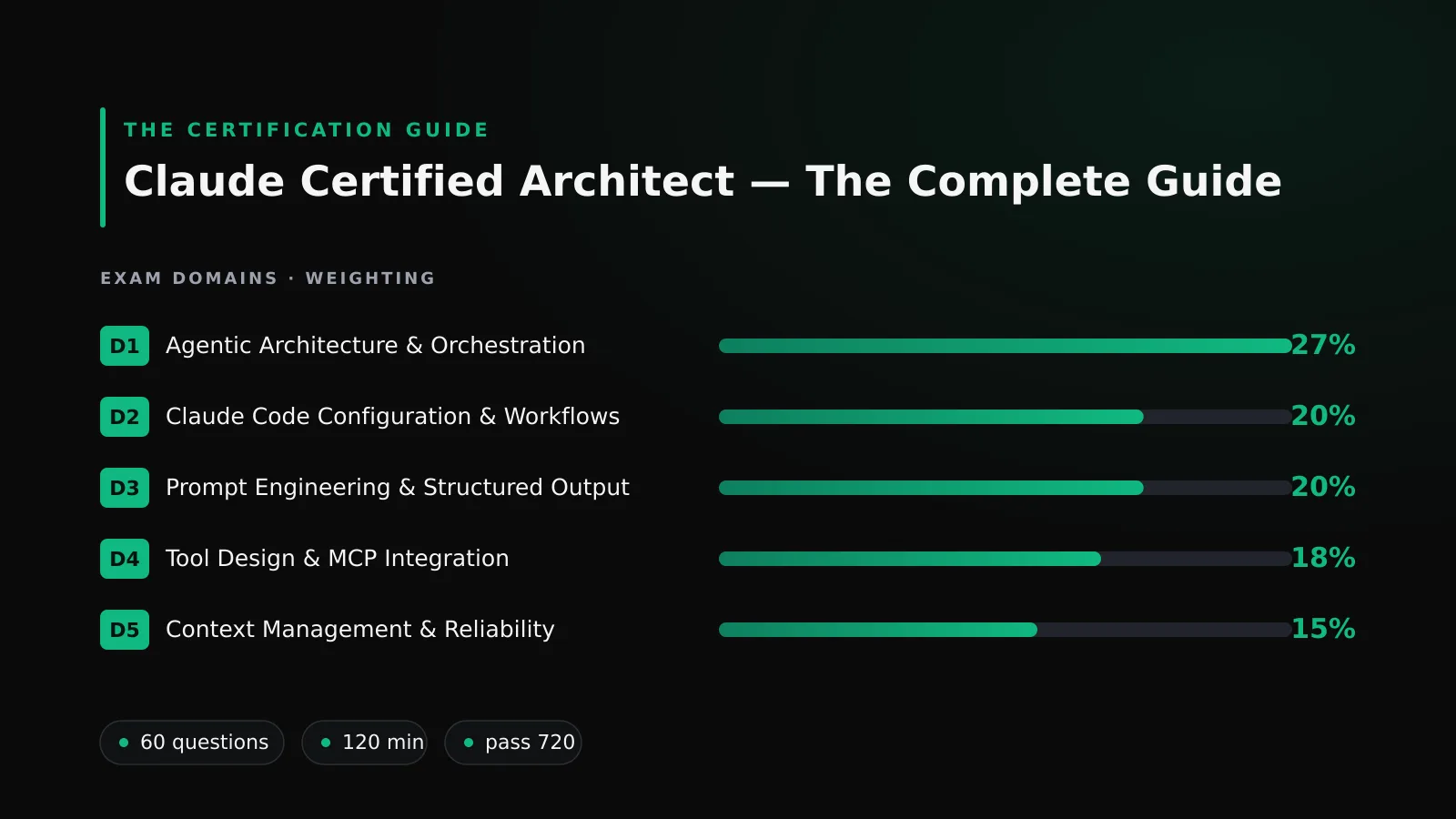
The five domain weights describe the approximate share of scored items. They come from the official CCAR-F exam guide, July 2026 version 1.0, checked on September 29. Use them to plan study time alongside the gaps in your own experience.
| Domain | Weight | What it covers |
|---|---|---|
| D1 · Agentic Architecture & Orchestration | 27% | Driving the agentic loop on stop_reason, multi-agent design, human handoff, guardrails and bounded autonomy. |
| D2 · Tool Design & MCP Integration | 18% | Designing tools an agent can use reliably, MCP servers, tool_choice, and error surfaces that don't fail silently. |
| D3 · Claude Code Configuration & Workflows | 20% | CLAUDE.md, hooks, subagents, permissions and plan mode. Configuring Claude Code so work is safe and repeatable. |
| D4 · Prompt Engineering & Structured Output | 20% | Reliable prompting, extended thinking, JSON/structured output, and stopping the model from fabricating missing data. |
| D5 · Context Management & Reliability | 15% | Context windows, compaction, prompt caching, and keeping long-running sessions coherent and cost-controlled. |
For D1 and D2, see the 12 rules for building agents I wrote during my preparation. Compare them with the exam objectives and test them in a small project.
Who should take it
This scope fits work on agents and tools for clients or your own team. Preparation will be easier if you already:
- ship agents, tools or workflows on Claude, the Agent SDK, MCP or Claude Code in actual projects;
- have hit production problems (silent tool failures, runaway loops, context blowups) and had to fix them;
- can reason about trade-offs (deterministic guardrail vs prompt instruction, compaction vs fresh session) rather than reciting definitions.
If you are new to this, build a small system and inspect what happens when it fails. Memorizing mock answers will not replace that work. There is no preparation duration that works for everyone.
How the exam works
Format checked on September 29, 2026:
Official items can have one or several correct responses, with the number specified in each question. The exam selects four of six scenarios. My sitting used four options and one correct answer, but that describes one particular form. Pearson VUE proctors the exam online or at a test center; scores range from 100 to 1000, with a passing score of 720.
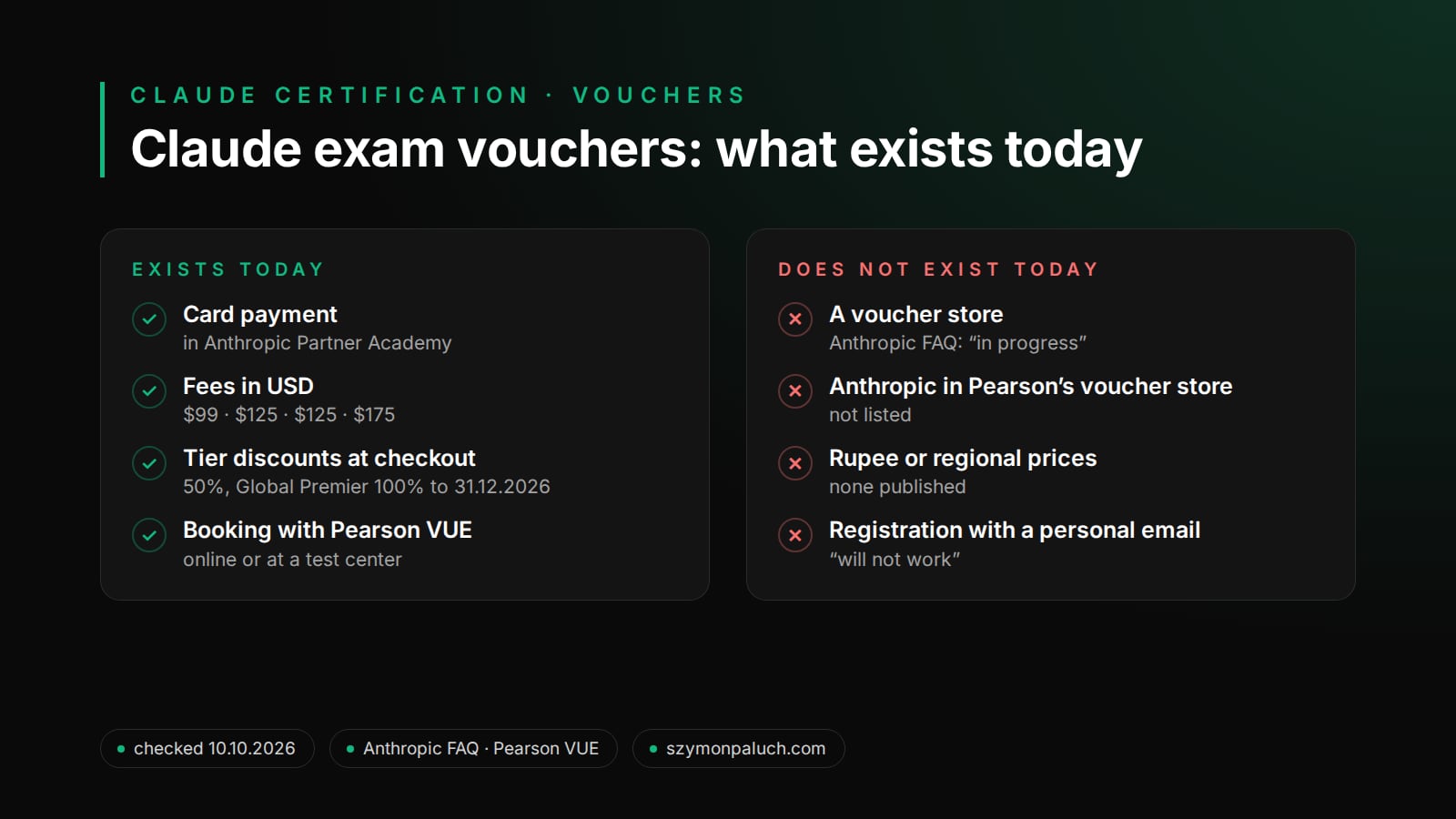
Registration goes through Anthropic Partner Academy for people at Claude Partner Network organizations. Your company domain must be recognized on the partner record. I cover exam fees, retakes and renewal costs separately to help you work out a budget.
Anthropic admits to its exams only people from Claude Partner Network organizations. Join our collective of AI consultants and sit all four exams through our partner organization.
How to prepare
Start with objectives you cannot yet demonstrate in practice. The exercises below are my suggested way to use the official resources, not live exam tasks. Keep the code, test result and a short decision rationale. After a mock, return to the row for your weakest domain.
| Domain | Skill | Official resource | Exercise | How to check it |
|---|---|---|---|---|
| D1 · 27% | Decide what the agent may execute and when a person must take over. | Agent SDK hooks | Add a refund hook above a set amount and bound retries after an error. | Test amounts below and above the limit, then a tool failure. The agent must not bypass the block. |
| D2 · 18% | Define an MCP tool’s inputs, output and errors. | MCP: server concepts | Build a tool that reads an order by ID. Distinguish an empty result from a service error. | Call it with a valid ID, an unknown ID and a failed service. The client must distinguish all three cases. |
| D3 · 20% | Choose project instructions and verify Claude Code’s work. | Claude Code: memory | Put the test command and scope in CLAUDE.md. Request a small repository change. | Read the diff and run the tests. Check that the change stays within scope; instructions alone do not enforce it. |
| D4 · 20% | Design a schema that can represent missing data. | Structured outputs | Extract order numbers from documents. Allow null and explain when to return it. | Check both JSON validity and source accuracy on documents with and without a number. |
| D5 · 15% | Preserve necessary facts during a long task. | Claude Code: context | Use /compact with the decisions and facts that need to survive. | Compare the summary with your list. Continue the task and check that the same requirements still apply. |
Take the full CCAR-F practice test after the exercises. It has 60 original single-answer questions across all six scenarios. The official exam differs in format, and the mock does not use its scoring formula.
The Agentic Architect
Practical patterns, case studies and AI news. Zero spam, once a week.
You'll get one email to confirm. Unsubscribe with one click. Privacy policy
Before booking and on exam day
- Demonstrate each domain with code or your own example, including a tool failure.
- Review incorrect mock answers and repeat the relevant exercises. A high score after several attempts can reflect memorizing the key.
- Check access through your company domain, your profile details and the exact match between your name and your ID.
- For an online sitting, run Pearson’s equipment and network test beforehand. Allow about 135 minutes in total for check-in and instructions as well as the exam.
- The exam is closed book: no notes, documentation, browser translation or AI assistant. Read the rules before your appointment.
Current registration and exam-day rules checked on September 29, 2026.
If your employer is not a partner, first check the exam access requirements. Paying a fee or scoring well on a mock does not establish registration eligibility.
After an exercise, read the three sample questions with explanations. Try to justify your choice before reading the answer. The separate 60-question tool lets you practise pacing; use its result to choose what to revisit.
Practice with 60 questions, free
Study mode, a 120-minute attempt and results by domain. Unofficial single-answer questions; the tool’s scoring does not predict your Anthropic result.
Is it worth it?
Preparation helped me organize how I choose tools and constrain an agent’s actions. A certificate does not show the code, tests or delivery outcomes, though. Give the person evaluating your work a project and decisions you can explain as well.
The Claude Code Partner Badge is earned through courses and a capstone. It does not replace passing CCAR-F. Use each credential’s full name in your portfolio.
How will you show this knowledge to a client? In the article on CCA’s value when looking for work, I separate the credential’s signal from the evidence to include in a portfolio. Choose one project that demonstrates your decisions.
Frequently asked questions
What is the Claude Certified Architect certification?
Foundations, code CCAR-F, is Anthropic’s exam on designing systems with Claude Code, the Agent SDK, the API and MCP. It assesses decisions across five domains.
How many questions are on the exam and how long is it?
60 questions in 120 minutes, with both single-answer and multiple-response items. The exam selects four of six scenarios. Pearson VUE proctors it online or at a test center.
What score do you need to pass?
The passing score is 720 on a scale from 100 to 1000. The report also gives percent-correct by domain. The official scaled score is not a simple percentage of correct answers.
What are the five exam domains and their weights?
Agentic architecture and orchestration 27%, tools and MCP 18%, Claude Code configuration 20%, prompts and structured output 20%, context and reliability 15%. The weights are approximate.
How long does it take to prepare?
It depends on your experience and gaps in each domain. Complete exercises, inspect your mistakes and then plan your exam date. No validated study duration guarantees a pass.
Is there a free practice exam?
Yes. This site has a separate tool with 60 original questions, study mode and a 120-minute attempt. It is an unofficial single-answer mock with its own scoring formula and results by domain.
Does the certification help with work?
It can demonstrate that you passed an exam covering a defined scope. A client or employer may also require a project, relevant experience and a technical discussion. The certificate alone does not guarantee a job or a contract.
Disclaimer. This guide is independent and unofficial. It is not affiliated with, authorized or endorsed by Anthropic. Exam details are modeled on the publicly available exam guide and my own experience sitting it; check Anthropic's official channels for current specifics. Claude and Claude Certified Architect are names owned by Anthropic.