Which Claude certification should you take? Associate, Developer or Architect
Take Associate if you use Claude at work and do not write code. Take Developer Foundations if you build applications on the Claude API. Take Architect Foundations if you design agentic systems and choose the trade-offs. Take Architect Professional if you run enterprise delivery, governance included. Below, all four exams compared on Anthropic's official exam guides.
Until July there was one Claude exam. On 23 July 2026 Anthropic added three more, and the question changed from "should I take it" to "which one". The names do not help much. "Architect" sounds like the senior option for any engineer, yet the Developer exam is closer to what most engineers do every day. I passed Architect Foundations. For the other three I read the official exam guides line by line, and the comparison below comes from them.
The four exams side by side
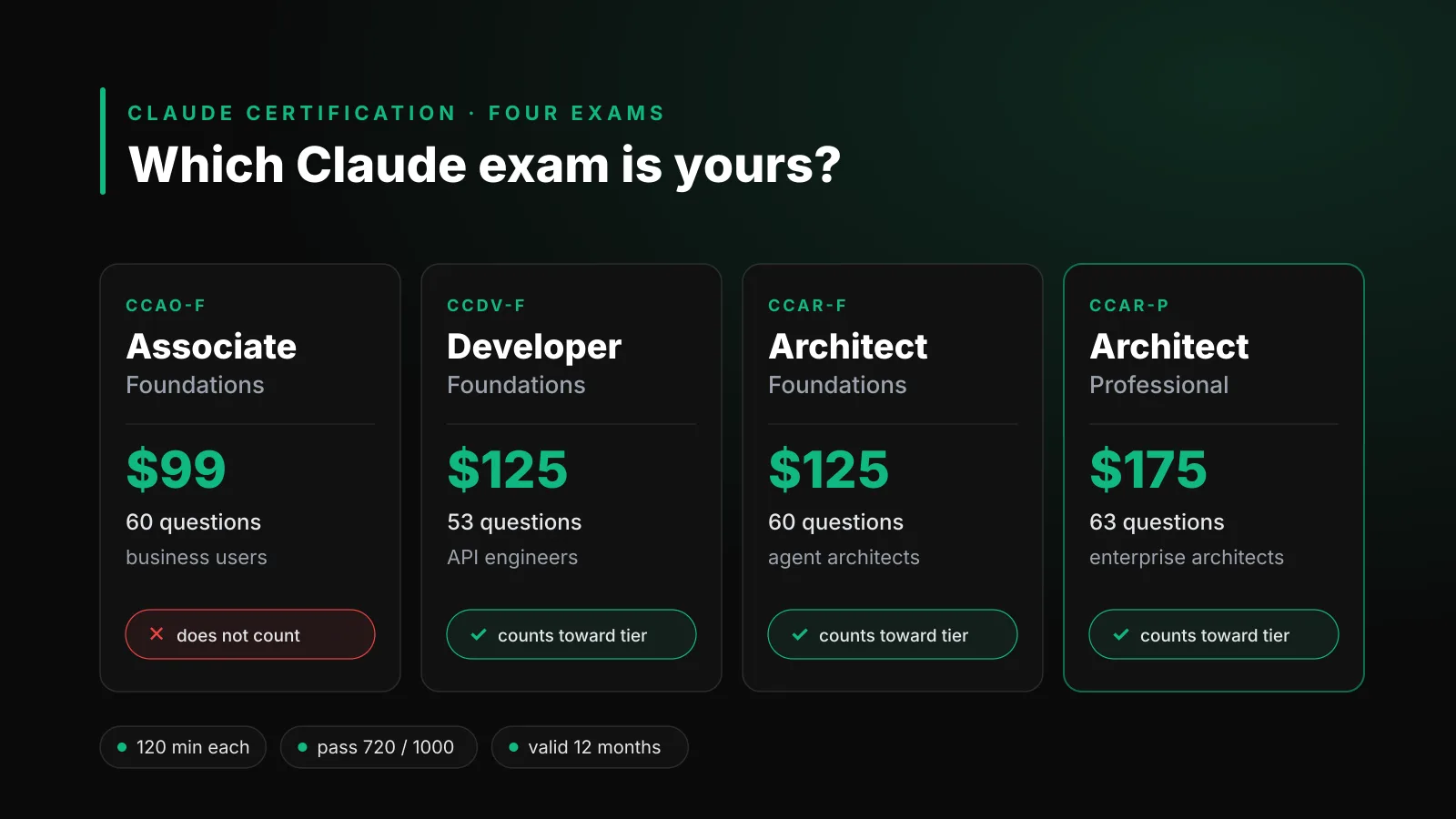
Each exam has its own code, audience, question count and fee. One column matters more than it looks: whether the certificate counts toward a firm's tier in the Claude Partner Network.
| Exam | Built for | Questions | Fee | Counts toward tier |
|---|---|---|---|---|
| Associate Foundations CCAO-F |
Business users: operations, marketing, project management, consulting | 60 | $99 | No |
| Developer Foundations CCDV-F |
Engineers who build applications on the Claude API | 53 | $125 | Yes |
| Architect Foundations CCAR-F |
Solution architects who design agentic systems | 60 | $125 | Yes |
| Architect Professional CCAR-P |
Experienced architects and engineers in enterprise delivery | 63 | $175 | Yes |
What all four share: 120 minutes under a Pearson VUE proctor, a pass at a scaled 720 out of 1000, and 12 months of validity. None has a formal prerequisite. Each guide lists recommended experience, and the credential goes to whoever passes the exam.
Associate Foundations: for people who use Claude at work
Associate is the only exam that needs no code. Its guide aims it at people in operations, marketing, project management, education and communications who use Claude as a work tool and build Claude Projects. It states plainly that the exam is not meant for developers who build against the API.
The heaviest of its seven domains is Output Evaluation and Validation, at 21%: spotting hallucinations, checking facts, deciding when a human has to review the output. That matches what I see when I train non-technical teams. Good users and risky users prompt about equally well, and the difference is whether they check. I took one published report apart along exactly that line, in the checking step most AI-written reports skip.
Two limits are worth knowing before you book it. Associate does not count toward a firm's partner tier, so a partner has no tier reason to pay for it. And at $99 it is the cheapest of the four, which does not make it the right first exam for an engineer.
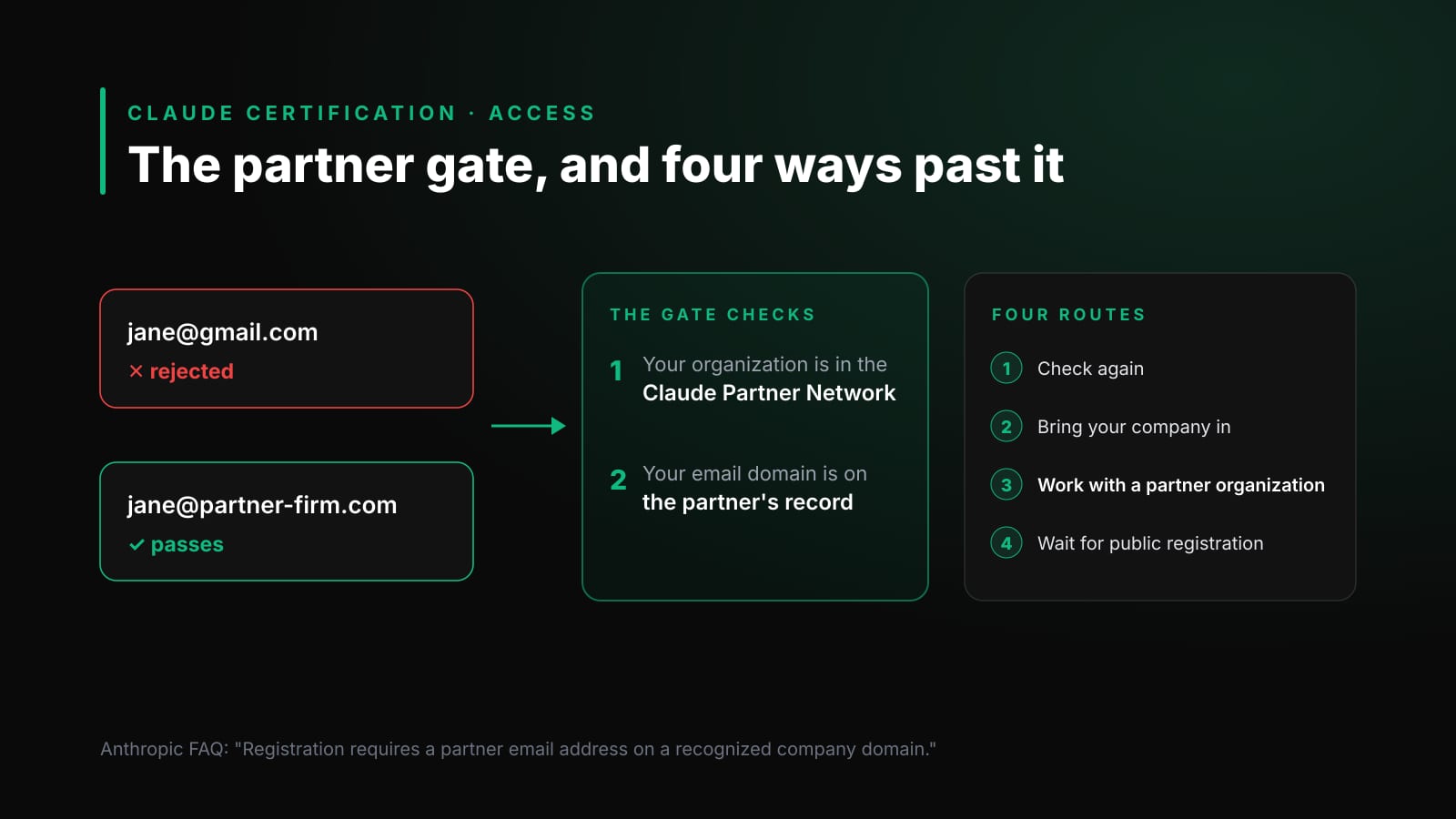
Anthropic admits to its exams only people from Claude Partner Network organizations. Join our collective of AI consultants and sit all four exams through our partner organization.
Developer Foundations: for engineers who ship applications
Developer Foundations is the exam for most software engineers who work with Claude. The guide recommends one to five years of engineering, at least six months with Claude or a comparable model, and Python or TypeScript.
Its blueprint is the most lopsided of the four. Applications and Integration takes 33.1% of the exam: API mechanics, application design, configuration and plain software engineering. Model Selection and Optimization adds 16.8%. Claude Code gets 3.1% and evaluation 2.6%. So despite the names, Developer tests integration code, and Claude Code configuration weighs far more in the architect exam, at 20%.
It is also the shortest exam: 53 questions in the same 120 minutes, which leaves more time per question than any of the other three.
Architect Foundations: for people who design agentic systems
Architect Foundations is the one I passed. It tests decisions across Claude Code, the Claude Agent SDK, the Claude API and MCP. The exam draws 4 production scenarios at random from a bank of 6, for example a customer support agent, a multi-agent research system or Claude Code running in CI, and asks which design holds up. The guide expects six months of hands-on building with those tools.
The five domains, their weights and the plan that got me to 833 are in my guide to the Architect Foundations exam.
Choose it over Developer if your job is deciding how an agent loops, where a hook replaces a prompt instruction and how context survives a long session. Choose Developer if your job is mostly writing and shipping the integration code.
Architect Professional: for experienced architects in enterprise delivery
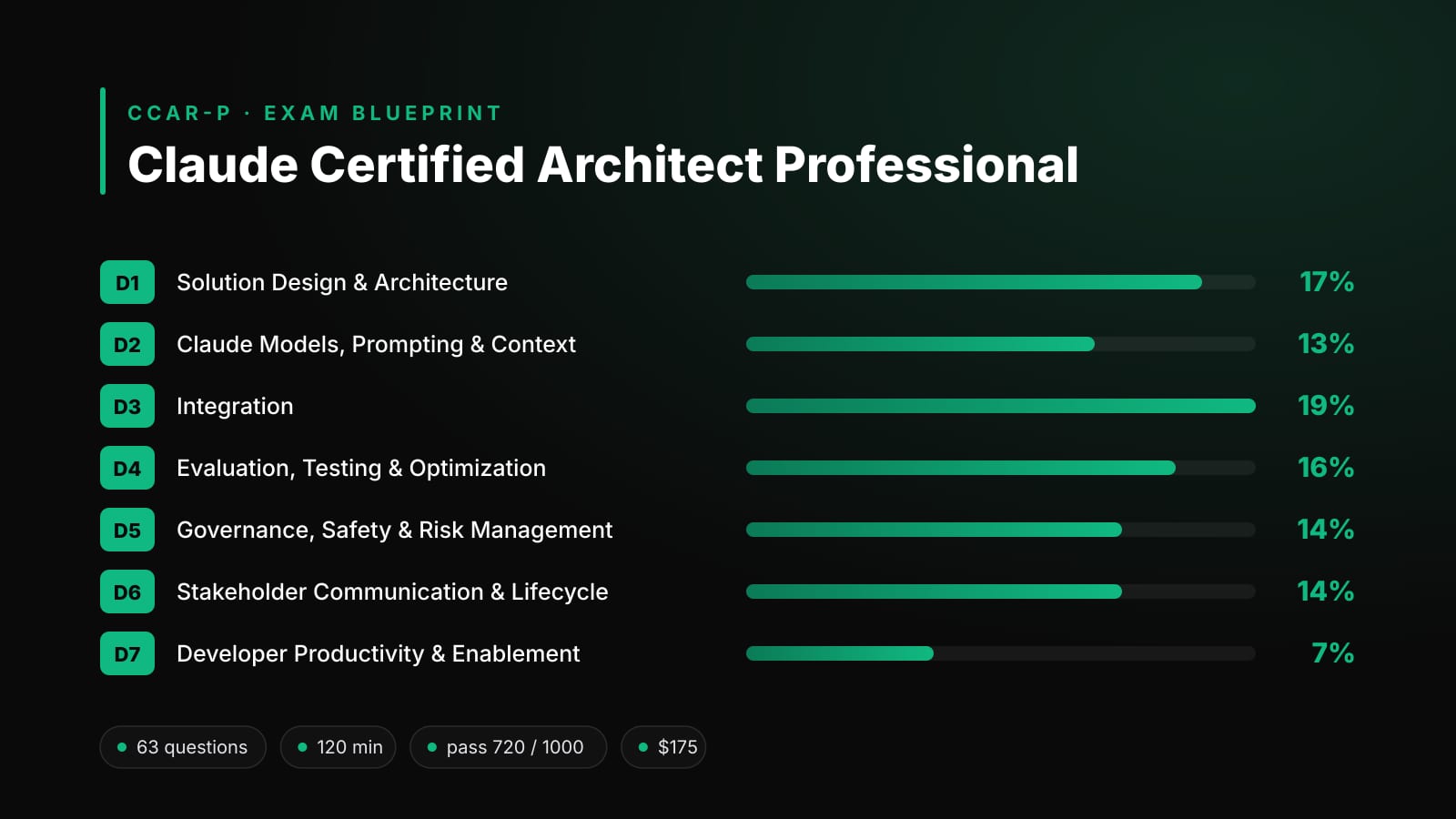
Professional is the advanced credential. Its guide recommends three or more years in systems architecture and six months with LLM systems in production. Beyond architecture it tests work that Developer and Architect Foundations barely touch: governance, regulations such as GDPR and HIPAA, evaluation design, and stakeholder communication, which shares a 14% domain with lifecycle management.
Foundations is not a prerequisite for it, and passing Foundations does not upgrade into Professional. They are two exams with two fees. I went through the Professional blueprint domain by domain, with three practice questions in its style, in what CCAR-P tests beyond the Foundations exam.
How to choose in four questions
FOUR QUESTIONS, IN ORDER
- 1. Do you write code that calls Claude? If not, take Associate.
- 2. Is your work mostly integrating Claude into applications? Then Developer Foundations.
- 3. Do you decide the architecture of agents, tools and context? Then Architect Foundations.
- 4. Do you also own governance, evaluation and the client conversation at enterprise scale? Then Architect Professional. If the agent side is still new to you, take Foundations first.
Choosing for a whole team moves the question up a level. In my experience the right exam follows how a team works with AI today. A team that prompts well needs Associate for most people. A team that runs workflows needs developers. A team that builds loops needs architects. Before you pick exams for ten people, check where your team stands in 12 questions.
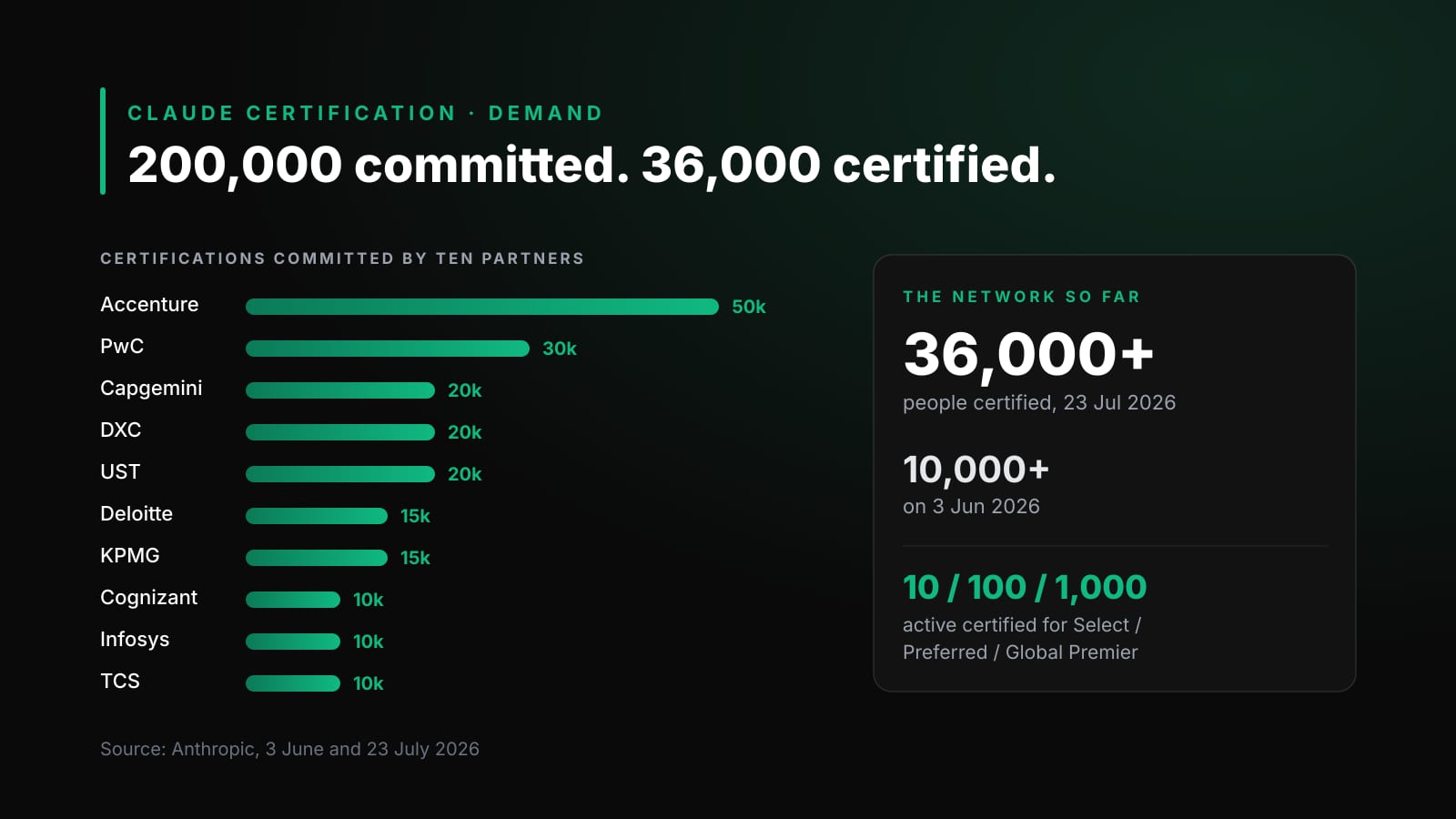
At a partner firm the tier arithmetic decides too. Developer and both architect exams count toward the tier, Associate does not, and the tier counts certified people, not certificates. What each exam costs with retakes, discounts and renewal is in the full breakdown of Claude certification fees.
Frequently asked questions
Which Claude certification is the easiest to start with?
Associate Foundations. It needs no programming, costs $99 and is aimed at business users of Claude. Its heaviest domain is checking and validating Claude's output, so it still takes real practice.
What is the difference between Claude Certified Developer and Claude Certified Architect?
Developer Foundations tests building and integrating applications on the Claude API, with 33.1% of the exam on applications and integration. Architect Foundations tests design decisions across Claude Code, the Agent SDK, the API and MCP in production scenarios. Both cost $125.
Is there a Claude certification for non-technical people?
Yes. Claude Certified Associate Foundations is for people who use Claude in business work, such as operations, marketing or project management. It requires no software development or API experience.
Do I need Architect Foundations before Architect Professional?
No. There is no formal prerequisite, and Foundations does not upgrade into Professional. They are separate exams with separate fees.
Which Claude certifications count toward the Claude Partner Network tier?
Developer Foundations, Architect Foundations and Architect Professional. Associate Foundations does not count toward partner tier eligibility.
Disclaimer. This comparison is independent and unofficial. It is not affiliated with, authorized or endorsed by Anthropic. Figures come from Anthropic's four exam guides (version 1.0, effective July 2026) and its certification FAQ, checked on 18 September 2026. Claude and the certification names belong to Anthropic.