60 Claude Certified Associate questions with explanations
Which exam are you preparing for?
All 60 original questions from my free Claude Certified Associate Foundations (CCAO-F) practice set are on this page, each with its answer and explanation. None needs code. 9 are multiple response, as on the real exam. I walk through three step by step: what the question asks, the trap and where to read more. The same questions run as an online test with a study mode, a timed 120-minute attempt and results by domain.
Associate questions describe ordinary work: a deck for the board, a contract with a data clause, a spreadsheet the team cannot use yet. The right answer usually checks the source, reads a setting precisely or says what the first request left out.
What exactly you get
I wrote these questions from Anthropic’s public exam guide and documentation for Associate Foundations. None comes from the live exam. 51 have one correct answer and 9 need two or more. A multiple-response question says how many answers to pick and scores only when every pick is right. Names, figures and plans in the scenarios are assumptions for the exercise.
I passed Architect Foundations (CCAR-F) in July 2026. These questions follow the public Associate guide. If you are not sure Associate is your exam, a comparison of all four Claude exams by audience, fee and scope will help.
What the real exam covers
According to Anthropic’s official exam guide for Associate Foundations, the exam has 60 questions, a 120-minute limit and a passing score of 720 on a scale from 100 to 1000. The guide lists a base fee of $99 per attempt. Pearson VUE proctors it online or at a test center. It is meant for people who use Claude at work without writing code. Questions are multiple choice or multiple response. Here are the guide’s domain weights and the question counts in my set:
| Domain | Weight | Questions in my mock |
|---|---|---|
| D1 · Prompting and Task Execution | 14% | 8 |
| D2 · Output Evaluation and Validation | 21% | 13 |
| D3 · Product and Model Selection | 12% | 7 |
| D4 · Workflow Integration and Solution Design | 16% | 10 |
| D5 · Configuration and Knowledge Management | 12% | 7 |
| D6 · Governance, Risk, and Responsible Use | 15% | 9 |
| D7 · Troubleshooting and Optimization | 10% | 6 |
Output evaluation is the largest domain, at 21%. It covers spotting invented facts, checking figures and deciding when a person should review the result. Governance follows at 15%. A prompt that sounds good tells you nothing about whether an answer is true, so many questions end with a check.
If you write code that calls Claude, the 53 Developer Foundations questions with explanations fit your work better. Associate does not count toward a firm’s tier in the Claude Partner Network.
Anthropic admits to its exams only people from Claude Partner Network organizations. Join our collective of AI consultants and sit all four exams through our partner organization.
Three questions to try
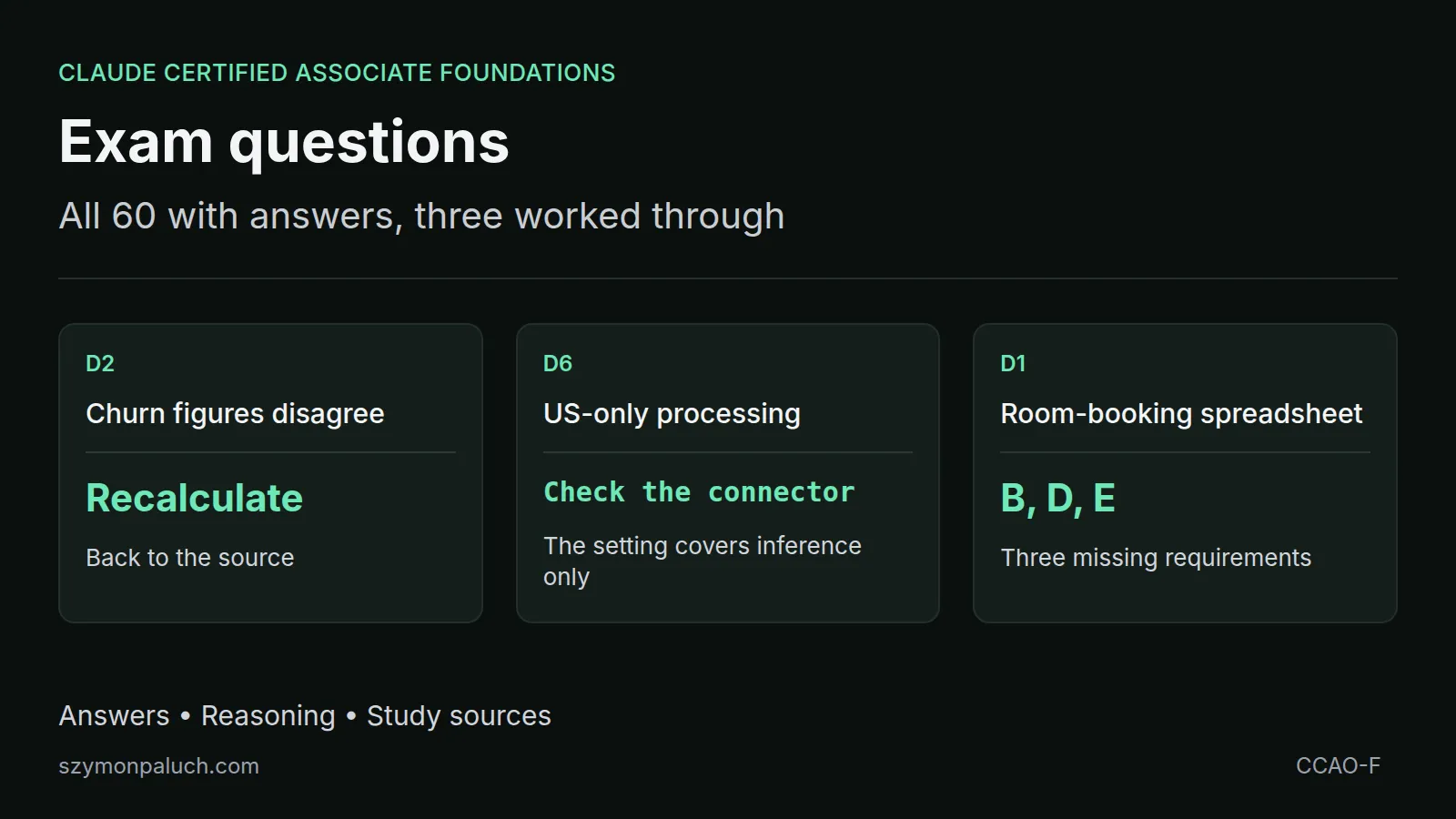
Pick an answer and write one sentence explaining it before you read the key. These are questions 25, 16 and 13 from the full set below. The third asks for three answers.
QUESTION 25 · D2 · OUTPUT EVALUATION
A customer-success director had Claude build a board deck from a subscription export. Slide 2 says annual churn fell to 4.1%, while the appendix table, built from the same export, shows 4.6%. Two other slides use the churn figure in their own calculations. The deck is due on Friday. What should she do?
- A. Keep the slide 2 figure, since board members read the summary most closely, and delete the appendix table to remove the conflict.
- B. Recalculate churn from the export, correct every place the wrong figure appears, and recheck the two slides that build on it.
- C. Ask Claude which of the two figures is correct, and change the other so the whole deck uses the figure Claude chooses.
- D. Average the two figures to 4.35% and use it everywhere, with an appendix note that small rounding differences may exist.
Correct: B. Two values for one metric from the same data mean at least one is wrong. The fix is to go back to the source, establish the correct figure and trace everything that depends on it. Anthropic’s documentation notes that models can produce text inconsistent with the given context, and its help center advises checking important calculations with dedicated software or by hand. A hides the conflict without knowing which figure is right. C lets the model that produced the conflict settle it without evidence. D invents a third number and calls the gap rounding. See Anthropic’s guidance on reducing hallucinations.
In practice, start from the export. Recompute the figure there, then find every place it appears in the deck, including calculations that use it. The same discipline applies to any document written with AI: nine errors in a publicly funded report written with AI show what happens when nobody does this step.
QUESTION 16 · D6 · GOVERNANCE
A federal contractor’s agreement requires its project documents to be processed only in the United States. Its usage-based Enterprise organization has the US-only inference setting turned on. A team member wants to enable a third-party translation connector from the directory to translate those documents inside Claude. What is the accurate assessment?
- A. The US-only setting covers the whole request chain, so the translation service will also process the documents inside the United States.
- B. Connectors are switched off automatically while US-only inference is on, so the team member will not be able to enable the connector.
- C. The setting covers only where Claude’s models run. The connector’s service processes data on its own infrastructure, so check its location first.
- D. Data sent through connectors is encrypted in transit, so the place where the translation service processes the documents does not matter.
Correct: C. US-only inference keeps Claude’s model processing in the United States. It does not control connectors or third-party services, which process data on their own infrastructure under their own terms, possibly outside the US. The team should confirm where the translation service runs before sending contract documents through it. A assumes the setting reaches services it does not cover. B is false: the setting governs where inference runs, not whether connectors can be used. D confuses protection in transit with the place of processing, and the contract restricts the place. See Anthropic’s help article on US-only inference.
Read a data setting the way a lawyer reads a clause: what exactly does it cover? Here it covers model inference and nothing else. Before you turn on any connector for restricted documents, find out who processes the data, where and under which terms. Write the answer down for whoever approves the change.
QUESTION 13 · D1 · PROMPTING
A facilities coordinator asked Claude to “make a spreadsheet for meeting-room bookings” and received an .xlsx file. Three problems stop her team from using it. Nothing shows when two bookings for the same room overlap. Dates are in MM/DD/YYYY while her office uses DD/MM/YYYY. Both buildings share one list, although each building manager maintains only their own rooms. Which THREE additions to her request address these problems?
- A. Begin the request with “You are a senior Excel consultant with twenty years of experience in facilities management.”
- B. State that two bookings for the same room with overlapping times must be flagged automatically in a Conflict column.
- C. Add “Make it professional, comprehensive and as good as possible, with no mistakes” at the end of the request.
- D. Specify that every date in the file uses the DD/MM/YYYY format her office uses in its calendars and reports.
- E. Ask for a separate sheet for each building, listing only that building’s rooms, so each manager edits only their own.
- F. Ask Claude to add a chart of how often each room was booked per week, to help with planning room capacity.
Correct: B, D, E. Each states a requirement the first request left Claude to guess, and each matches one problem: a rule for flagging overlaps, the office’s date format, one sheet per building. Claude’s help center on file creation advises describing the structure, content and formatting you want. A gives a persona but no requirements, so Claude still knows nothing about overlaps, dates or buildings. C asks for quality without saying what quality means for this file. F adds a chart, which may help later but fixes none of the three problems. See Anthropic’s help article on creating files with Claude.
List what went wrong with the first file, then turn each problem into one sentence of the new request. An addition that fixes none of the problems does not belong in this request. Then open the new file and test it: enter two overlapping bookings and a date such as 03/04, and see what the spreadsheet does.
If you picked another option, name the requirement it misses. Which figure is right? What does the setting actually cover? Which problem does this addition fix? Associate rewards that habit more than knowledge of any menu.
All 60 questions with answers
Here is the full set, in the same order as the online test. Each question names its domain and scenario. The answer and its explanation stay folded under “Show the answer”, so choose first.
Keep count of your correct answers. A multiple-response question counts only when you picked every right option and nothing else. The next section turns your count into the mock’s score. To match the real exam, give yourself 120 minutes for all 60.
Question 1 · D7 · Troubleshooting and Optimization
Scenario: Proposal review rounds
A bid team on a Team plan keeps a 25-page proposal as a Claude Docs document. Seven of its nine sections are approved. After each review round, the coordinator pastes every reviewer comment into the conversation and asks Claude to regenerate the whole proposal, and each round then costs a day of re-checking because wording and figures in approved sections keep shifting. Only sections 4 and 7 still need changes. What is the most efficient way to run the next round?
- A. Regenerate the whole proposal once more, adding "Do not change any approved section" at the top of the request
- B. Highlight the passages to change in sections 4 and 7 and use Edit with Claude or an @Claude comment, then re-check only those
- C. Start a new chat each round, paste in the latest proposal and every comment, and ask Claude for a complete clean version
- D. Ask each reviewer to regenerate their own section in a separate chat, then merge the returned sections into the doc by hand
Show the answer
Correct answer: B. B is right: in a Claude Docs document you can highlight a passage and choose Edit with Claude, or mention @Claude in a comment, and Claude makes the edit where you marked it and explains what it did. The seven approved sections stay as they are, so the re-check shrinks to sections 4 and 7. A still asks Claude to rewrite the whole proposal, so every approved section has to be checked again, and an instruction to leave them alone does not guarantee that wording and figures survive. C moves the same full regeneration into a new chat and adds pasting work. D splits the edits across chats that lack the rest of the proposal, then adds manual merging that can create new inconsistencies.
Question 2 · D4 · Workflow Integration and Solution Design
Scenario: Employment-law questions
A department head asks whether her team can simply ask Claude for the current employment-law rules in three countries and stop checking with the legal team. The associate needs to explain what Claude can and cannot be relied on for. Which two points should the explanation include?
- A. Claude can write confident text that is wrong, so answers with legal consequences need checking against authoritative sources
- B. When Claude cites a source, the claim generally matches it, so answers that come with citations can skip the legal team's review
- C. The most capable model at its highest effort level is accurate enough on law that expert review is no longer needed
- D. Claude's built-in knowledge has a cutoff, so current rules need web search or Research, and the cited sources still need reading
- E. Claude's legal errors mostly come from vague questions, so a precise, detailed prompt can take the place of the legal review
Show the answer
Correct answers: A, D. A and D are right: Anthropic says Claude can produce responses that look correct but are mistaken, that it should not be relied on as a single source of truth, and that high-stakes advice needs careful scrutiny. It also notes that Claude may lack up-to-date information, so current rules need web search or Research, and the original sources should be read because a synthesis can miss context. B fails because citations make checking possible but do not guarantee the claim. C fails because Anthropic's guidance says hallucination-reduction techniques reduce errors without eliminating them. E fails because errors also occur with clear prompts.
Question 3 · D3 · Product and Model Selection
Scenario: Terminology agreed in another project
A consultant on a Pro plan, with chat search turned on, spent several chats in her "Client A" project agreeing the client's terminology rules with Claude. In a chat inside her separate "Client A phase 2" project, she asks Claude which terminology they agreed, and Claude cannot find the earlier discussion. What explains this, and what should she do?
- A. Chat search in a project covers only that project's chats; ask in the original project and add the rules to the new project's knowledge
- B. Memory is off by default on Pro plans; turning it on in Settings will make the rules available in every project and chat she uses from now on
- C. Chat search runs only while Research is turned on; she should switch Research on in the new project and ask the same question again
- D. Paste the full transcripts of the earlier chats into each new chat in the phase 2 project whenever she needs the agreed terminology
Show the answer
Correct answer: A. A is right: searching past chats is scoped, and project conversations can be searched only from within the same project. Asking from the original project retrieves the agreement, and writing the rules into the new project's knowledge makes them available to every chat there without relying on search. B fails because memory is on by default on Pro, and each project keeps its own memory separate from other projects anyway. C fails because chat search works when you simply ask about earlier conversations; Research is for gathering information from the web and connected apps. D would work, but it repeats the effort in every chat and fills the context with whole transcripts instead of the rules.
Question 4 · D6 · Governance, Risk, and Responsible Use
Scenario: Thumbs-down on a settlement
On her company's Team plan, a legal operations analyst got a poor answer in a chat that contains a confidential settlement agreement. She wants to click thumbs down and paste the key clause into the feedback comment. Company policy allows confidential client documents in Claude only on terms that keep them out of model training. What should she know before submitting?
- A. Feedback is fine, because on Team plans inputs and outputs are never used for model training, and that rule covers feedback as well
- B. Feedback stores the whole conversation for up to five years and may be used for training, so she should not submit it on this chat
- C. Feedback is fine if she deletes the chat straight afterwards, because deleting a chat also removes the copy kept with her feedback
- D. Feedback is fine if she leaves the comment box empty, because only the written comment is sent to Anthropic, not the conversation
Show the answer
Correct answer: B. B is right: on commercial plans, inputs and outputs are not used for training by default, but explicit feedback through the thumbs up or down button is the stated exception, and Anthropic stores the entire related conversation for up to five years. That breaks her policy whether or not she adds the clause. A misses that exception. C fails because data associated with a feedback submission is retained for five years, while deleting a chat only removes the chat itself. D fails because the feedback record includes the whole conversation, not just the comment she types.
Question 5 · D6 · Governance, Risk, and Responsible Use
Scenario: Customer database connector
A marketing coordinator wants Claude to answer questions from the company's customer database, which sits on the internal network behind the firewall. A developer friend offers to publish a custom connector for it on a public server over the weekend. Company policy requires an IT security review before any new integration touches customer data. What should she do?
- A. Accept the offer, because a custom connector can only return the records that her own database account is already permitted to see
- B. Raise it with IT through the integration review, noting that custom connectors are reached from Anthropic's cloud, not from her laptop
- C. Ask for a weekly export of the full customer table and upload it to a project shared with the marketing team, which avoids a connector
- D. Accept the offer, but set the chat's tool access mode to On demand, so the connector loads only when a question needs customer data
Show the answer
Correct answer: B. B is right: the policy requires a security review, and the connection path is a real question for that review, because custom connectors connect from Anthropic's cloud, so the server must be reachable over the public internet unless IT uses documented options such as allowlisting Anthropic's IP ranges. That is work to escalate, not to improvise. A skips the review, and what a custom server exposes depends on how it is built. C moves bulk customer data into a shared project without any review, a wider exposure than the connector. D changes when tools load, not who reviews or secures the integration.
Question 6 · D1 · Prompting and Task Execution
Scenario: Workshop plan rework
A team lead asked Claude to "plan a workshop on giving feedback" without saying how long it would be, and Claude produced a three-day program. Over five follow-up messages she wrote "shorter", "remove day two", "it's only one session" and similar corrections. The latest plan is 90 minutes long but still refers to a role-play from "yesterday" and a homework review. The workshop is a single 90-minute session for 12 newly promoted managers. What should she do next?
- A. Start a new chat with a complete brief: one 90-minute session, 12 newly promoted managers and the goals, and let Claude plan from it
- B. Reply once more listing every leftover reference to earlier days, and ask Claude to remove each one from the current version of the plan
- C. Start a new chat and paste her original first message unchanged, since a fresh conversation will not carry over the three-day design
- D. Ask Claude to explain why it keeps referring to earlier days, so that she understands the cause before sending any more corrections
Show the answer
Correct answer: A. A is right: the root problem is context missing from the original request, so the fix is a complete brief, and a fresh chat means the plan is built for one 90-minute session instead of being patched down from three days. Claude's help center advises including as much context as possible, as if briefing someone with no background knowledge. B keeps patching a plan that was designed for three days, so other traces of that design are likely to remain. C starts fresh but repeats the same incomplete prompt, which invites the same assumption about length. D asks for a diagnosis the stem already gives: the length, audience and goals were never stated.
Question 7 · D4 · Workflow Integration and Solution Design
Scenario: Customer-facing order assistant
A customer service manager wants a Claude-powered assistant on the public website. It should answer order questions for about 8,000 customers a day, look up each logged-in customer's orders in the company's order system, and issue refunds below a set amount. She asks an associate to deliver it. What is the associate's most appropriate role?
- A. Build an artifact that calls Claude, publish it, and link it from the website so that customers can start chatting with it straight away
- B. Set up a scheduled task that reads the support inbox every hour and issues the refunds below the threshold without approval
- C. Put the order policies in a project and share the project with customers, so they can ask their questions in project chats
- D. Use Claude to draft the requirements, sample dialogues and escalation rules, then hand the build to developers or an architect
Show the answer
Correct answer: D. D is right: a public, authenticated assistant that reads an order system and issues refunds is an integration project for developers or architects. The associate adds value by turning the business need into clear requirements, example conversations and escalation rules before handing it over. A fails because people using an artifact that calls Claude sign in with their own Claude account and connect their own apps, so it cannot act on the company's order system for them. B fails because unattended refunds are the kind of hard-to-undo action Anthropic advises against scheduling. C fails because projects can be shared only within your own organization.
Question 8 · D1 · Prompting and Task Execution
Scenario: Renewal email prompt
A customer-success lead keeps the prompt that drafts contract-renewal emails in her team's project instructions. Last week she changed the tone guidance, added a 120-word limit and pasted in two example emails, all at the same time. Some drafts improved, but drafts for accounts with open support tickets now leave out the ticket status, which they must mention. She does not know which change caused this. What is the best way to iterate from here?
- A. Keep all three changes, add the line "Always mention open support tickets", and roll the prompt out to the team without more testing
- B. Undo all three changes and go back to the old prompt for good, since the previous version never left out the ticket status
- C. Build a small fixed set of test accounts, including some with open tickets, then reapply the changes one at a time and compare drafts
- D. Ask Claude which of the three changes made it leave out the ticket status, and keep or drop each change based on its explanation
Show the answer
Correct answer: C. C is right: a fixed set of test cases that includes the failing situation, combined with one change at a time, shows which edit causes the omission and which edits deliver the improvement. Anthropic's guidance says to start simple, test each addition to see whether it actually improves results, and judge prompts against clear success criteria. A may patch the symptom, but the cause stays unknown and the prompt ships untested. B throws away the improvements along with the problem. D relies on Claude's after-the-fact explanation of its own behavior, which is a plausible account rather than a test.
Question 9 · D5 · Configuration and Knowledge Management
Scenario: HR policy Q&A project
An HR operations lead runs a project that answers staff policy questions. Its knowledge holds the current Employee Handbook and 60 past HR email replies, added so that answers match the team's friendly tone. Several answers have quoted leave rules from those old emails that the handbook has since changed. The team wants to keep the friendly tone. Which change to the project's configuration fits best?
- A. In the instructions, say policy answers come only from the Employee Handbook, citing the section, that the emails are tone examples only, and that gaps go to HR
- B. Delete the 60 email replies from project knowledge and add 'Write in a friendly tone' to the instructions, leaving only the Employee Handbook to answer from
- C. Upload a second copy of the Employee Handbook to project knowledge, so that its rules outweigh the old emails whenever Claude looks up a leave rule for staff
- D. Ask every employee to begin each question with 'According to the handbook', so that Claude knows which of its sources to rely on when it answers them
Show the answer
Correct answer: A. A is right: project instructions apply to every chat in the project, so they are the place to say which knowledge source is authoritative for policy, what the emails are for, and what to do when the handbook is silent. Citing the section also lets staff check each answer. B fixes accuracy but removes the examples that carry the tone; Anthropic calls examples one of the most reliable ways to steer tone, and a one-line adjective is vague by comparison. C adds a duplicate file, which does nothing to tell Claude that the emails are not policy. D depends on every employee remembering a phrase and leaves the project itself misconfigured.
Question 10 · D5 · Configuration and Knowledge Management
Scenario: Tenant repair replies
A property management team uses a project to draft replies to tenants' repair requests. Its instructions read: "NEVER give a repair date. DON'T use jargon. Keep it short." Replies now say only "We cannot provide timing information", which upsets tenants, and some still use terms like "HVAC". Many tenants read English as a second language, and the contractor, not the team, sets visit times. Which rewrite of the instructions is most likely to fix this?
- A. Keep the three rules and add "Be empathetic and friendly" at the end, so that Claude softens the tone of the replies it already writes for tenants
- B. Replace the rules with "Use your judgment on dates, wording and length, as an experienced coordinator would", to give Claude more freedom
- C. Keep the rules as they are and ask the coordinators to rewrite the opening and closing lines of each reply by hand before it goes to the tenant
- D. Ask for warm, plain-English replies under 120 words, and explain that the contractor sets visit times, so replies say a coordinator will confirm one
Show the answer
Correct answer: D. D is right: it tells Claude what to do instead of what not to do, makes the target concrete (plain English, a word limit) and gives the reason behind the date rule, which lets Claude generalize and offer a useful next step instead of a refusal. A keeps the negative rules that produced the curt replies and adds a vague adjective, the kind of instruction Anthropic advises replacing with concrete direction. B drops the constraints the team needs, so Claude could start promising dates. C moves the fix into manual editing and leaves the instructions producing the same drafts.
Question 11 · D7 · Troubleshooting and Optimization
Scenario: Recurring NDA corrections
A legal operations team uses a project to draft first-pass summaries of incoming NDAs. Memory is turned off for their Team organization. For six weeks, the reviewing lawyer has made the same three corrections on most drafts: governing law is missing, the term is given in months rather than years, and whether the NDA is mutual is not stated up front. Each paralegal fixes these by replying in their own chat. What is the best adjustment?
- A. Keep correcting in each chat, since Claude takes in these corrections and will stop making the same three mistakes over time
- B. Switch the project to the most capable model, since the repeated errors show that the current one cannot handle legal documents well
- C. Ask the lawyer to stop writing notes and fix the drafts directly, so that the paralegals spend less time on each correction
- D. Add the three rules and an approved sample summary to the project instructions, test on recent NDAs, and track the corrections
Show the answer
Correct answer: D. D is right: the corrections are recurring team conventions, so they belong in the project instructions, which apply to every chat in the project, with an approved example showing the target. Testing on recent NDAs and tracking whether the lawyer's corrections fall shows whether the change worked. A fails because context is not shared across chats in a project unless it is added to project knowledge, and with memory off nothing carries over. B fails because the errors come from unstated conventions, not a capability gap. C fails because it throws away the feedback that shows what to fix.
Question 12 · D7 · Troubleshooting and Optimization
Scenario: Five deliverables, one prompt
A project manager uses a single prompt to turn a 40-page steering-committee pack into five deliverables: an executive summary, a risk log, an email to sponsors, a slide outline and an FAQ. The summary is strong, but the risk log misses several risks named in the pack, and the FAQ is thin and repeats the summary. What is the most likely cause, and the best fix?
- A. The pack is too long for Claude to read in full; split it into five parts and send each part to Claude as a separate message
- B. One prompt is carrying too many goals; run each deliverable as its own focused step, checking each output before using it next
- C. The model lacks the capability for this task; switch to the most capable model available and then run exactly the same prompt again
- D. Claude needs stronger emphasis; add BE THOROUGH IN EVERY SECTION in capital letters at the very top of the same prompt
Show the answer
Correct answer: B. B is right: Anthropic's prompting guidance says unreliable results on a complex task call for breaking it into separate prompts that each do one thing well, because a focused task produces better results than several objectives at once. Checking each output also lets the risk log be verified against the pack before the email and FAQ draw on it. A fails because a 40-page pack fits comfortably in the context window, and the strong summary shows Claude read it. C fails because a stronger model running the same overloaded prompt leaves the cause in place. D fails because emphasis does not reduce the number of competing goals.
Question 13 · D1 · Prompting and Task Execution
Scenario: Room-booking spreadsheet
A facilities coordinator asked Claude to "make a spreadsheet for meeting-room bookings" and received an .xlsx file. Three problems stop her team from using it: nothing shows when two bookings for the same room overlap, dates are in MM/DD/YYYY while her office uses DD/MM/YYYY, and both buildings share one list although each building manager maintains only their own rooms. Which THREE additions to her request address these problems?
- A. Begin the request with "You are a senior Excel consultant with twenty years of experience in facilities management"
- B. State that two bookings for the same room with overlapping times must be flagged automatically in a Conflict column
- C. Add "Make it professional, comprehensive and as good as possible, with no mistakes" at the end of the request
- D. Specify that every date in the file uses the DD/MM/YYYY format her office uses in its calendars and reports
- E. Ask for a separate sheet for each building, listing only that building's rooms, so each manager edits only their own
- F. Ask Claude to add a chart of how often each room was booked per week, to help with planning room capacity
Show the answer
Correct answers: B, D, E. B, D and E are right: each states a requirement the first request left Claude to guess, and each matches one of the three problems: a rule for flagging overlaps, the date format the office uses, and one sheet per building. Claude's help center on file creation advises describing the structure, content and formatting you want. A supplies a persona but no requirements, so Claude still knows nothing about overlaps, dates or buildings. C asks for quality in general terms without saying what quality means for this file. F adds a usage chart, which may be useful later but fixes none of the three problems.
Question 14 · D6 · Governance, Risk, and Responsible Use
Scenario: Wrong penalty in supplier email
A procurement officer asked Claude, through the Gmail connector, to draft a reply to a supplier, and approved the send when Claude asked. The email stated a late-delivery penalty of 2% per week; the signed contract says 0.5%. She notices the next morning, before the supplier has replied. Which two actions reflect responsible use?
- A. Write to the supplier promptly, correct the figure to the contract's 0.5% and take responsibility for the error as the sender
- B. Tell the supplier that the figure came from an AI tool, so the company is not answerable for what the email said about penalties
- C. Switch to the most capable model at maximum effort, so that checking contract figures before approving a send is no longer needed
- D. Before approving future drafts that quote contract terms, check every figure in them against the signed contract itself
- E. Submit thumbs-down feedback on the chat and wait for Anthropic's reply before contacting the supplier about the figure
Show the answer
Correct answers: A, D. A and D are right: Anthropic's guidance on agentic use says you remain responsible for actions Claude takes on your behalf, including messages sent, so the officer corrects the record and owns the error, then checks quoted terms against the source before approving future sends. Anthropic also advises against relying on Claude as a single source of truth for high-stakes content. B deflects a responsibility that stays with the sender and the company. C assumes a stronger model removes the need for verification, which no model guarantees. E delays the correction, and feedback is not a channel for fixing an email that has already been sent.
Question 15 · D6 · Governance, Risk, and Responsible Use
Scenario: Store chat assistant persona
An online retailer's customer-service lead is writing the persona instructions for a Claude-powered chat assistant on the store's website, set up through the store's helpdesk vendor. Her draft names it "Emma, Customer Care" and says: "If asked, say you are part of our human support team." What should she change?
- A. Keep the draft, and add a sentence to the website's terms of service saying that some customer chats may be handled by automated tools
- B. Keep the draft, but have a human agent review a 10% sample of chats each week to confirm that Emma's answers are accurate and polite
- C. Have the assistant say it is an AI at the start of every chat, and remove the instruction to claim it is part of the human support team
- D. Replace the name Emma with a neutral "Support" label, but keep the instruction to say the team is human if a customer asks about it
Show the answer
Correct answer: C. C is right: Anthropic's Usage Policy requires every consumer-facing chatbot to disclose that users are interacting with AI rather than a human, at a minimum at the start of each chat session, and it prohibits using outputs to convince a person that they are communicating with a human when they are not. A puts the disclosure in terms that customers rarely read, not at the start of the session, and keeps the false claim. B checks quality but leaves the deception in place. D changes the label while keeping the instruction to claim to be human, which is the core problem.
Question 16 · D6 · Governance, Risk, and Responsible Use
Scenario: US-only processing clause
A federal contractor's agreement requires its project documents to be processed only in the United States. Its usage-based Enterprise organization has the US-only inference setting turned on. A team member wants to enable a third-party translation connector from the directory to translate those documents inside Claude. What is the accurate assessment?
- A. The US-only setting covers the whole request chain, so the translation service will also process the documents inside the United States
- B. Connectors are switched off automatically while US-only inference is on, so the team member will not be able to enable the connector
- C. The setting covers only where Claude's models run; the connector's service processes data on its own infrastructure, so check its location first
- D. Data sent through connectors is encrypted in transit, so the place where the translation service processes the documents does not matter
Show the answer
Correct answer: C. C is right: US-only inference keeps Claude's model processing in the United States, but it does not control connectors or third-party services, which process data on their own infrastructure under their own terms, possibly outside the US. The team should confirm where the translation service operates before routing contract documents through it. A assumes the setting reaches services that it explicitly does not cover. B is false: the setting governs where inference runs, not whether connectors can be used. D confuses protection in transit with the location of processing, and location is what the contract restricts.
Question 17 · D5 · Configuration and Knowledge Management
Scenario: Sales pitch project access
On a Team plan, a sales enablement manager is setting up a project with the approved pitch guide, pricing rules and answer instructions for 40 account executives. Two enablement specialists will keep the content current. A similar project drifted last year after several executives edited its instructions. How should she configure access to the new project?
- A. Share it with all 42 people as Can edit, and add a line to the project instructions asking the executives not to change the instructions or the knowledge
- B. Keep the project private, set everything up in one chat with the instructions pasted in, and share that chat's link with each of the 40 executives
- C. Create a separate private copy of the project for each executive, so that any change one of them makes stays inside that person's own copy only
- D. Share it with the 40 executives as Can view and with the two specialists as Can edit, so only the specialists can change instructions or knowledge
Show the answer
Correct answer: D. D is right: Can view members can see a project's knowledge and instructions and chat in it, but cannot edit it, while Can edit members can change instructions and knowledge. That matches who should maintain the content. A grants edit rights to everyone and relies on a line that Claude reads, which is not access control, so it repeats last year's drift. B shares a snapshot of one chat's messages rather than a project, so the executives get no shared knowledge base or instructions. C produces 40 copies that the two specialists cannot keep current, which recreates the drift problem at a larger scale.
Question 18 · D5 · Configuration and Knowledge Management
Scenario: Friday media summary
Each Friday a communications officer asks Claude, with the Gmail and Google Drive connectors turned on, for a media summary. The inputs are PDF press-clipping reports that arrive as Gmail attachments, and a Google Doc into which colleagues paste screenshots of social-media charts. The summaries cite the right emails but none of the clipping figures, and they miss the chart data entirely. Which two changes address these gaps?
- A. Switch the chat's tool access mode to Always available, so that both connectors are loaded at the start and can read every file in full
- B. Save the PDF attachments to Drive or upload them to the chat, because the Gmail connector reads attachment metadata, not attachment content
- C. Ask an Owner to set the Gmail and Drive tools to Always allow, so that Claude can open attachments and images without asking for approval
- D. Have colleagues add the key chart figures as text or a table in the Google Doc, because images embedded in Drive documents are not processed
- E. Turn on extended thinking for the Friday summary, so that Claude reasons longer over the emails and the Google Doc and works out the figures
Show the answer
Correct answers: B, D. B and D are right: the Gmail connector gives Claude attachment metadata but not attachment content, while the Drive connector can read PDFs; and when Claude reads a Drive file it extracts text only, so images embedded in a document are skipped. A changes when connectors are loaded into the conversation, not what they can read. C changes whether Claude asks before acting, not what the connectors can extract, and the emails were already being read. E gives Claude more reasoning over the same inputs, which still lack the figures, so it invites guessed numbers rather than fixing the gap.
Question 19 · D2 · Output Evaluation and Validation
Scenario: Forklift battery bulletin
A communications specialist at a distribution company used Claude to draft a safety bulletin on charging forklift batteries, to be posted in three warehouses. The steps look plausible and are well written, but she has no electrical or safety training. The company employs a certified site safety officer. What is the right next step?
- A. Ask Claude to add a reference to a relevant safety standard for each step, and post the bulletin once every step has one
- B. Have the safety officer review and approve the technical steps before posting, while she checks clarity and layout herself
- C. Search the web to confirm two or three of the steps, and post the bulletin if those steps match what she finds online
- D. Regenerate the bulletin with the most capable model available and post it, since that model is least likely to make errors
Show the answer
Correct answer: B. B is right: a wrong step could injure someone, she cannot judge the content herself, and a qualified reviewer is available, so expert sign-off belongs before posting. Claude's help center says users should not rely on Claude as a single source of truth and should carefully scrutinize high-stakes advice. A adds references that Claude generates, which could themselves be wrong, and still involves no qualified judgment. C spot-checks a few steps against unvetted pages and leaves the rest unchecked. D may lower the error rate, but it does not replace review of safety-critical instructions.
Question 20 · D6 · Governance, Risk, and Responsible Use
Scenario: Bank's six planned uses
A retail bank's operations team lists six planned uses of Claude. Under the High-Risk Use Case Requirements in Anthropic's Usage Policy, which three require a qualified professional to review Claude's output before it is finalized or sent?
- A. Summarizing last week's internal IT incident tickets into a one-page update for the operations manager
- B. Drafting the letters that tell loan applicants whether they were approved, and the reasons for the decision
- C. Recommending to individual customers, through the bank's app, which investment fund suits their savings goals
- D. Writing an internal staff wellbeing newsletter with general tips on sleep, stress and regular exercise
- E. Translating the internal guide on resetting staff passwords into Spanish for the bank's branch employees
- F. Answering customers' questions about whether their loan contract lets them repay early without a penalty
Show the answer
Correct answers: B, C, F. B, C and F are right: the Usage Policy lists finance (loan approvals, investment advice) and legal interpretation as High-Risk Use Cases, and when Claude provides advice, recommendations or decisions directly affecting individuals or consumers, a qualified professional in that field must review before dissemination or finalization. Where outputs reach customers directly, AI involvement must also be disclosed. A and E are internal tasks that make no decision about any individual. D is wellness advice on sleep, stress and exercise, which the policy explicitly excludes from the healthcare category, and it goes only to staff.
Question 21 · D5 · Configuration and Knowledge Management
Scenario: Diverging procedure copies
A finance team of nine analysts at a 300-person company on a Team plan keeps one project per client. Each project's instructions hold a copy of the team's 7,000-character procedure for writing monthly variance commentary, and the copies have drifted into nine different versions. Code execution is enabled, and the organization allows skill sharing. What is the best way to maintain the procedure from now on?
- A. Ask an Owner to paste the procedure into the organization instructions, so that every conversation in the company follows a single version of it
- B. Keep a copy in each project, add a version number at the top, and have each project owner paste in the newest version at the start of every month
- C. Package the procedure as one skill shared with the nine analysts, so an update reaches all of them, and remove the copies from the project instructions
- D. Have each analyst paste the procedure into their own Instructions for Claude, so it applies in all of their projects without any separate copies
Show the answer
Correct answer: C. C is right: a skill holds a task procedure that loads when relevant and works across Claude, and when its owner saves a new version, everyone it is shared with gets the update at next use, so there is one source to maintain while client context stays in each project. A fails twice: organization instructions are capped at 3,000 characters, and they would push a finance procedure into all 300 people's conversations. B keeps nine copies and depends on a monthly manual step, which is how the drift began. D still leaves nine copies, one per analyst, applied to all of their conversations.
Question 22 · D2 · Output Evaluation and Validation
Scenario: Kickoff plan and a quick question
A project coordinator at a company on a Team plan has two requests for Claude. First, she wants to know the difference between a RACI and a RASCI matrix, for her own understanding. Second, she needs a project kickoff plan that six colleagues will edit over the next month and that will later go to the client as a Word file. Which output formats fit best?
- A. An inline answer for the RACI question, and a Claude Docs document for the plan, edited by colleagues and exported to Word
- B. A Claude Docs document for the RACI question, and an inline answer for the plan that she pastes into an email to her colleagues
- C. An inline answer for the RACI question, and a PDF file of the plan that colleagues download and mark up before it goes out
- D. An inline answer for the RACI question, and a Claude Docs document for the plan that she later shares with the client by link
Show the answer
Correct answer: A. A is right: a short explanation for her own use belongs inline, while a substantial plan that several people will revise is what a doc artifact is for. Claude Docs lets people with edit access work on the same doc in real time and exports to Word. B reverses the fit: a short answer gains nothing from a doc, and an email paste gives colleagues nothing to edit together. C produces a static file that six people cannot co-edit in one place. D fails at the last step: on Team plans, docs cannot be shared outside the organization, so the client needs the Word export.
Question 23 · D2 · Output Evaluation and Validation
Scenario: Five outputs, which to verify
An operations coordinator used Claude for five outputs this week. Which TWO need checking by a qualified person or independent verification before they are used?
- A. Five subject-line ideas for the internal staff newsletter, from which the newsletter editor will choose one
- B. A summary of a new data-retention law that will set how long the company keeps its customer records
- C. A tidier version of her own meeting notes, which she uses only as her personal to-do list for the week
- D. A first-draft agenda for next week's team meeting, which she will adjust as the discussion goes along
- E. Import duty amounts Claude calculated from 40 supplier invoices, to be entered on a customs declaration
Show the answer
Correct answers: B, E. B and E are right: B is a legal interpretation that will drive a compliance decision, so someone qualified, such as the legal or privacy lead, should confirm it, and E is a calculation for an official filing, which the help center says should be verified with specialized software or by hand. The help center also warns against relying on Claude as a single source of truth for high-stakes advice. A is a set of options the editor screens anyway. C is for her own use and easy to correct. D is a draft she will change during the meeting. In these three, normal use already catches errors at low cost.
Question 24 · D3 · Product and Model Selection
Scenario: Outdated travel-rules document
A travel coordinator on a Team plan maintains an internal Google Doc listing entry and visa requirements for the nine countries staff visit most. It was last updated two years ago, and she must produce a corrected version with a source for every change. Web search is enabled for her organization and her Google Drive is connected. Which approach fits the task best?
- A. Use Research with her Drive connected to check each country against current official sources, citing every change, then open the citations
- B. Ask in a regular chat with web tools turned off, because Claude's training data already covers visa rules for common destinations
- C. Upload the doc to a Project and ask Claude to flag every entry that looks out of date, based on what it already knows about each country
- D. Use extended thinking without web access, so Claude reasons carefully through which of the nine countries' rules have most likely changed
Show the answer
Correct answer: A. A is right: Research is built for gathering information across many sources, including connected apps and the web, and Anthropic lists updating outdated internal documents with information from the web as one of its uses. Citing every change and opening the sources meets the requirement for a source per change. B fails because Claude's training knowledge has a cutoff and entry rules change, so it cannot supply current sources. C fails for the same reason: a Project gives Claude the document, not current information. D fails because extended thinking helps with reasoning that does not need recent web information, which is the opposite of this task.
Question 25 · D2 · Output Evaluation and Validation
Scenario: Churn figures disagree
A customer-success director had Claude build a board deck from a subscription export. Slide 2 says annual churn fell to 4.1%, while the appendix table, built from the same export, shows 4.6%. Two other slides use the churn figure in their own calculations. The deck is due on Friday. What should she do?
- A. Keep the slide 2 figure, since board members read the summary most closely, and delete the appendix table to remove the conflict
- B. Recalculate churn from the export, correct every place the wrong figure appears, and recheck the two slides that build on it
- C. Ask Claude which of the two figures is correct, and change the other so that the whole deck uses the figure Claude chooses
- D. Average the two figures to 4.35% and use it everywhere, with an appendix note that small rounding differences may exist
Show the answer
Correct answer: B. B is right: two values for one metric from the same data mean at least one is wrong, so the fix is to return to the source, establish the correct figure and trace everything that depends on it. Anthropic's documentation notes that models can produce text that is inconsistent with the given context, and the help center advises verifying mission-critical calculations with specialized software or by hand. A hides the inconsistency without knowing which figure is right. C lets the model that produced the conflict settle it without evidence. D invents a third number that matches neither calculation and mislabels the gap as rounding.
Question 26 · D4 · Workflow Integration and Solution Design
Scenario: Leave calculator artifact
An HR coordinator with no developer support built an artifact that estimates each employee's remaining annual leave. It gives correct results for full-time staff, but HR testing found three wrong results: two for part-time staff and one for someone who joined mid-year. She wants colleagues to start using it next week. What should she do next?
- A. Share it now with a note asking colleagues to report errors, since many users will find the remaining edge cases faster
- B. Give Claude the three failing cases, the correct results and the policy rule, ask for a fix, then re-test them and the passing cases
- C. Start a new chat with her original prompt and generate the whole tool again, in the hope that the new version handles these cases
- D. Reply that there are still errors and ask Claude to check its calculations carefully, then share the tool once Claude says it is fixed
Show the answer
Correct answer: B. B is right: specific failing cases with expected results and the governing rule give Claude concrete feedback, and re-testing both the fixed cases and the earlier passing ones catches a fix that breaks something else. Anthropic advises verifying important calculations rather than trusting them. A fails because it knowingly ships wrong leave balances to staff and turns colleagues into testers. C fails because regenerating from the same prompt discards the working parts and gives Claude no new information about what went wrong. D fails because vague feedback does not tell Claude what is wrong, and Claude saying it is fixed is not a test.
Question 27 · D2 · Output Evaluation and Validation
Scenario: Parent pick-up notice
A school office manager asked Claude for two versions of a notice about new pick-up times starting 3 November. Version 1 is 420 words, formal and complete: the new times, a gate change, the 24 October deadline to register for late pick-up, and a contact. Version 2 is 120 words, warm and easy to read on a phone, but it leaves out the registration deadline. Most parents read school messages on their phones, and many speak English as an additional language. What should she send?
- A. Version 1, because it is the only complete version, and parents who find it too long can call the office with questions
- B. Version 2 as it stands, because parents prefer short messages and the deadline can follow later in a separate reminder
- C. Both versions in one message, so that each parent can choose the one that suits their reading preference and needs
- D. Version 2 revised to include the registration deadline, with every date and time then checked against the source details
Show the answer
Correct answer: D. D is right: Version 2 suits the audience (short, plain and phone-friendly) but is incomplete, so the best output keeps its form, adds the missing deadline and then checks every date and time, since those are the details parents must act on. A sends a long, formal text to readers who need short, plain wording. B leaves out a deadline that falls before the change, and a later reminder may arrive too late for some families. C doubles the reading load and can leave parents unsure which version to follow.
Question 28 · D4 · Workflow Integration and Solution Design
Scenario: Expense-approval requirements
A business analyst has notes from 14 stakeholder interviews about a new expense-approval process. Finance wants every claim approved within 48 hours, regional managers want to approve small amounts themselves, and internal audit needs a full approval trail. The steering group will sign off a requirements list next week. How should she use Claude to analyze the requirements?
- A. Ask Claude for the requirements of a typical expense-approval process from its general knowledge, attaching the notes as background
- B. Have Claude settle conflicting requests by keeping whatever most interviewees asked for, so the list goes to sign-off with no open issues
- C. Ask Claude for a polished requirements document first, and check it against the notes only if a stakeholder raises an objection
- D. Have Claude list each requirement with its stakeholder and quote, merge duplicates, and flag conflicts and gaps for her to resolve
Show the answer
Correct answer: D. D is right: tying each requirement to a stakeholder and a direct quote keeps the list grounded in what people actually said and makes it auditable, and flagging conflicts such as delegated approval versus a full audit trail leaves the trade-offs for people to decide. A fails because generic requirements describe a typical process, not this organization's needs. B fails because a majority vote is not a priority rule; audit's single requirement may be mandatory, and hiding conflicts misleads the steering group. C fails because checking only when someone objects lets omissions and invented requirements reach sign-off.
Question 29 · D2 · Output Evaluation and Validation
Scenario: Outage notice for customers
An IT service manager has an internal post-incident review of a six-hour outage of the customer portal. It names the engineers involved, lists internal server names, mentions a dispute with a vendor that is still being negotiated, and includes unconfirmed theories about the root cause. She needs a notice for business customers. Which approach best adapts the review for this audience?
- A. Ask Claude to simplify the language of the review so non-technical readers can follow it, then send that version to customers
- B. Ask Claude to make the notice as reassuring as possible and to promise customers that an outage like this will not happen again
- C. Brief Claude on the audience and what to include or omit, then check the draft against the review for accuracy and confidentiality
- D. Send the full review unchanged, because complete transparency about the incident builds the most trust with business customers
Show the answer
Correct answer: C. C is right: adapting for customers means choosing content as well as wording (what happened, the impact, what was done, what customers need to do) and leaving out staff names, internal systems, the vendor dispute and unconfirmed theories, then checking the draft against the source for accuracy and confidential details. Anthropic's prompting guidance recommends telling Claude the audience and purpose of an output. A changes the reading level but keeps names, server details and speculation. B adds a promise nobody can guarantee. D exposes confidential material and speculation to external readers.
Question 30 · D2 · Output Evaluation and Validation
Scenario: Analyst quote in a deck
A marketing manager asked Claude for talking points on customer-loyalty trends, and Claude answered from its own knowledge without searching the web. One point quotes a named analyst at a well-known research firm, with a report title and year. She searched the firm's website and the wider web and found neither the analyst nor the quote. The deck goes to a client tomorrow. What should she do?
- A. Ask Claude for the report's web address, and keep the quote if the link opens a page on the research firm's website
- B. Keep the point but soften the attribution to "as one analyst reportedly said", which avoids naming a specific person
- C. Ask Claude whether the quote is genuine, and keep it in the deck if Claude confirms the wording and the report title
- D. Treat the quote as a likely fabrication and leave it out unless she can find it in the original report herself
Show the answer
Correct answer: D. D is right: a specific quote that cannot be found anywhere fits a known hallucination pattern, and Claude's help center warns that Claude can display quotes that look authoritative but are not grounded in fact. Only the original report can confirm it. A treats a page that opens as proof, but a working link does not show that the quote appears on that page. B keeps words that may be invented and only blurs who supposedly said them. C asks the same model to vouch for its own output, which is not independent evidence.
Question 31 · D2 · Output Evaluation and Validation
Scenario: FAQ from support emails
A customer-service lead has exported 300 customer emails from the last quarter and wants Claude's help to build an FAQ page. Many emails ask the same things in different words, and in a few cases agents gave customers different answers to the same question. Which approach best organizes this material?
- A. Have Claude group the questions into themes with counts, merge duplicates, and flag conflicting answers for the product owner
- B. Have Claude turn every email into its own question-and-answer entry, in the order received, so nothing customers asked is lost
- C. Use only the 25 most recent emails, since they reflect current issues best, and have Claude write an FAQ entry for each one
- D. Have Claude write a standard FAQ for this type of product from its general knowledge, skipping the emails to save time
Show the answer
Correct answer: A. A is right: curating the material means grouping repeated questions into themes, using the counts to decide what the FAQ covers first, merging duplicates into single entries, and routing conflicting answers to someone who can decide the correct one before anything is published. B produces up to 300 overlapping entries, which is an archive rather than an FAQ. C discards most of the evidence, so common questions from earlier in the quarter may be missed. D ignores what customers actually asked and may give answers that conflict with company policy.
Question 32 · D3 · Product and Model Selection
Scenario: One-off proposal summary
A facilities manager has 45 minutes before a meeting and needs a one-page summary of a single 20-page cleaning-services proposal: price, scope, contract length and anything unusual. She will not need the proposal again after the meeting. A colleague suggests setting up a Project first, because Project content is cached and uses less of the usage limit. What is the best way to do this task?
- A. Create a Project, add the proposal to its knowledge, write project instructions for the summary, then ask for it in a project chat
- B. Turn on Research so Claude can check the supplier's claims across the web before it writes the one-page summary for the meeting
- C. Attach the proposal to a regular chat and ask for the one-page summary, naming the four points and the meeting it is for
- D. Upload the proposal once and ask Claude to save it to memory, so the summary can be requested again from any later chat
Show the answer
Correct answer: C. C is right: a single document used once fits a regular chat with the file attached and a clear brief of what the summary must cover and why. A fails because Project caching pays off only when the same content is reused; setting up knowledge and instructions for a file she will never open again costs time she does not have. B fails because Research is for multi-source information gathering and takes minutes; she needs what this proposal says, not a web investigation. D fails because memory keeps short topics about you and your work as you chat, not a stored copy of a document, and she has no later need for it anyway.
Question 33 · D4 · Workflow Integration and Solution Design
Scenario: Vendor shortlist research
A procurement lead must shortlist three of eight project-management tool vendors for a 200-person company. Single sign-on, EU data residency and a per-seat budget are must-haves. He plans to use Claude's Research feature. Which approach is best?
- A. Run Research on the best project-management tools first, then adopt the criteria that appear most often in the report
- B. Ask Claude in a regular chat with web search off to rank all eight vendors, since it already knows this software market
- C. Set the must-haves and weighted criteria first, ask Research for a cited comparison against them, then confirm deal-breakers
- D. Ask Research to choose the single best vendor for the company, so that the shortlisting and scoring steps can be skipped entirely
Show the answer
Correct answer: C. C is right: the company's needs should define the criteria before any research starts, Research is designed for multi-source comparisons with citations, and deal-breakers such as data residency deserve confirmation from the vendors rather than a web summary. A fails because criteria drawn from published rankings reflect what those sources emphasize, not this company's must-haves. B fails because Claude's training knowledge has a cutoff and pricing and features change, so the ranking would be unsourced and possibly outdated. D fails because it hands the decision to Claude and skips the human judgment the shortlist exists for.
Question 34 · D7 · Troubleshooting and Optimization
Scenario: Support-reply pilot results
A support team piloted Claude-drafted first replies for four weeks, with agents reviewing every draft. For password resets and delivery questions, 85% of drafts went out with light edits. For billing disputes, agents rewrote 70% of drafts from scratch, mostly because the drafts misread the account history pasted into the chat. What is the best adjustment based on these results?
- A. Keep Claude drafting resets and delivery replies, pause drafting for billing disputes, investigate why, and measure again
- B. End the pilot for all categories, because a 70% rewrite rate shows that Claude cannot be relied on for customer support work
- C. Keep every category as it is, add "take extra care with billing" to the prompt, and stop tracking the rewrite rates by category
- D. Remove agent review for resets and delivery replies to save time, and leave the billing dispute drafting exactly as it is now
Show the answer
Correct answer: A. A is right: the results differ by category, so the adjustment should too. Keeping the use that works, pausing the one that fails, finding why account histories are misread, and measuring again follows the evidence. B fails because it discards a clear success because of one weak category. C fails because a vague caution does not address why the drafts misread account history, and dropping the measurement removes the way to tell whether anything improved. D fails because it leaves the failing category untouched and removes review on the strength of only four weeks of results, when oversight should be matched to the risk of each output.
Question 35 · D6 · Governance, Risk, and Responsible Use
Scenario: Confidential deal project
At a consultancy on a Team plan, an associate creates a project for a client's confidential acquisition and uploads the target company's financial statements. When creating it, she chose to share it with her broader organization so that colleagues could find it. Only the five-person deal team is covered by the client's confidentiality agreement. What should she do?
- A. Leave it shared with the organization, because chats inside a project shared with everyone stay private to each user unless they are shared
- B. Rename the project "CONFIDENTIAL: deal team only" and add an instruction telling Claude not to discuss the files with anyone else
- C. Leave it shared, but move the financial statements out of project knowledge and attach them to her own chat, where others cannot open them
- D. Change general access to "Only people invited" and invite the five deal-team members, so only they can see and use the project's knowledge
Show the answer
Correct answer: D. D is right: a project shared with the organization can be found and used by every member, while a private project keeps its chats, knowledge and artifacts inaccessible to anyone not invited. Inviting only the deal team matches the confidentiality agreement. A is true about chats but misses the point: any colleague can start a chat in the project and get answers drawn from the statements. B fails because Claude cannot see a project's name, and an instruction to Claude is not access control. C hides the files from the deal team as well, and leaves a public project with no purpose.
Question 36 · D1 · Prompting and Task Execution
Scenario: Per-diem policy update
An HR manager must update the company travel policy to new government per-diem rates, supplied as a PDF, and then produce a staff FAQ and an announcement email. Finance must approve the policy wording before anything goes to staff. She asked Claude for all three in one message, and the FAQ gave a daily meal allowance of 45 euros while the updated policy said 52 euros. What is the best way to structure the work?
- A. Keep one request but add "make sure all three documents are fully consistent with each other", then regenerate all three together
- B. Run three chats in parallel, one per document, each given the old policy and the rates PDF, so that each document gets full attention
- C. Draft the FAQ and the email first, since staff will read those, then update the policy text so that it matches what the FAQ says
- D. Have Claude tabulate old and new rates, revise the policy, get finance sign-off, then draft the FAQ and email from the approved policy
Show the answer
Correct answer: D. D is right: the FAQ and email depend on the policy, so they should be drafted only after the policy exists and finance has approved it, with the approved text as their single source. The rate table adds a checkable step before the policy is rewritten. Anthropic's guidance notes that chaining prompts is useful when you need to inspect intermediate outputs. A asks for consistency but keeps the single step that produced the mismatch. B derives each document separately, so figures can drift apart in three places instead of one. C reverses the dependency and lets FAQ wording decide policy before finance has approved anything.
Question 37 · D5 · Configuration and Knowledge Management
Scenario: Three rules, three layers
On a Team plan, an operations analyst who is a Member, not an Owner, collects three rules at a workshop: (1) no response anywhere in the company should include a customer's account number; (2) chats in the grant-writing project must follow the funder's five-section structure; (3) she personally wants every answer she gets to open with a three-bullet summary. Where should each rule live?
- A. Put all three rules in the grant-writing project's instructions, since that project is where the workshop's work happens and all its members can see them
- B. Ask an Owner to add (1) to the organization instructions, put (2) in the grant-writing project's instructions, and put (3) in her own Instructions for Claude
- C. Put (1) and (3) in her own Instructions for Claude because they apply everywhere, and add (2) to the grant-writing project's knowledge as a document
- D. Ask an Owner to put all three rules in the organization instructions, because organization instructions take precedence over personal instructions
Show the answer
Correct answer: B. B is right: organization instructions are set by Owners and apply to every conversation in the organization, which fits a company-wide data rule; project instructions apply only to chats in that project; and Instructions for Claude are a personal, account-wide setting. A confines the account-number rule to one project and imposes one person's preference on her colleagues. C covers the account-number rule only in her own conversations, so the rest of the company is unprotected. D pushes a project-specific structure and one person's taste into everyone's conversations, against the advice to keep organization instructions for behaviors that should apply uniformly.
Question 38 · D1 · Prompting and Task Execution
Scenario: Warehouse site decision
A logistics manager must recommend one of two sites for a new warehouse. She has lease costs, drive times to the 20 largest customers, labor availability figures and flood-risk ratings for both. She already leans toward Site A, and her first idea is to ask Claude to "write a memo explaining why Site A is the better choice". Which approach best fits this task?
- A. Keep the request as it is, because a persuasive memo is what leadership will read, and Claude can still mention Site A's downsides
- B. Ask Claude to brainstorm twenty factors that could matter for any warehouse location, then choose the five that seem most important
- C. Give Claude both sites' data, ask it to propose weighted criteria for her to confirm, then compare the sites and state its assumptions
- D. Ask Claude to role-play the two landlords negotiating with each other, so that each site's strengths come out in the conversation
Show the answer
Correct answer: C. C is right: choosing a site is an analysis task, so the prompt should supply the data, make the criteria and weights explicit before any judgment, and ask for visible reasoning and assumptions she can check. A treats analysis as drafting with the conclusion fixed in advance; Anthropic's research on sycophancy found that AI assistants consistently tend to favor responses that match the user's stated views, so the memo would likely confirm her lean. B is a brainstorming approach that yields generic factors instead of a comparison of her data. D produces a staged dialogue rather than a weighing of the evidence.
Question 39 · D6 · Governance, Risk, and Responsible Use
Scenario: Sales rep mood scoring
A sales director asks an operations associate to use Claude, through the company's Slack connector, to read each sales rep's messages every week and give each rep a 1-to-10 score for frustration and for likelihood of quitting. Only managers would see the scores, and the reps would not be told. What is the most appropriate response?
- A. Decline: inferring named employees' emotions from their messages is a prohibited use; suggest raising retention concerns with reps directly
- B. Run the scoring as asked, because the Slack connector only reaches channels the associate can already see, so Claude accesses no data beyond existing permissions
- C. Proceed, but restrict the analysis to public channels and report the scores in low, medium and high bands rather than as exact numbers per rep
- D. Add a clause on AI monitoring to the employee handbook first, then run the scoring once the reps have acknowledged it at their next annual review
Show the answer
Correct answer: A. A is right: Anthropic's Usage Policy prohibits building or supporting techniques that infer the emotions of a natural person, except for medical or safety reasons, and prohibits tracking a person's emotional state or communications without consent. Weekly frustration and quit-risk scores for each named rep are exactly that. B is true about permissions, since connectors inherit the user's access, but irrelevant: the problem is the use, not the access. C still scores each rep's emotional state, only more coarsely. D adds notice months later, and the emotion-recognition prohibition has no consent exception, so a handbook clause does not make it acceptable.
Question 40 · D2 · Output Evaluation and Validation
Scenario: Complaint reply tone
A support team lead uses a Claude project to draft replies to customer complaints, which agents edit and send. One agent remarks that the drafts seem curter for customers with certain surnames. Before changing anything, the team lead wants to find out whether the drafts actually differ by customer name. What is the best check?
- A. Run identical complaints through the project, changing only the customer's name, and compare the drafts for tone and offers
- B. Ask Claude in the project whether its replies treat customers differently depending on their names, and act on its answer
- C. Add "Treat every customer equally and without bias" to the project instructions and consider the problem resolved
- D. Pull ten recent sent replies at random and read them for tone, since a random sample gives an unbiased picture
Show the answer
Correct answer: A. A is right: holding the complaint constant and varying only the name isolates the factor in question, so any difference in tone or offers can be traced to it. Anthropic's research on discrimination in model decisions used the same idea, systematically varying demographic details in otherwise identical prompts. B relies on self-report, which cannot reveal a pattern the model does not notice in itself. C may be a reasonable mitigation later, but it is not a check and produces no evidence. D mixes different complaints, products and agents' edits, so a difference in tone cannot be traced to the name.
Question 41 · D1 · Prompting and Task Execution
Scenario: Field technician handbook
A training manager asked Claude in one message to "write an onboarding handbook for new field technicians" and attached 14 documents, including safety procedures, the van inventory list and the job-ticket guide. The result was a generic 6-page text whose sections did not follow the technicians' first week. The finished handbook should run to about 30 pages, and the safety lead must approve its structure before any content is written. How should she restructure the work?
- A. Send the same request again with "make it at least 30 pages long and very detailed" added, so Claude has room for all 14 documents
- B. Ask Claude for an outline that follows the first week, get the safety lead's approval, then draft one section at a time from its sources
- C. Open a separate chat for each of the 14 documents, have Claude turn each one into a chapter, and combine the chapters into one file
- D. Use Research so that Claude can model the handbook on published onboarding guides from other field-service companies before writing
Show the answer
Correct answer: B. B is right: an outline step followed by section-by-section drafting puts the safety lead's approval exactly where the stem requires it, and each drafting step is small enough to stay tied to its source documents. Anthropic's guidance recommends breaking complex requests into substeps and notes that chaining is useful when intermediate outputs need inspecting. A keeps a single step, so the text gets longer but the structure is still unapproved. C splits the work by document rather than by the technicians' week, so chapters overlap and no agreed structure exists. D brings in outside material when the problem is structure and the sources are internal.
Question 42 · D2 · Output Evaluation and Validation
Scenario: Lease cost check
A finance coordinator asked Claude in chat for the total cost of a five-year office lease: a base rent that rises 3% each year, the first four months rent-free, and a one-off fit-out charge. Claude gave a total and a short explanation. The figure will go on a contract approval form that the CFO signs. Which validation technique fits best?
- A. Ask Claude to double-check its arithmetic in the same chat, and accept the total if the second answer matches the first
- B. Have Claude build the calculation as an .xlsx file with visible formulas, then check the inputs and one year by hand
- C. Compare the total with what the company paid for its previous office lease, and accept it if the two are reasonably close
- D. Ask the same question in a new chat and, if the two totals differ, use the larger one to stay on the safe side
Show the answer
Correct answer: B. B is right: Claude's help center advises verifying complex or mission-critical calculations with specialized software or manual methods, and a spreadsheet with working formulas lets her confirm each input (rent, increase, rent-free months, fit-out) and recompute part of the result herself. A repeats the same unchecked process, and a matching answer can repeat the same error. C is a sense check against a different lease with different terms, so it cannot confirm this figure. D picks a number by size rather than correctness and still verifies nothing.
Question 43 · D4 · Workflow Integration and Solution Design
Scenario: Quarterly business reviews
Customer success managers spend about six hours preparing each quarterly business review deck. They pull usage figures from exported reports, summarize the quarter's support tickets, and write recommendations for the client's next quarter. The team lead wants Claude to cut preparation time without weakening the client relationship. Which redesign fits best?
- A. Claude drafts the usage and ticket slides from the exports in the team template; the manager checks figures and writes the recommendations
- B. Claude builds the complete deck, recommendations included, and sends it to the client automatically on the day before each meeting
- C. Keep the current process unchanged and use Claude only to proofread each finished deck for spelling and formatting before it goes to the client
- D. Claude writes the recommendations for each client, while the managers keep assembling the usage figures and ticket summaries by hand
Show the answer
Correct answer: A. A is right: collating figures and summarizing tickets are routine, time-consuming steps Claude can draft from the exports into a presentation, while the manager checks the numbers and keeps the account-specific judgment the relationship depends on. Because review should match the risk of each output, client-facing material gets a human check before it goes out. B fails because client communications would go out with no human approval. C fails because it leaves the six hours of collation untouched. D fails because it inverts the division of labor, spending people on routine collation and Claude on the judgment the client values most.
Question 44 · D1 · Prompting and Task Execution
Scenario: Funder form description
A nonprofit communications officer must write a 300-word description of her organization's after-school literacy program for a funder's application form, which asks for the program's aims, who it serves and last year's results. She has last year's program report as a PDF. She used Research, and Claude returned a well-cited but generic text built on national literacy statistics and other charities' programs. Which approach fits this task better?
- A. Run Research again with her organization's name in the query, so that Claude finds published material about her own program
- B. Ask Claude to brainstorm thirty possible descriptions in different styles, then pick the one that sounds most like her organization
- C. Treat it as drafting: give Claude the program report, the funder's three questions, the word limit and a past description she likes
- D. Ask Claude to write the description from its general knowledge of literacy programs, leaving gaps that she fills with her own figures
Show the answer
Correct answer: C. C is right: this is a drafting task whose facts are internal, so the strategy is to supply those facts, the reader's questions, the length limit and an example of the voice she wants, then revise the draft. Anthropic's guidance recommends being specific about audience, purpose and constraints, and using examples to show a style. A keeps a research strategy for content that lives in her own report, and published material about one local program may be thin or out of date. B applies brainstorming to a tightly specified piece and still supplies no facts. D starts from generic text, so the description is not built around her program's results.
Question 45 · D2 · Output Evaluation and Validation
Scenario: E-scooter rules report
A city policy officer used Research to produce a report on e-scooter rental rules in five named cities, as they stand in 2026, for a council committee. The report is 11 pages long and has 46 citations. What is the best first step in evaluating it?
- A. Treat the report as verified, because Research cites a source for every claim and the committee can follow those citations
- B. Check it against her brief: all five cities covered, each rule current for 2026, and key claims confirmed in the cited sources
- C. Ask Claude in the same chat whether the report is complete and accurate, and fix only the sections where it admits a weakness
- D. Ask Research for a one-page executive summary of the report, then check that the summary and the full report agree
Show the answer
Correct answer: B. B is right: evaluation starts from the success criteria in the brief (all five cities, rules current for 2026) and then confirms that the cited sources actually say what the report claims. Claude's help center tells users to review cited sources, because original pages can hold context the synthesis left out. A treats the presence of citations as proof, but a cited page can be outdated or summarized out of context. C asks the tool to grade its own work, which is not independent evidence. D only checks that two Claude outputs agree with each other, not with the sources or the brief.
Question 46 · D4 · Workflow Integration and Solution Design
Scenario: Choosing a first pilot
A marketing director asks an associate to recommend one use case for a six-week Claude pilot that must show a measurable result. Four candidates are on the list. Which one is the best first pilot?
- A. Letting Claude choose which customer segments receive discount offers each week, and then sending those offers automatically
- B. Drafting the weekly product-update email from approved release notes, edited by the content lead, measured on editing time
- C. Rewriting the company's brand strategy, measured by how inspiring the leadership team finds the final version of it
- D. Answering journalists' press inquiries directly on the company's behalf, without review, to cut the response time
Show the answer
Correct answer: B. B is right: it has a defined user, task and output, recurs every week, starts from approved source material, keeps a person reviewing before anything is sent, and has a measurable quality signal in editing time. That matches the four-part use-case definition and the risk-matched oversight in Anthropic and Accenture's deployment guidance. A fails because it automates consequential decisions and sends them to customers with no human approval. C fails because it is a one-off with a subjective measure, so six weeks cannot produce a comparable result. D fails because unreviewed external statements carry reputational risk that drafting with review avoids.
Question 47 · D3 · Product and Model Selection
Scenario: Cross-workstream dependency check
A program manager has spent the morning in one chat on Sonnet, making routine edits to status notes. The chat also holds the plans for six workstreams she pasted earlier. She now needs an analysis of hidden dependencies and scheduling conflicts across all six before a launch decision; a miss would be costly, and she can wait several minutes for the answer. She already raised Sonnet's effort level, and the result still missed two conflicts her team had spotted. What should she do?
- A. Start a new chat on Opus and paste all six plans again, because a conversation keeps the model it was started with
- B. Switch the chat to Haiku and run the analysis several times, since the fastest model can repeat it cheaply and catch more
- C. Stay on Sonnet and split the work into six new chats, one per workstream, so each analysis is smaller and easier to check
- D. Switch this chat to Opus for the dependency analysis, then switch back to Sonnet when she returns to the routine edits
Show the answer
Correct answer: D. D is right: Opus is the family for complex, multi-step reasoning where quality matters more than speed, and she has already tried raising effort, which is often the better first lever. The model can be changed at any point in a conversation, with the change applying from the next response, so she keeps the pasted plans and returns to Sonnet for routine work. A fails because its premise is false, so the new chat only adds re-pasting. B fails because Haiku is built for speed and simple high-volume work, not deeper reasoning. C fails because dependencies across workstreams cannot be found when each chat sees only one plan.
Question 48 · D4 · Workflow Integration and Solution Design
Scenario: Proposal-time claim for the board
After a 20-minute demo in which Claude drafted a sales proposal in five minutes, a sales VP wants to tell the board that Claude will cut proposal time by 80% from next quarter. Proposals currently take about two days, including legal and pricing review. What should the associate recommend?
- A. Present the demo's five-minute draft against the two-day average as the expected saving, because the board wants a clear number
- B. Tell the board Claude should not be used for proposals at all, because it can produce errors that would reach clients in the documents
- C. Quote Anthropic's published benchmark results instead of the demo, since benchmarks are a more objective measure of the speed gain
- D. Pilot Claude on real proposals, measure total time with review and rework against the two-day baseline, then report what was found
Show the answer
Correct answer: D. D is right: a demo is not representative of production, and the two days include legal and pricing review that a fast first draft does not remove. Measuring real proposals end to end against the current baseline, and reporting the result with what still needed correcting, gives the board a number it can rely on. A fails because it compares a single unreviewed draft with a full reviewed process. B fails because errors are a reason for review, not for ruling out a reasonable drafting use. C fails because general benchmarks say nothing about this team's proposal workflow.
Question 49 · D3 · Product and Model Selection
Scenario: Model guide for a team
An operations manager is writing a one-page internal guide to help her team choose between the Haiku, Sonnet and Opus model families in Claude. Which two statements are accurate enough to include in the guide?
- A. Sonnet is an older family kept only for compatibility, so new work should start on either Haiku or Opus instead
- B. Haiku is the fastest, lowest-cost family, a good fit for simple high-volume work such as quick lookups and summaries
- C. Haiku suits the longest documents best, because a faster model can read more text in a single message than the others
- D. A chat stays on the model it started with, so pick Opus for any chat that might later become complex
- E. Opus suits complex, multi-step work where quality matters more than speed, and it uses more of a plan's usage
Show the answer
Correct answers: B, E. B and E are right: Anthropic describes Haiku as its fastest model and points it at simple lookups, summaries and high-volume lightweight tasks, and positions Opus for complex multi-step work where quality matters more than speed, with higher token intensity, so it draws more on usage limits. A fails because Sonnet is a current family that Anthropic calls the best combination of speed and intelligence and positions for everyday writing, analysis and Q&A. C fails because speed says nothing about how much text fits; the context window is a separate limit set per model. D fails because the model can be changed at any point in a conversation.
Question 50 · D5 · Configuration and Knowledge Management
Scenario: Stale risk log export
A project manager on a Pro plan keeps a private project for weekly steering-committee updates. In March she uploaded a PDF export of the project's risk log, which is a Google Doc the team updates daily. In May, Claude's drafts still list risks that were closed weeks ago. Her Google Drive connector is already connected. What is the best fix?
- A. Export a fresh PDF before each weekly update and attach it to that chat, keeping the March export in project knowledge as a historical reference
- B. Add a line to the project instructions telling Claude to leave out closed risks, and to treat the March export as current unless told otherwise
- C. Remove the March export from project knowledge and add the risk log's Google Doc from Drive, so the project uses the latest version as it changes
- D. Ask Claude at the start of each chat to search the web for the latest version of the risk log, so that every draft works from the newest copy
Show the answer
Correct answer: C. C is right: Google Docs added to a project from Google Drive sync with the latest version of the document, and adding files from Drive is available in private projects, so a live source replaces the stale snapshot. A creates a weekly manual task and leaves the March export in knowledge, where it can still contradict the fresh copy. B cannot work, because the March file does not show which risks were closed after it was exported. D fails because a private Google Doc is not on the public web; web search is the wrong route to an internal document that the Drive connector can already reach.
Question 51 · D2 · Output Evaluation and Validation
Scenario: Regional KPI summary
An operations analyst asked Claude to turn a 14-tab KPI workbook into a one-page summary for the COO. The brief: all six regions, four KPIs for each, and the month-over-month change for every figure. The summary reads well. Which TWO checks best establish whether it is accurate and complete before it is sent?
- A. Ask Claude to rate its confidence in each figure from 1 to 10, and look again only at the figures it rates below 8
- B. Have a colleague read it to confirm that the tone and length suit the COO and that the headings are clear
- C. Recompute a sample of the month-over-month changes directly from the workbook and compare them with the summary
- D. Ask Claude to regenerate the summary, then send whichever of the two versions reads more clearly and concisely
- E. Tick the summary off against the brief to confirm all six regions and four KPIs appear, each with a change figure
Show the answer
Correct answers: C, E. C and E are right: C tests accuracy by recomputing figures from the source workbook, and E tests completeness by checking the output against the 24 region-and-KPI pairs the brief required. Together they cover both halves of the evaluation. A relies on self-reported confidence, which is not evidence; Claude's help center says not to rely on Claude as a single source of truth. B checks audience fit, which matters but says nothing about wrong or missing figures. D compares two unchecked drafts on style, so an error or a missing region can survive in either.
Question 52 · D1 · Prompting and Task Execution
Scenario: Translated service bulletins
A city transit agency's communications officer uses Claude to draft weekly service-change bulletins in English. Each bulletin then goes through the agency's machine-translation tool to produce Spanish, Vietnamese and Tagalog versions, which bilingual staff check before posting. The staff keep rewriting the same kinds of phrases, such as "hit the ground running" and "the 14 bus is out of action", because they translate badly. Her prompt already says "Don't use idioms." Which change to the prompt is most likely to fix the problem in future bulletins?
- A. Explain that every bulletin goes through machine translation into three languages, so it needs literal, plain wording that translates cleanly
- B. Make the existing rule stronger by writing it in capitals, repeating it at the end of the prompt and adding that it is very important
- C. Attach the list of 40 idioms the translators have flagged so far and tell Claude that none of those expressions may appear again
- D. Open the prompt with "You are an award-winning public transport copywriter" so that Claude writes in a clearer, more professional register
Show the answer
Correct answer: A. A is right: telling Claude why the wording matters lets it generalize to every phrase that would translate badly, including ones nobody has listed yet, and it describes what to write instead of only what to avoid. Anthropic's prompting guidance says that explaining the reason behind an instruction helps Claude make better related choices. B adds emphasis but no understanding, so Claude still has to guess what counts as a problem phrase. C blocks only the 40 known expressions and does nothing about new ones. D sets a persona and a tone, but a copywriter role does not tell Claude about the translation step.
Question 53 · D3 · Product and Model Selection
Scenario: Peer annual-report analysis
A research coordinator on a Team plan must answer questions across 28 long annual reports from peer organizations over the next month. When she attaches all of them to one chat, Claude tells her the conversation has reached its length limit. What is the best way to keep working with all 28 reports?
- A. Ask the plan owner to upgrade the team's plan, which raises the context window so all 28 reports fit in one chat
- B. Paste the reports' text into the message instead of attaching the files, so that the same 28 reports take up less space in the chat
- C. Add the reports to a project's knowledge with clear, descriptive file names, and ask focused questions in project chats
- D. Resend all 28 reports as the first message of a new chat, relying on automatic context management to summarize them
Show the answer
Correct answer: C. C is right: on paid plans, when project knowledge approaches the context limit, Claude switches to retrieval (RAG) and searches the uploaded files for the relevant parts, expanding capacity up to tenfold, and descriptive file names help it retrieve the right document. A fails because a plan's context window is fixed; the plan sets usage allowances, not how much one chat can hold. B fails because the same text takes the same space whether pasted or attached. D fails because automatic context management summarizes earlier messages in a long conversation; a single first message that is too large is the case the documentation says it does not solve.
Question 54 · D2 · Output Evaluation and Validation
Scenario: Survey statistic for a report
A communications consultant used web search in Claude to find a statistic on flexible work. Claude's answer says "62% of employees would change jobs for more flexibility" and cites a business-news blog. The figure will headline a report the client is publishing. Which validation step is most appropriate?
- A. Search for the figure elsewhere and accept it if at least three other websites repeat the same percentage in a similar sentence
- B. Ask Claude whether the blog is a reliable source, and keep the figure if Claude describes the blog as trustworthy and established
- C. Keep the figure and credit the blog, because Claude's answer included a citation that readers of the report can follow themselves
- D. Trace the figure to the original survey and check its exact question, sample, country and year before it goes into the report
Show the answer
Correct answer: D. D is right: a statistic is only as reliable as the survey behind it, so the check is to find the primary source and confirm the number means what the sentence claims: who was asked, where, when and in what words. Claude's help center advises cross-referencing cited sources and using authoritative sources for critical decisions. A counts repetitions, but many sites copy one another, so repetition is not independent confirmation. B asks the model to vouch for a source instead of checking it. C treats a secondary citation as proof without anyone opening it.
Question 55 · D7 · Troubleshooting and Optimization
Scenario: Daily product-title rewrites
A merchandising assistant rewrites about 40 product titles every weekday. She sends each title as a separate message in one chat she has used since July, restating the same five style rules in every message. She runs out of usage by mid-afternoon, although the work itself is simple. Which two changes would cut her usage most directly without lowering quality?
- A. Turn on Research so that Claude can check how competitors title similar products before it rewrites each of her titles
- B. Raise the effort level to Max so that fewer of the rewritten titles need a second attempt later in the working day
- C. Group each day's titles into one or a few messages, stating the five style rules once rather than in every message
- D. Start a new chat for each day's batch instead of continuing the single conversation she has been using since July
- E. Attach the full 30-page brand guide to every message so that Claude never misses one of the rules while rewriting
Show the answer
Correct answers: C, D. C and D are right: Anthropic advises batching similar requests into one message, and repeating the rules 40 times a day adds length to every message. Conversation length also drives usage, and a chat running since July makes each new message carry a long history; starting a new conversation is the recommended step when a long chat strains limits. A fails because Research uses limits faster and the task needs no outside information. B fails because higher effort uses more tokens, and simple rewrites suit lower effort. E fails because large attachments increase usage, and five rules do not need a 30-page guide.
Question 56 · D4 · Workflow Integration and Solution Design
Scenario: Interview scheduling
A recruiting coordinator spends hours each week finding interview slots for four interviewers and emailing candidates. Her organization has enabled the Google Calendar and Gmail connectors, she has authenticated both, and the interviewers share their calendars with her. Last month a wrong interview time sent to a candidate embarrassed the team. How should she bring Claude into this workflow?
- A. Ask an owner to let Gmail sends run without approval, so that Claude can schedule interviews and email candidates end to end
- B. Copy each interviewer's weekly calendar into a chat every Monday and ask Claude to suggest the free slots for the coming week
- C. Have Claude find mutual availability in the shared calendars and draft each candidate email, and approve every send herself
- D. Move availability out of the calendars into a shared project where interviewers type their free times for Claude to match
Show the answer
Correct answer: C. C is right: the Calendar connector can find mutual availability across calendars she has access to, and the Gmail connector drafts messages and, by default, asks for approval before each send, so Claude removes the searching and typing while she keeps the final check that last month's mistake shows matters. A fails because removing approval drops the one control that would catch another wrong time. B fails because copying calendars by hand is slow and goes stale, when the connectors already read them directly. D fails because it replaces the calendars people already use with a manual parallel process.
Question 57 · D3 · Product and Model Selection
Scenario: Monthly regulatory digest costs
A regulatory affairs team runs a monthly workflow in a Project: Claude, on Opus, turns about 30 regulator updates into a two-page digest. A reviewer signs off each digest against a six-point checklist, and every digest for the past four months has passed. The team now runs short of usage near month-end and wants to spend less on the digest without risking its accuracy. What should they do?
- A. Move the digest to Sonnet from next month, since it handles everyday analysis well and the reviewer's checklist will catch anything it misses
- B. Re-run last month's updates on a lighter setup, such as lower effort or Sonnet, score them against the checklist, and switch only if they pass
- C. Leave the workflow unchanged, because lowering the effort level or changing the model of a workflow that already passes review will reduce quality
- D. Ask Claude which model and effort level it recommends for this digest, and apply its recommendation from the next monthly run onward
Show the answer
Correct answer: B. B is right: Anthropic's model guidance suggests improving efficiency by lowering effort or moving to a lighter model over time, and deciding with tests on your actual prompts and data. The team already has real inputs, approved outputs and a checklist, so a side-by-side run gives evidence before anything changes. A fails because it switches an accuracy-critical workflow untested and makes the reviewer the safety net, adding rework. C fails because a lighter setup may well pass; only testing tells, and doing nothing leaves the usage problem unsolved. D fails because Claude's opinion about itself is not evidence of how it performs on this digest.
Question 58 · D4 · Workflow Integration and Solution Design
Scenario: Office move planning
An office manager must move 60 staff to a new floor. The old lease ends on 31 March, IT needs three weeks on the new floor before anyone moves in, furniture arrives five weeks after it is ordered, and no more than 20 people can move in one weekend. How should she use Claude to build the plan?
- A. Give Claude the dates, lead times and limits, ask for a dependency-ordered plan with latest start dates and its assumptions, then check them
- B. Ask Claude for a standard office-move checklist, then add the lease date, lead times and weekend limits herself once the checklist is finished
- C. Turn on Research to find how other companies scheduled their office moves, then copy the most common timeline into her own project plan
- D. Ask Claude for the final move schedule and send it to all staff straight away, so that every team has as much time as possible to prepare
Show the answer
Correct answer: A. A is right: planning works best when Claude gets the real constraints up front and is asked to order tasks by dependency, work back from the 31 March deadline, and state the assumptions it made, which she then checks with IT and the furniture supplier. B fails because a generic checklist ignores the dependencies that decide the schedule, leaving the hard part to her. C fails because other companies' timelines reflect their constraints, not hers. D fails because an unchecked schedule may rest on wrong assumptions about lead times, and sending it to everyone makes corrections costly.
Question 59 · D7 · Troubleshooting and Optimization
Scenario: Announcements copying one example
To set the house style, a communications officer added one past announcement, about a new parking policy, as an example in her prompt. Now every new announcement, whether about a training course or a system outage, opens with "Starting Monday", uses the same three sections even when one does not apply, and sometimes mentions parking. What is the best fix?
- A. Make the parking example longer and label it mandatory, because Claude is clearly not following it closely enough yet
- B. Remove the example and add a list of phrases and sections Claude must never use, so the outputs stop repeating them
- C. Add a few varied example announcements and state which features are fixed and which should change with each topic
- D. Start a new chat and paste the same prompt with the same parking example, because the current chat has grown too long
Show the answer
Correct answer: C. C is right: a single example teaches its specifics, so Claude copies the opening line, the three sections and even the parking topic as if they were the house style. Anthropic's prompting guidance says examples should be diverse enough that Claude does not pick up unintended patterns, and stating which features are fixed and which vary with the topic removes the remaining guesswork. A fails because Claude is following the example too closely, not too loosely. B fails because it drops the style guidance and relies on prohibitions, where telling Claude what to do works better than what not to do. D fails because the same prompt with the same single example reproduces the same pattern in a fresh chat.
Question 60 · D6 · Governance, Risk, and Responsible Use
Scenario: Read-only email policy
A company's AI policy says Claude may search and summarize staff email but must never send, reply to or forward messages. The company is on a Team plan with the Gmail connector enabled. As the Owner responsible for the setup, which control best enforces the policy?
- A. In the Gmail connector's tool permissions, set send, reply and forward to Blocked, which applies org-wide and members cannot override
- B. Add "Never send, reply to or forward email" to the organization instructions, which take precedence over each member's own instructions
- C. Rely on the Gmail connector's default behavior, in which Claude asks each member for approval before it sends, replies to or forwards a message
- D. Disable the Gmail connector for the whole organization, since a connector that can send email cannot be limited to reading staff mail only
Show the answer
Correct answer: A. A is right: Owners can restrict a connector's actions across the organization, for example letting Claude search and summarize email while preventing it from sending, and individual users cannot override the restriction. B is an instruction, not a control; Anthropic notes that instruction prioritization relies on prompt-level instructions and behavior may vary. C leaves the decision to each member, who can simply approve a send, and on Team plans owners can even let members skip the approval prompt. D overreacts: blocking write actions while keeping read access is exactly what connector tool permissions are for.
The Agentic Architect
Practical patterns, case studies, agentic projects taken apart and AI news. Zero spam, once a week.
You'll get one email to confirm. Unsubscribe with one click. Privacy policy
How to read your score
The mock reports a score from 100 to 1000, the same range as the official exam, but it uses my own formula: 100 + 900 × the share of correct answers. With 60 questions, each correct answer adds 15 points. The reference line is 720, which takes 42 correct answers. It is a reference inside this tool. It is neither Anthropic’s scoring formula nor a validated prediction of your exam result.
| Correct answers | Mock score | What to do next |
|---|---|---|
| 0 to 26 | 100 to 490 | Redo the set in study mode and read every explanation. |
| 27 to 34 | 505 to 610 | Go back to the documentation for your two weakest domains. |
| 35 to 41 | 625 to 715 | Just under 720. For each miss, name the requirement your choice ignored. |
| 42 to 49 | 730 to 835 | At or above 720 in this tool. Explain why each wrong option is wrong. |
| 50 to 60 | 850 to 1000 | After several attempts you may be recalling the key. Change one assumption in a scenario and explain the answer again. |
Study mode and exam mode
For a timed run, open the free 60-question CCAO-F practice exam. Study mode shows the explanation after you check an answer and pauses the timer while you read. Exam mode gives you 120 minutes, with flagging and answer changes until you submit. The questions are in English.
Results show your number of correct answers, the score from the table above and a breakdown across the seven domains. Progress saves in this browser, so you can close the tab and come back later. The test page also explains how to practise inside Claude through MCP. You need no account and no email address.
How I would use it
On the first attempt, read the scenarios slowly. They are short, and every detail counts. Then:
PREP PLAN
- 1. First pass in study mode. No time pressure. Read every explanation, including the ones you got right. The point is to see why the other options fail.
- 2. A full sitting in exam mode. One session, 120 minutes, no breaks. You practise working within a time limit.
- 3. Study the domain breakdown. Go back to Anthropic’s help center for your two weakest domains. Output evaluation carries the most weight.
- 4. Explain the decision without the key. A high score after several attempts may mean you remember answers. Change one fact in a scenario, such as the plan or the setting, and check whether the same option still wins.
Booking is a separate step. Registration requires an email address in the domain of a Claude Partner Network organization, and Pearson VUE delivers the exam. A high mock score changes none of that.
Preparing a whole team that does not write code? I describe how I run AI training for people outside IT, built around one task the team already does. The exam’s scenarios come from the same kind of everyday work.
Ready for 60 questions?
Free, in the browser, no signup. Progress is saved locally.
Frequently asked questions
Are these real exam questions?
No. I wrote all 60 questions myself from Anthropic’s public exam guide and documentation, and none is taken from the exam. Anthropic’s exam policy forbids distributing real exam content and obtaining it from unauthorized sources. This set is not affiliated with or endorsed by Anthropic.
Do I need to write code for Associate?
No. The guide aims Associate at people who use Claude at work, and the exam is not meant for developers who build against the API. The questions here follow that scope: projects, connectors, files, checking answers and governance.
What score should I aim for before booking?
The official passing score is 720 on a scale from 100 to 1000. This mock uses 720 as its reference too, which takes 42 of 60 correct answers, but the formula is mine, so no mock score predicts your result. Before booking, make sure you can explain why each wrong option is wrong in your two weakest domains.
Important disclaimer. This is unofficial study material. It is not affiliated with, authorized or endorsed by Anthropic. I wrote all 60 questions myself, based on the publicly available exam guide and Claude documentation. Claude and Claude Certified Associate are names owned by Anthropic. Anthropic’s certification exam policy sets the rules for exam content.