Updated
awesome-ai-gtm: a map of the autonomous GTM funnel
I collected 138 AI tools and arranged them into 7 GTM funnel stages. Not another link list, but a blueprint for a funnel where agents pass the work on like an assembly line.
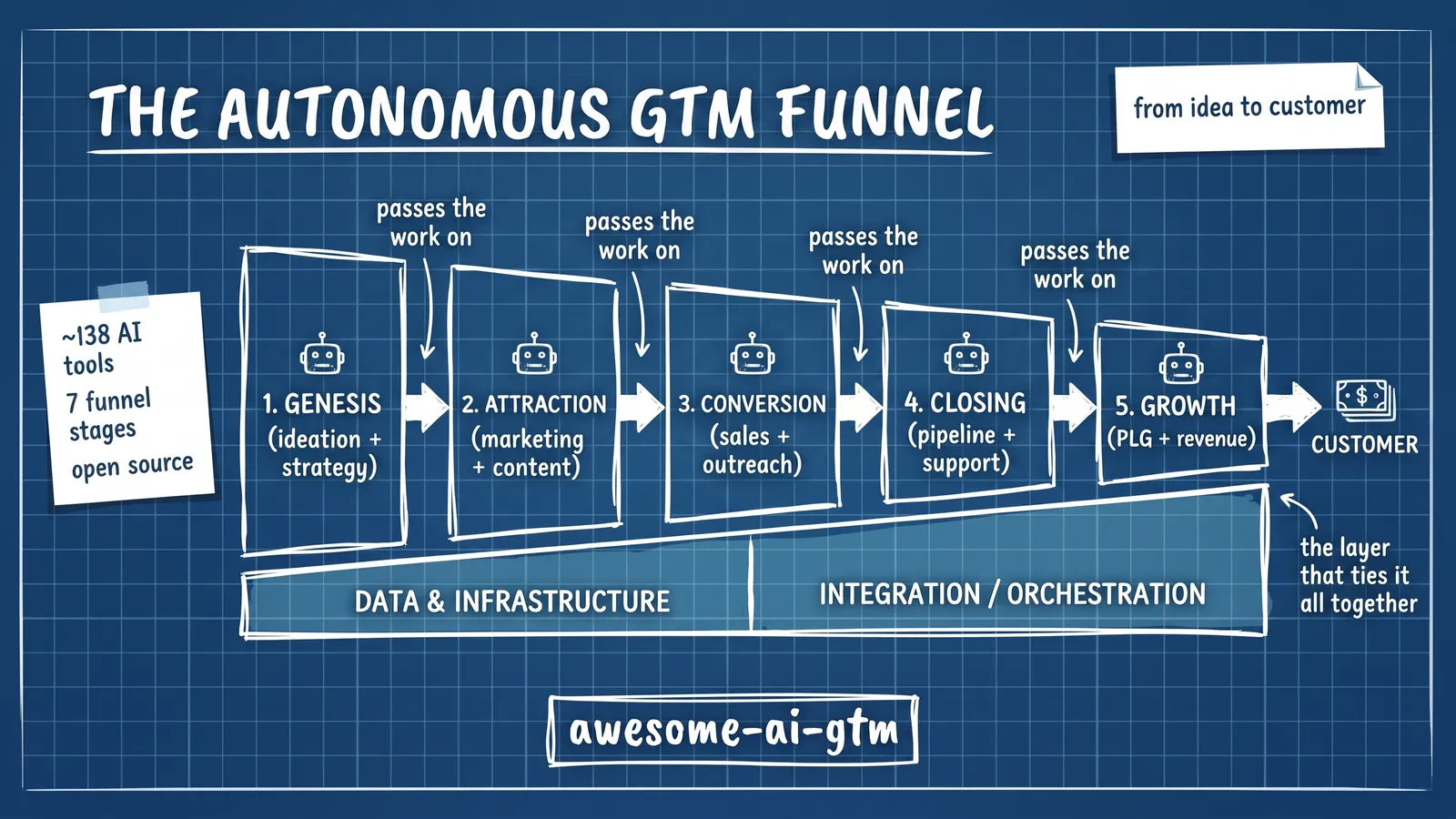
GTM is no longer a set of separate tools. Today it's one coherent system of agents that pass the work on like an assembly line. Ideation feeds research. Research feeds content. Content feeds outreach. Once you start seeing it as a sequence rather than a random bag of subscriptions, the whole problem looks different.
Chaos that looks like a stack
A typical team today runs a dozen or more AI tools. One for ideas, one for market research, one for writing, one for prospecting, one for email. Each does its slice well. The problem is that nobody sees the whole. The tools don't know about each other, data doesn't flow, and a human manually carries the output from one window to the next.
That isn't a stack. It's a bag of tools that only pretends to be a system. It looks modern, it generates invoices, but between the stages there's still a human with copy-paste. And as long as that human is standing there, autonomy is off the table. On the internal side the same problem goes by another name: the minimum viable AI stack. There I lay out which layers you actually need and which ones the vendor adds on top.
I sorted out the chaos
I collected 138 AI tools and arranged them into 7 GTM funnel stages: from Genesis through Attraction, Conversion and Closing, up to Growth, with a data and orchestration layer underneath that ties it all together. The point wasn't to gather the longest possible list. The point was to show where each tool sits in the funnel and who it passes the work on to. The stages alone do not yet say what changes inside each one. I wrote that up separately: what AI actually takes over stage by stage, and how to tell a deployment that delivers.
That's how awesome-ai-gtm came about. An open map that a founder or a sales team can actually navigate. Not another random list of links, but a schema for building a funnel where the individual stages feed each other.
THE 7 FUNNEL STAGES
- 1. Genesis. Ideation and strategy. The idea, market research, brand identity.
- 2. Attraction. Marketing and content. SEO, copy, image and video.
- 3. Conversion. Sales and outreach. Prospecting, lead enrichment, email.
- 4. Closing. Pipeline and support. Sales management, customer service.
- 5. Growth. Product-led growth, revenue intelligence, experiments.
- 6. Data and infrastructure. Data platforms, reverse ETL, governance.
- 7. Integration and orchestration. The layer that ties the agents into one flow.
This is what I do hands-on: advising on AI strategy and building agents that survive the demo.
Why a map, not a list
An awesome-list on GitHub is usually a flat index of links. Useful, but dead. You see the names, you don't see the relations. You don't know what feeds what, where the gap is, or which stage is left manual for you. And it's the relations that decide whether you build a system or keep pasting results between tabs.
That's why awesome-ai-gtm is laid out along the funnel, not alphabetically. Every tool has its place in the sequence: what it takes in and what it hands on. When you look at a map like that, you immediately see where you have a hole and which part of the flow still needs a human.
"A list tells you which tools exist. A map tells you how to wire them into a funnel that passes its own work on."
The Agentic Architect
Practical patterns, case studies and AI news. Zero spam, once a week.
You'll get one email to confirm. Unsubscribe with one click. Privacy policy
The layer that ties it all together
Beneath the funnel stages sit two layers that are easy to forget, because they don't make a flashy demo. Data and infrastructure is the foundation: without a shared data layer, agents at successive stages work on a different version of the truth. Integration and orchestration is the glue: it's what makes the output of one stage land automatically on the input of the next.
Those two layers are exactly what decides whether you have an autonomous funnel or just neatly arranged tools. Without them, every stage is an island. With them, you have an assembly line the work rides on by itself. Worth keeping in mind that a funnel like that is a multi-agent system in practice, with the same latency, error propagation and cost.
It's an open source project
The map isn't finished, and it never will be. The AI tooling market shifts every week, so a single person can't keep up. That's why awesome-ai-gtm is open. Anyone can add a tool they've tested and that actually delivers results, or fix where something sits in the funnel.
The goal isn't the longest list. The goal is a useful one: so that someone landing on it for the first time sees a ready-made schema, not another bag of links to dig through.
Come in, take a look, add yours
Head to the repository, see what the map looks like, and send a pull request if you know a tool that can't be missing from it. github.com/hculap/awesome-ai-gtm