Updated
Claude Partner Badge Claude Code. What it is and why it matters
The Claude Partner Badge Claude Code confirms completion of eight Anthropic courses and a capstone. I describe what the path covers and what else to check when choosing a consultant.
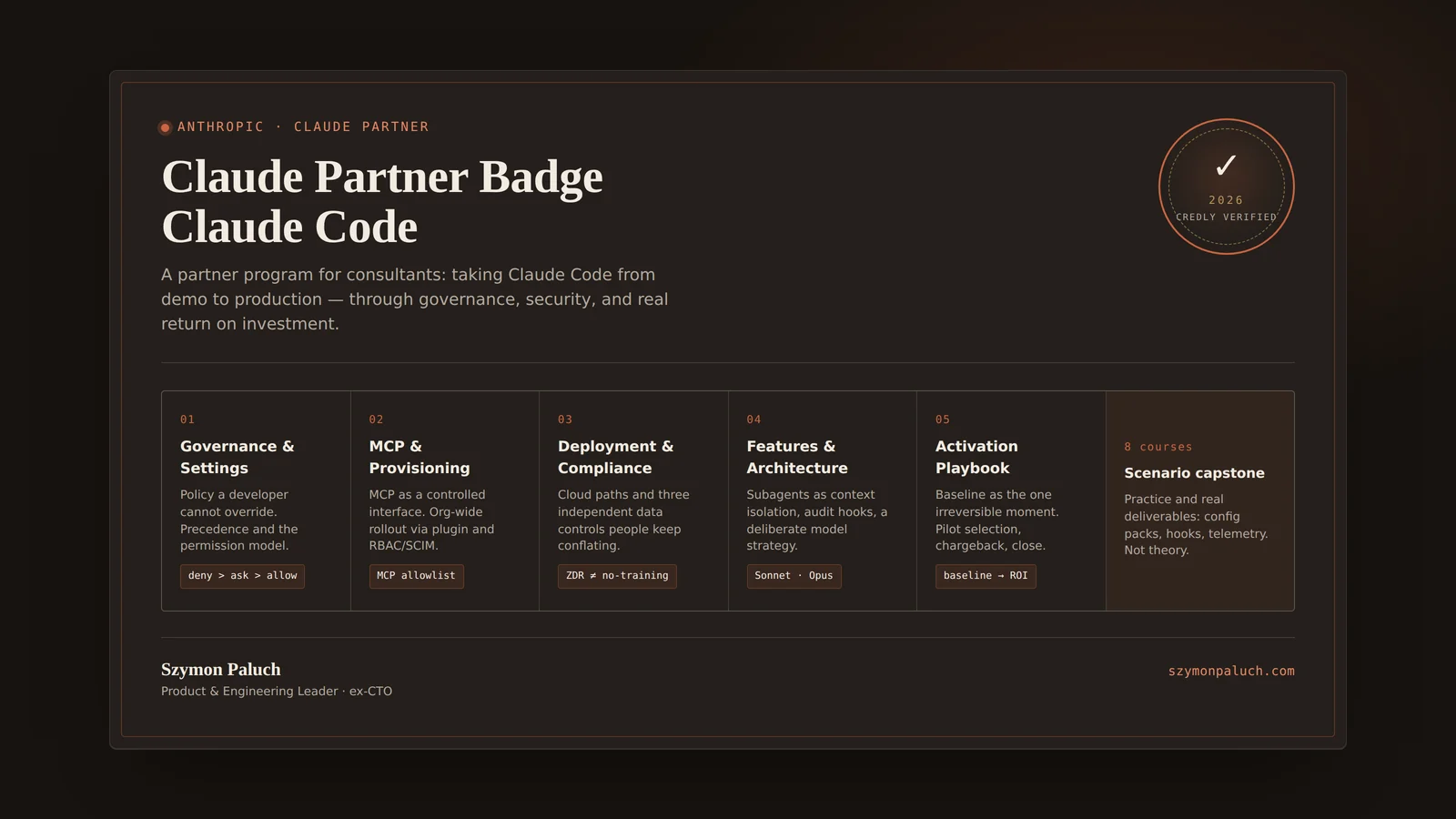
I earned the Claude Partner Badge Claude Code from Anthropic. I completed eight courses and a capstone based on a client scenario. The path covers preparing and deploying Claude Code in an organization, from configuration and security rules to team adoption and measurement.
What the Claude Partner Badge Claude Code is
This Anthropic partner badge concerns a consultant’s work with Claude Code. The courses cover scoping, configuration, deployment and introducing the tool into a team’s work.
Each of the eight courses covers part of a client engagement. The exercises produce configurations, decision records and answers to security questions. You also work with commands, Skills, hooks and telemetry. The path ends with a capstone based on a client scenario, required to earn the badge.
The Agentic Architect
Practical patterns, case studies and AI news. Zero spam, once a week.
You'll get one email to confirm. Unsubscribe with one click. Privacy policy
What a Claude Code activation actually involves
The courses follow the stages of a deployment. Below I describe five areas of that work and the decisions involved.
1. Governance and managed configuration
In managed-settings.json, you set organizational rules that developers cannot weaken with their own configuration. These cover controls such as SSO login, organization selection and installing personal MCP servers.
Managed settings sit at the top of the configuration-file hierarchy. Check the exceptions for individual keys, including cases that honor a stricter rule from another scope. Permission rules are evaluated in the order deny, ask, allow, followed by the default behavior. A matching deny rule takes precedence over an allowance.
2. MCP and team access
With MCP, you decide which tools and resources the agent can use. Access to all of Jira has a different scope from access to a few explicitly defined operations.
Distribute configuration across the organization as a plugin. RBAC roles define who has access and what they can do. SCIM synchronizes accounts and groups. Also establish who approves new MCP servers and who can use them.
3. Deployment paths and data protection
When discussing data, check separately whether it is used for training, how long it is retained and whether Zero Data Retention applies. Each rule answers a different question.
Account for the company’s cloud agreements, such as an Azure MACC spending commitment, and the platform it uses, such as Microsoft Foundry.
Check how the company protects data. DLP helps prevent sensitive information from being disclosed. CASB enforces policies for cloud services. SIEM collects and analyzes security events.
For an audit, establish how the team finds data needed for legal proceedings or internal investigations. That is the purpose of eDiscovery. A legal hold protects material from deletion for a case. Agree with the people responsible for these tools how the new deployment should work with them.
4. Features and technical architecture
Commands are stored in Markdown files, and a Skill’s description helps the tool decide when to use it. A subagent separates a task’s context. A hook can block an edit, send a notification or log a tool call for audit.
A model strategy might use Sonnet for everyday work and Opus for architectural decisions. Test that choice on your tasks. Handle secrets carefully too: store an API key as a GitHub Actions secret and pass it through an environment variable. I also discuss choosing hooks and subagents in twelve rules for building agents.
5. Pilot and handover to the team
Before the first trial, measure how the team works without the new tool. Compare later work and costs with that baseline. I explain how to discuss ROI when some costs and benefits are still unknown in a separate article.
You also need to choose the pilot participants and investigate what drives costs. A sudden increase may be a reason to review model choice. At handover, provide a versioned plugin. Agree who will support the team in daily use and schedule a discussion with the sponsor after 30 days.
The badge confirms completion of the path and its capstone. It is not a CCAR-F proctored exam result or evidence of a particular client deployment. The Claude certification comparison covers the four exams and their audiences.
Anthropic admits to its exams only people from Claude Partner Network organizations. Join our collective of AI consultants and sit all four exams through our partner organization.
Why it matters
When choosing a consultant, ask for a project example. Establish what they were responsible for and how you can verify their results.
I have seen projects that looked good in a presentation struggle with their first users. I also discuss the gap between a pilot and a system in daily use in the article on agentic AI in 2026.
If you plan to take an exam, I covered Claude Certified Architect Foundations and preparation separately.
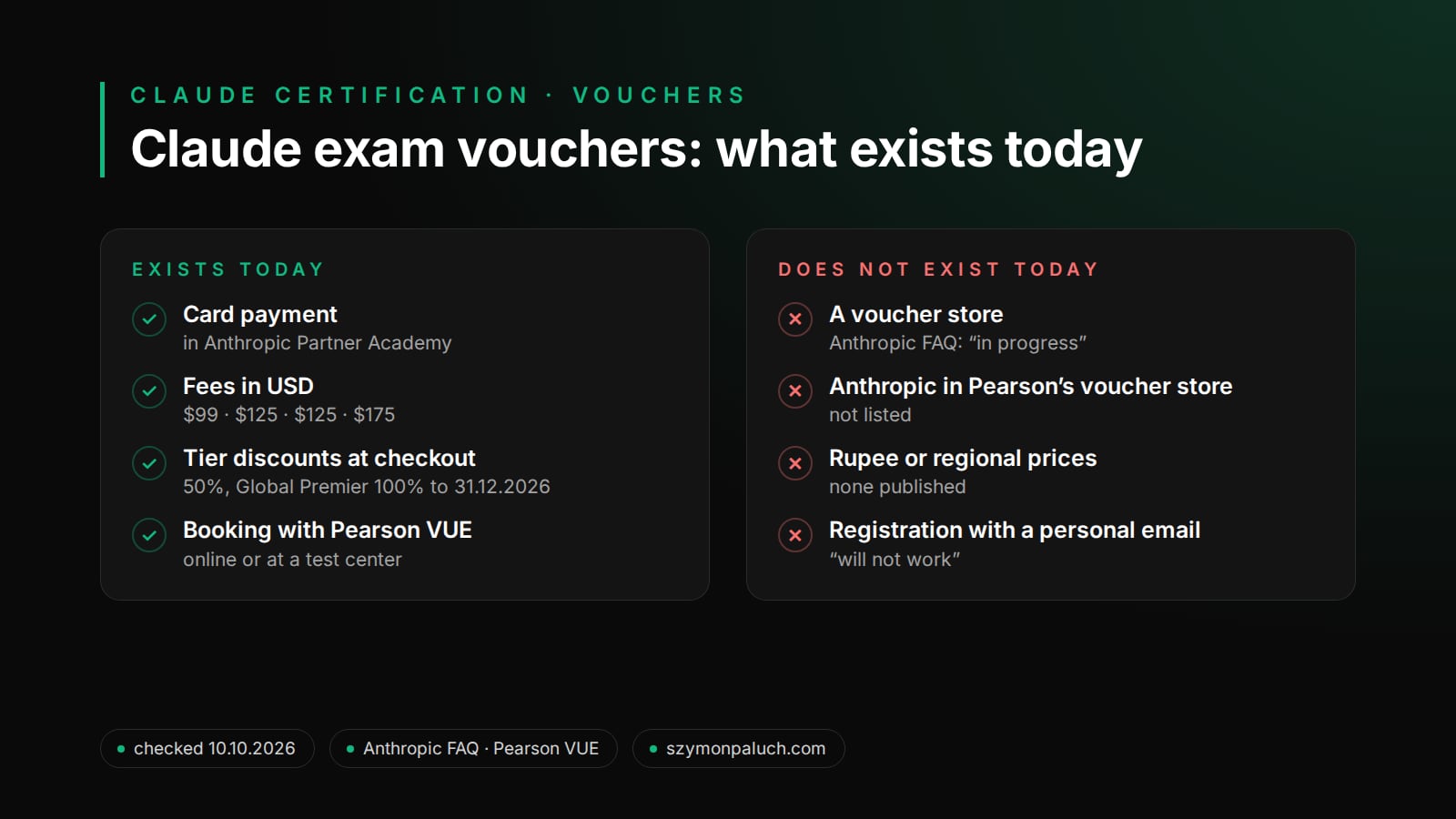
The exams require an account through a Claude Partner Network organization. A personal email address will not let you register. For people whose employer is not a partner, I collected ways to gain access under Anthropic’s rules.
With the other model provider I hold a different kind of proof. My company has a status in OpenAI's partner program rather than a personal badge. I explained how a company tier in the OpenAI Partner Network differs from a badge like this one.
Teams can work on related tasks in my AI agents workshop. We spend two days in your repository: the first using agents with code, the second building your own. The workshop page for engineering teams explains the scope and terms.