63 Claude Certified Architect Professional questions with explanations
Which exam are you preparing for?
All 63 original questions from my free Claude Certified Architect Professional (CCAR-P) practice set are on this page, each with its answer and explanation. 9 of them are multiple response, as on the real exam. I walk through three step by step: the requirement, the trap and where to study. The same questions run as an online test with a study mode, a timed 120-minute attempt and results by domain.
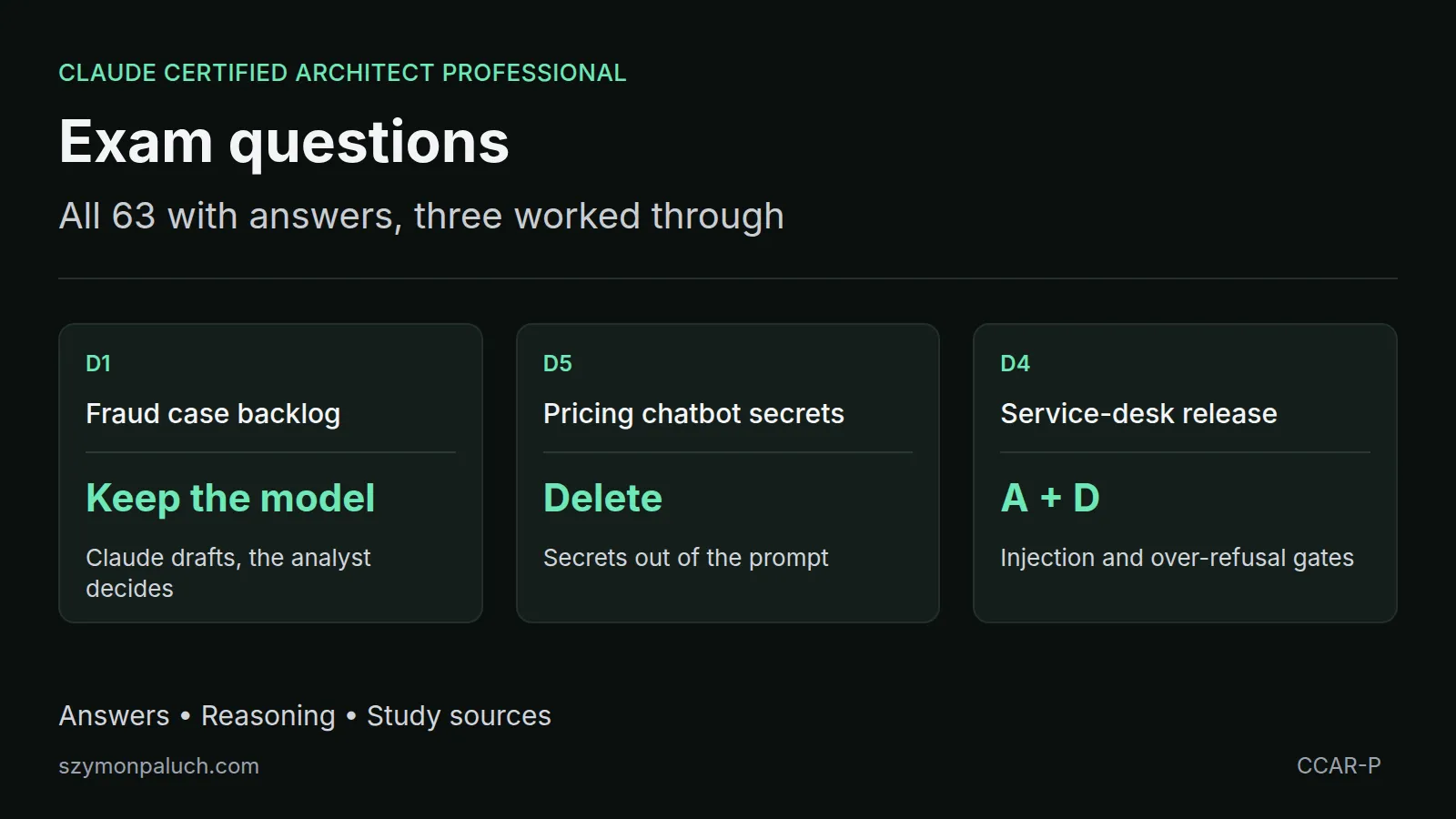
Professional questions rarely hinge on an API parameter. They ask which proposal fits a client’s constraint: a policy, a budget, or a stakeholder who wants evidence. These three examples show how to read that constraint before you look at the options.
What exactly you get
I wrote these questions from Anthropic’s public exam guide and documentation for Architect Professional. None comes from the live exam. 54 have one correct answer and 9 need two or more. A multiple-response question says how many answers to pick and scores only when every pick is right. Companies, volumes and percentages in the scenarios are assumptions for the exercise, not figures from my client work.
I passed Architect Foundations (CCAR-F) in July 2026. These questions follow the public Professional guide, and my walkthrough of the CCAR-P blueprint explains each domain and how Professional differs from Foundations.
What the real exam covers
According to the official CCAR-P exam guide, July 2026 version 1.0, the exam has 63 questions, a 120-minute limit and a passing score of 720 on a scale from 100 to 1000. The guide lists a base fee of $175 per attempt. Pearson VUE proctors it online or at a test center. Questions are multiple choice or multiple response. Here are the guide’s domain weights and the question counts in my set:
| Domain | Weight | Questions in my mock |
|---|---|---|
| D1 · Solution Design & Architecture | 17% | 11 |
| D2 · Claude Models, Prompting & Context Engineering | 13% | 8 |
| D3 · Integration | 19% | 12 |
| D4 · Evaluation, Testing & Optimization | 16% | 10 |
| D5 · Governance, Safety & Risk Management | 14% | 9 |
| D6 · Stakeholder Communication & Lifecycle Management | 14% | 9 |
| D7 · Developer Productivity & Operational Enablement | 7% | 4 |
Integration is the largest domain. Domains 5 and 6, governance and stakeholders, take 28% together. Many questions describe a client’s requirement in a sentence or two. The right option turns that requirement into a control or a measurement.
If you are preparing for Foundations instead, the 60 CCAR-F questions with explanations cover that exam’s five domains. A score on one set says nothing about readiness for the other exam.
Anthropic admits to its exams only people from Claude Partner Network organizations. Join our collective of AI consultants and sit all four exams through our partner organization.
Three questions to try
Pick an answer and write one sentence explaining it before you read the key. These are questions 60, 18 and 55 from the full set below. The third asks for two answers.
QUESTION 60 · D1 · SOLUTION DESIGN
A card issuer’s fraud team asks the architect to “use Claude to detect fraud.” A gradient-boosted model already scores about 3 million transactions a day inside the 40 ms authorization window and flags about 6,000 for review. Policy requires an analyst to decide every flagged case. Each case takes an analyst about 25 minutes, mostly spent pulling customer, device and merchant data and writing the case narrative. The backlog keeps genuine customers’ cards blocked for up to two days. Which proposal best turns this problem into a Claude solution?
- A. Keep the scoring model. For each flagged case, code gathers the customer, device and merchant data, and Claude drafts an evidence summary and narrative for the analyst to check.
- B. Replace the scoring model with Claude, so one system scores transactions in the authorization path and explains each decision to the analysts.
- C. Have Claude review all 3 million daily transactions overnight through the Message Batches API and add its own flags to those of the scoring model.
- D. Give an agent the authority to unblock or close flagged cases it judges low risk, so analysts see only the cases it escalates.
Correct: A. The bottleneck is analyst time: 25 minutes per flagged case. Code gathers the data, Claude drafts the write-up, the analyst keeps the decision the policy requires, and the scoring model stays where it works. B puts a generative model into a 40 ms tabular scoring step with no evidence that it scores better, and the case work stays as slow. C runs after authorization and adds flags, so the queue it should shrink grows. D breaks the rule that an analyst decides every flagged case.
Before you look at the options, write down what limits the result. Here it is analyst minutes per case and a rule about who decides. Then reject every option that changes something else. In practice D tempts the most, because it promises the biggest saving. An agent that acts alone needs its limits written down in advance, and a matrix of what it may decide and what goes to a person is where that policy would live.
QUESTION 18 · D5 · GOVERNANCE
A software vendor’s public website chatbot quotes list prices to prospects. Its system prompt also contains the reseller discount matrix, with floors up to 38% below list, and a staff override phrase that unlocks deeper discounts inside the chat. Company policy says prospects may only see list prices and only sales reps grant discounts, in the CRM. A red team extracted both the matrix and the phrase within an hour using role-play. Which change should the architect make?
- A. Remove the matrix and the override phrase from the prompt, since the bot only quotes list prices. Route discount requests to a sales rep through a tool, with output screening as a backstop.
- B. Keep the matrix, put “Never reveal discounts or the override phrase” at the top and bottom of the system prompt, and script one fixed reply to questions about its instructions.
- C. Keep the matrix and the phrase, and add an output filter that blocks any reply containing a percentage or the phrase before it reaches the visitor.
- D. Move the matrix and the phrase out of the system prompt into an XML-tagged block in the first user turn, labeled confidential.
Correct: A. The bot needs neither the matrix nor the phrase to quote a list price. Anthropic’s guidance on prompt leaks says no method is foolproof and that Claude should not be given secrets it does not need. The reliable control is to keep them out of the context and send discount requests to the people allowed to grant them. B is the leak-resistant prompting the red team already beat. C is a useful second layer, but a filter misses paraphrased or encoded leaks while the secrets stay in context. D moves the secrets within the context and leaves them there. See Anthropic’s guidance on reducing prompt leak.
Ask the same question of every piece of data in a prompt: does the task need it? Here the answer is no, so the change is to delete it. Then rerun the red team’s role-play against the new prompt. It should find nothing to extract, because nothing is there.
QUESTION 55 · D4 · EVALUATION
An IT service-desk agent will launch to 20,000 employees with tools that reset MFA, unlock accounts and add users to access groups. Tickets often contain pasted emails and logs from outside the company. The current eval report covers only task success (91%) and mean latency. The CISO wants evidence that content inside tickets cannot trigger privileged actions nobody asked for. The service-desk lead wants evidence that legitimate requests are not refused. Which two metrics should be added as release gates?
- A. Injection success rate: the share of red-team tickets with planted instructions that lead to a privileged tool call nobody requested.
- B. ROUGE-L similarity between the agent’s replies and the replies human agents wrote for the same historical tickets last year.
- C. Mean output tokens per resolved ticket, tracked per tool, so the cost of each privileged operation is known before launch.
- D. Over-refusal rate on a set of legitimate requests, including ones that look sensitive, such as group changes the requester is entitled to.
- E. The share of tickets in which the agent states, at the end of the conversation, that it is confident the action it took was correct.
Correct: A, D. Each turns one stakeholder’s requirement into a measurable gate. A measures what the CISO asked about, using tickets that carry planted instructions; with privileged tools the target is zero. D measures the opposite failure, the one the service-desk lead cares about: a good eval tests cases where an action should happen as well as cases where it should not. B rewards wording similar to old replies and says nothing about injections or refusals. C is a cost metric neither stakeholder raised. E collects the agent’s own claim instead of an observed outcome. See Anthropic’s article on evals for AI agents.
Option E deserves a second look. The agent’s statement that it is confident costs nothing to collect and measures nothing: the certainty a model states drifts away from its accuracy, so it cannot gate a release. For both real gates, write the test set before you run it: tickets with planted instructions for A, legitimate but sensitive requests for D.
If you picked another option, name the constraint it ignores. Who decides a flagged case? What does the bot need to know? Which two people need evidence? That constraint tells you which part of the guide to reread.
All 63 questions with answers
Here is the full set, in the same order as the online test. Each question names its domain and scenario. The answer and its explanation stay folded under “Show the answer”, so choose first.
Keep count of your correct answers. A multiple-response question counts only when you picked every right option and nothing else. The next section turns your count into the mock’s score. To match the real exam, give yourself 120 minutes for all 63.
Question 1 · D3 · Integration
Scenario: Overnight mis-selling review
An insurer screens about 60,000 recorded sales calls a day for mis-selling indicators. Calls end by 20:00, and the compliance team works the flagged list from 09:00 the next morning. The regulator expects at least 90% recall. On 1,000 labeled calls, the team's current fast model reaches 81% recall and a larger model 94%, at about four times the per-token price. The current design calls the fast model synchronously, chosen "to keep latency low". Which configuration should the architect justify?
- A. The larger model via the Message Batches API after 20:00: per-call latency is irrelevant before 09:00, batches cost half price, and leftovers at 07:00 run synchronously
- B. The fast model as today, because overnight throughput depends on low per-call latency, and raise its recall after launch by adding more few-shot examples to the prompt
- C. The fast model on every call, then the larger model only on the calls the fast model flags, so that the expensive model sees a small fraction of the daily volume
- D. The larger model called synchronously with streaming enabled, so that each verdict starts arriving sooner and the overnight run finishes well before the morning shift
Show the answer
Correct answer: A. A is right: the deciding constraint is a 09:00 deadline, not per-call latency, so the more accurate model can run through the Message Batches API, which bills at 50% of standard prices and usually finishes within an hour; because a batch can take up to 24 hours, the synchronous fallback protects the deadline. B launches 9 points below the regulator's 90% recall and hopes to close the gap later. C is a cascade whose recall cannot exceed the fast model's 81%, because calls it misses never reach the larger model. D pays full price, and streaming improves perceived speed for a person reading output, not for an overnight pipeline.
Question 2 · D2 · Claude Models, Prompting & Context Engineering
Scenario: Pharmacy assistant guardrails
A pharmacy chain's consumer app answers questions about store services and over-the-counter products. Two rules must always hold: messages that mention overdose or self-harm go to a crisis flow, and questions about prescription dosing go to a pharmacist. Both rules currently sit in the main assistant's 9,000-token system prompt. Red-teaming found 7% of such messages answered normally, and each rule added so far has made ordinary answers worse. The p95 latency budget leaves no room for an extra sequential model call. Which guardrail design fits?
- A. Repeat both rules at the start and the end of the system prompt in capital letters, and add ten examples of messages that must be routed elsewhere
- B. Screen each message with a separate classification call first, and pass it to the main assistant only after the screen has cleared it
- C. Run a Claude Haiku 4.5 screen with structured output in parallel with the main response, and route or replace the reply before display if it flags
- D. Review a random 5% of conversations each week and add any message patterns that were missed to the system prompt as new rules
Show the answer
Correct answer: C. C is right: Anthropic describes guardrails where one model instance handles the query while another screens it, noting that this tends to perform better than one call doing both. Its jailbreak guidance recommends a lightweight model such as Claude Haiku 4.5, with structured outputs constraining the screen to a classification. Running in parallel keeps latency within budget, and holding the reply until the screen returns lets code enforce the routing. A keeps both jobs in the overloaded prompt that is already degrading answers. B separates the jobs correctly but adds the sequential call the latency budget rules out. D is detective: a missed crisis message is found a week later, after the harm.
Question 3 · D1 · Solution Design & Architecture
Scenario: Regulated leaflet translation
A medical-device maker must localize patient instruction leaflets into 14 languages. Every leaflet must use the approved terminology glossary, keep every warning from the source text and stay within a set reading level, and all three can be checked against a written checklist. In a pilot, 30% of first drafts failed the checklist, but when a linguist's checklist comments were pasted back into the conversation, the revised drafts fixed most of the issues. Which pattern should the architect use?
- A. Parallel voting: generate three independent translations of each leaflet and publish whichever version most of three separate judge calls prefer against the checklist
- B. A single translation call with the glossary and checklist in the prompt, with linguists reviewing and correcting every leaflet by hand before release, as they do today
- C. An evaluator-optimizer loop: one call translates, another checks the draft against the checklist and returns findings for revision, with capped rounds and linguist sign-off
- D. An autonomous agent with web search that decides for each leaflet how to research terminology, translate and review, choosing its own steps and number of rounds
Show the answer
Correct answer: C. C is right: Anthropic's two signs of fit for an evaluator-optimizer loop are that drafts improve when feedback is articulated, which the pilot showed, and that a model can give such feedback, which the written checklist makes possible. Capping the rounds bounds cost and latency, and linguist sign-off stays as the release gate. A picks among independent drafts but never feeds the checklist findings back, so a flaw shared by all three survives. B leaves the 30% first-draft failure rate for linguists to fix by hand and ignores the measured gain from feedback. D gives the model autonomy over steps that are already known, adding cost and unpredictability, and open web research can bring in terminology outside the approved glossary.
Question 4 · D1 · Solution Design & Architecture
Scenario: Claims intake pipeline
An insurer's claims-intake pipeline sends each uploaded claim document to Claude, which extracts the claim fields and itemized amounts with structured outputs, and code writes the result straight into the claims system. A review finds three problems. About 4% of uploads are blank pages, photos of the wrong document or unreadable scans, and these come back with plausible invented values. Some recorded claims have itemized amounts that don't add up to the claimed total, or a policy number that doesn't exist. Adjusters fix errors directly in the claims system, so the team can't tell whether a prompt change helped or hurt. Which three additions complete the end-to-end design?
- A. An input check that classifies each upload and sends blank, unreadable or wrong-document uploads to manual handling before any extraction runs
- B. Moving extraction to the most capable model available, so that amounts and policy numbers come out right the first time without extra checks
- C. Code that checks each extraction before writing it (items sum to the total, the policy was in force on the loss date) and sends failures to review
- D. A higher
max_tokenslimit, so that the model has more room to reason about difficult scans before it returns the structured fields - E. Appending each adjuster correction to the production prompt as a new few-shot example, so that the model keeps learning from every fix
- F. Capturing adjuster corrections with the source document as labeled cases in a versioned eval set that gates every prompt or model change
Show the answer
Correct answers: A, C, F. A, C and F are right: they add the missing input gate, output gate and feedback loop. A stops wrong or empty uploads before extraction, so the model is never asked to fill fields from a blank page. C checks business rules a schema cannot express: structured outputs guarantee valid, typed fields, not that items add up or that a policy exists. F turns corrections into a regression suite, so every change is measured before release. B still writes unchecked values; a stronger model is not a control. D changes output room, not whether the input is a claim document. E grows the prompt with every fix and never tests the result; Anthropic advises curating a few canonical examples instead.
Question 5 · D2 · Claude Models, Prompting & Context Engineering
Scenario: Product description examples
A homeware marketplace uses Claude to write 80-word product descriptions. The prompt has three examples, all for kitchen products, each opening with "Elevate your cooking" and laid out as bullets, placed inline after the instructions with no delimiters. In production, 70% of the descriptions for bedding, lighting and garden products also open with "Elevate your", several mention cooking, and many use bullets although the brand guide requires prose. Which change best addresses this?
- A. Use 3–5 prose examples from varied categories with different openings, each wrapped in
<example>tags to separate it from the instructions - B. Remove all the examples and rely on zero-shot instructions alone, since examples always lead the model to copy their wording and their layout
- C. Keep the current three examples and add "Do not start with 'Elevate your'" and "Mention cooking only when it is relevant" to the instructions
- D. Raise the number of kitchen examples from three to fifteen, so that the model sees enough variety in wording to stop repeating the same phrase
Show the answer
Correct answer: A. A is right: Anthropic's guidance is that examples should be relevant, diverse enough that Claude doesn't pick up unintended patterns, and wrapped in <example> tags so Claude can tell them apart from instructions, with 3–5 examples as the usual number. The current set is uniform in category, opening and layout, so the model copies all three traits. B throws away examples, one of the most reliable ways to steer format and tone, instead of fixing them. C patches two symptoms while the examples keep teaching the same pattern, including the bullet layout. D adds more of the same category, which strengthens the cooking bias rather than adding variety.
Question 6 · D4 · Evaluation, Testing & Optimization
Scenario: Invoice-coding eval redesign
A finance team's invoice-coding assistant assigns general-ledger codes and cost centers. Over 25 prompt iterations it was tuned against a fixed set of 150 hand-picked invoices, all clean, digital, English PDFs, and it now scores 97% on them, but a week of production spot checks shows 82%. Production includes scanned and multi-page invoices, credit notes, and 30% German or Polish invoices. Grading is an exact match on the code fields. Which two changes to the evaluation design should come first?
- A. Grow the existing set to 1,500 cases by having Claude generate synthetic invoices closely modeled on the 150 that already pass
- B. Replace the exact-match check on codes with an LLM judge that is asked whether each assigned code is a reasonable choice
- C. Rebuild the set from production invoices sampled by format, language and supplier, including scans, multi-page files and credit notes
- D. Drop automated scoring and have two senior accountants grade every case by hand before each release, as the gold standard
- E. Hold out a test split that is never used while tuning prompts, and base every release decision on that split alone
Show the answer
Correct answers: C, E. C and E are right. The 97% comes from a set that neither mirrors production nor stays independent of tuning. Anthropic's eval guidance is to mirror the real-world task distribution and include edge cases, and C does that with real scans, multi-page invoices, credit notes and other languages. E fixes the second problem: after 25 iterations against the same 150 cases, the score partly measures fit to those cases, so release decisions need a held-out split. A multiplies the unrepresentative distribution. B weakens an objective check on a categorical answer, where code-based grading is fast and reproducible. D gives up volume and automation for slow, expensive grading.
Question 7 · D1 · Solution Design & Architecture
Scenario: Broker quote turnaround
A commercial insurer quotes small-business policies for brokers. Its data shows a 34% win rate when a quote reaches the broker within 15 minutes and 11% when it takes longer. Leadership has named revenue growth through quote speed as the project's value pillar, not cost reduction. Today underwriters re-key each broker submission email into the rating engine, which takes about two hours. The architect is comparing synchronous extraction from each email as it arrives with the Message Batches API at half the model price. Which recommendation aligns with the value pillar?
- A. Message Batches, because it halves model spend and most batches finish in under an hour, which is still much faster than today's two-hour re-keying
- B. Message Batches for most submissions, with synchronous calls kept for the brokers who complain about delays, to balance model cost against quote speed
- C. Synchronous extraction as each email arrives, judged on p95 time to quote against the 15-minute target and on win rate, with model cost as a secondary metric
- D. Synchronous extraction, judged mainly on model cost per submission compared with the batch option, to show leadership exactly what the faster design costs them
Show the answer
Correct answer: C. C is right: the pillar is speed that wins business, so the design must get quotes out within 15 minutes, and the KPIs must be time to quote and win rate, with cost tracked but secondary. A optimizes the wrong pillar: most batches finish within an hour, but results can take up to 24 hours, and even an hour misses the 15-minute window that drives the win rate. B makes speed depend on complaints, so most late quotes lose deals silently. D has the right design but judges it on cost, which tells leadership nothing about the revenue the project was approved to grow.
Question 8 · D7 · Developer Productivity & Operational Enablement
Scenario: Monorepo CLAUDE.md overload
A 60-developer team shares one monorepo containing a web frontend, a payments backend and Terraform. Its project CLAUDE.md has grown to 1,400 lines: build commands and repo-wide conventions, frontend component rules, payments compliance rules, and step-by-step procedures for releases and database migrations. Claude Code warns at startup that the file is over the recommended length, and developers report that Claude ignores rules that are plainly written there. How should the architect restructure the configuration?
- A. Split the file into topic files and pull each one into CLAUDE.md with
@pathimports, so that the root file becomes short and easy to review - B. Ask each developer to copy the sections for their area into their own
~/.claude/CLAUDE.md, and delete those sections from the project file - C. Keep a short root CLAUDE.md for commands and conventions, move area rules to
.claude/rules/files scoped bypaths, and make procedures skills - D. Pass the whole file as a system prompt with
--append-system-promptin every developer's shell alias, so that it carries more weight than CLAUDE.md
Show the answer
Correct answer: C. C is right: Claude Code's documentation targets under 200 lines per CLAUDE.md, because longer files consume context and reduce adherence. Rules that matter for one part of the codebase belong in path-scoped rules, which load only when Claude works with matching files, and multi-step procedures belong in skills, which load when invoked or relevant. A only reorganizes: imported files also load at launch, so the context cost is unchanged. B takes shared rules out of version control and lets each developer's copy drift. D still puts all 1,400 lines into every session, and the docs position that flag for scripts and automation rather than interactive use.
Question 9 · D7 · Developer Productivity & Operational Enablement
Scenario: Claude Code usage review
A platform team reviewed three months of Claude Code use. Two patterns stand out. In many pull requests, Claude reported the work as done, but the change broke edge cases that the existing test suite would have caught. And in all-day sessions, developers switch between unrelated tasks and correct Claude repeatedly on the same point, after which its suggestions get worse. Which workflow change addresses both patterns?
- A. Have Claude run the relevant tests until they pass and show the output;
/clearbetween unrelated tasks, and restart with a better prompt after two failed corrections - B. Keep each developer's session open all day so that Claude retains every earlier correction, and ask it to explain its reasoning in detail before declaring a task finished
- C. Add "Be careful with edge cases" and "Remember all my previous corrections" to the project CLAUDE.md, so that every session starts with both reminders
- D. Run
/compactwhenever Claude's suggestions get worse, so that earlier corrections are summarized rather than lost, and review each diff more carefully by hand
Show the answer
Correct answer: A. A is right: Claude Code's best practices say Claude stops when the work looks done, so giving it a check it can run, such as the test suite, and asking for the output as evidence closes the loop. The same guide names the kitchen-sink session (fix: /clear between unrelated tasks) and correcting over and over (fix: after two failed corrections, /clear and write a better prompt), because context full of failed approaches degrades results. B keeps the polluted context, and explaining reasoning is not verification. C adds vague reminders that are context, not a check. D condenses a context full of failed approaches instead of clearing it, and leaves verification to manual review.
Question 10 · D1 · Solution Design & Architecture
Scenario: Stored-procedure migration
A retailer is migrating 640 SQL Server stored procedures to dbt models on a new warehouse. The procedures call each other: the dependency graph has nine levels, some procedures depend on 30 others, and many calls cross business domains. A pilot that sent random batches of 50 procedures to parallel Claude calls produced models that referenced objects not yet migrated or named differently; 40% failed to compile, and fixing one often broke another. For every procedure, the team has a production data snapshot and its expected output. Which decomposition should the architect adopt?
- A. Send all 640 procedures to a 1M-context model in one request, so that it sees every dependency at once and returns all the dbt models in a single response
- B. Work up the dependency graph from the leaves: each call gets one procedure plus the models it needs, and must match its snapshot before dependents start
- C. Keep the random parallel batches, and add a repair agent at the end that fixes every compile error after all 640 models have been generated
- D. Split the procedures by business domain (sales, inventory, finance) and give each domain to its own agent that migrates its procedures in parallel
Show the answer
Correct answer: B. B is right: the decomposition follows the structure of the problem. Working up from the leaves means each call sees the real, already-migrated models it depends on, and the snapshot comparison is a programmatic gate, so an error is caught where it starts instead of spreading; procedures on the same level can still run in parallel. A puts the whole graph into one context and one response, where recall degrades as tokens grow and nothing is verified until the end. C repeats the pilot's failure and adds a repair pass that must untangle errors compounded across dependents. D cuts across dependencies, because many calls cross domains, so the agents still meet unmigrated objects.
Question 11 · D2 · Claude Models, Prompting & Context Engineering
Scenario: Oversized contract summaries
A nightly job summarizes newly signed contracts with Claude Haiku 4.5, and quality and cost meet their targets for 97% of them. The remaining 3% fail every night with HTTP 400 "prompt is too long". They are contracts with long exhibits, 230,000–600,000 tokens including the prompt, and each summary must reconcile the exhibits with the main terms. What should the architect change?
- A. Retry the failed requests with exponential backoff later in the night, when the API is likely to be less busy and more capacity is free
- B. Move the whole job to Claude Sonnet 5.5, so that every contract, large or small, runs on a model with a 1M-token context window
- C. Truncate each oversized contract to its first 190,000 tokens, so that every request fits within Claude Haiku 4.5's context window
- D. Count each request's tokens first and route only those above Haiku 4.5's 200K window to a 1M-context model such as Claude Sonnet 5.5
Show the answer
Correct answer: D. D is right: a 400 "prompt is too long" means the input alone exceeds the model's context window, and Claude Haiku 4.5's window is 200K tokens. The token counting API lets code estimate each request before sending it, so only the oversized contracts move to a model with a 1M-token window, where long-context requests are billed at standard pricing. A treats a validation error as a transient one; the same input fails every time. B fixes the 3% by paying a higher per-token price on the 97% that already meet their targets. C drops the exhibits that each summary must reconcile with the main terms.
Question 12 · D6 · Stakeholder Communication & Lifecycle Management
Scenario: Pilot complaint handling
Forty in-house lawyers are piloting a clause-drafting assistant. The general counsel (GC) forwards about 15 complaint emails a week and asks for each to be fixed by the next day. Last month, two same-day prompt edits fixed the reported case, but each broke drafting behavior that had worked, which lawyers noticed days later. The GC's stated priority for the pilot is that nothing that works today may break. How should the architect run the feedback loop?
- A. Keep fixing each complaint the next day with a prompt edit, and ask the lawyers to report anything that breaks so it can be fixed the day after
- B. Freeze the prompt until the pilot ends in eight weeks, collect all the complaints in a list, and address them together in the production design
- C. Log feedback in the tool with its transcript, triage weekly with the GC, turn confirmed issues into test cases, and ship weekly only if all pass
- D. Replace complaint emails with a monthly satisfaction survey of the 40 lawyers, and use the average score to decide which areas to improve next
Show the answer
Correct answer: C. C is right: the GC's priority rules out unchecked same-day edits, and Anthropic's eval guidance is that failures become test cases and test cases prevent regressions; a weekly release gated on those cases fixes complaints without breaking what works, and the weekly triage resets the GC's expectation from next-day fixes to a predictable cadence. A repeats the process that already caused two regressions. B stops the feedback loop for eight weeks and leaves known problems in front of the lawyers. D replaces specific, reproducible cases with an average that cannot be turned into a fix.
Question 13 · D2 · Claude Models, Prompting & Context Engineering
Scenario: Support agent after migration
An e-commerce company migrated its support agent to Claude Opus 5.5. Accuracy on the eval set is unchanged, but cost per ticket rose 35%. Transcripts show the agent calling lookup_order for general policy questions and re-fetching the same order before every reply. The system prompt, written for a model two generations older, includes "CRITICAL: You MUST ALWAYS call lookup_order before answering", "Verify every figure twice" and "Be maximally thorough". What should the architect do first?
- A. Add "CRITICAL: NEVER call lookup_order for general questions" next to the existing rule, so that the two emphatic rules balance each other out in practice
- B. Rewrite these lines for the current model: say plainly when the tool is needed and why, remove "verify twice" and "maximally thorough", and re-run the eval
- C. Set
tool_choiceto requirelookup_orderon every turn, so that tool use is at least consistent and the eval can measure its cost precisely - D. Roll back to the previous model until a completely new prompt has been written from scratch, since the old prompt was carefully tuned for that model
Show the answer
Correct answer: B. B is right: Anthropic's prompting guide warns that recent Claude models respond more strongly to the system prompt, so aggressive wording such as "CRITICAL: You MUST" causes overtriggering and should become plain instructions like "Use this tool when...", ideally with the reason. Its cost guide names "verify twice" and "be maximally thorough" as instructions newer models follow too literally, raising cost with no accuracy gain, and calls an audit against the current model a free win. A adds a contradictory rule, and contradictory rules were found to cost accuracy. C would force the behavior that drives the cost, and Opus 5.5 rejects forced tool_choice with a 400. D abandons the newer model to avoid a targeted edit.
Question 14 · D4 · Evaluation, Testing & Optimization
Scenario: Research assistant cache misses
An internal research assistant for 25 analysts sends the same 50,000-token prefix (tools, system prompt and reference tables) on every request, with a cache breakpoint at the end of the prefix and the default cache lifetime. Requests arrive about every 10–15 minutes through the working day, and almost every response reports about 50,000 cache_creation_input_tokens and zero cache_read_input_tokens. Analysts wait for each answer. Which change cuts input cost the most without slowing answers?
- A. Disable prompt caching for this prefix, since hits are near zero and each cache write is billed at 1.25 times the base input price
- B. Add three more cache breakpoints inside the 50,000-token prefix so that partial matches can still be read when the full prefix misses
- C. Set the breakpoint's cache lifetime to one hour, so the prefix is written at most once an hour and other requests read it from cache
- D. Send these requests through the Message Batches API, which bills all input at half the standard price and needs no change to the prompt
Show the answer
Correct answer: C. C is right: with the default 5-minute lifetime the entry expires between requests, so each request pays a 1.25x write and never reads. Anthropic recommends the 1-hour cache for prompts reused less often than every 5 minutes but more often than hourly. At four to six requests an hour, one 2x write plus reads at 0.1x or less costs at most about 2.5 times the prefix per hour, against 4 to 6 without caching and 5 to 7.5 today. A removes the surcharge but pays full price every time. B changes nothing, because every breakpoint expires on the same schedule. D is asynchronous, so analysts would wait.
Question 15 · D6 · Stakeholder Communication & Lifecycle Management
Scenario: Nightly pipeline runbook
An architect is writing the on-call runbook for a client's nightly contract-summary pipeline, which calls the Claude API directly with the official Python SDK at its default retry settings. The client's operations team will run it without the architect. Which two runbook entries are correct?
- A. 529 overloaded_error: our request payload is malformed. Stop retrying, find the faulty document and fix the request body before rerunning
- B. 400 invalid_request_error: a transient fault on Anthropic's side. Retry the identical request up to five times with exponential backoff
- C. 429 rate_limit_error: the SDK backs off, honoring retry-after. If 429s persist with no retry-after header, check the tier's monthly spend cap
- D. 504 timeout_error on long summaries: raise max_tokens and the client timeout, and keep non-streaming calls so result handling stays simple
- E. 500 api_error: retry with exponential backoff. If it persists, open a support case and include the request-id value from the failed response
Show the answer
Correct answers: C, E. C and E are right: the SDK retries rate limits with backoff and honors retry-after, but a usage tier's spend-cap 429 has no retry-after header and keeps failing until access resumes; for a 500, the docs say to retry with exponential backoff and to give support the request ID if it persists. A misreads 529, which means the API is temporarily overloaded, not that the request is wrong. B misreads 400, which signals a problem with the request's format or content (or a spend limit you set), so identical retries keep failing. D contradicts the guidance to stream long requests rather than set a large max_tokens without streaming.
Question 16 · D6 · Stakeholder Communication & Lifecycle Management
Scenario: Document-check turnaround SLA
A mortgage lender's sales director wants to advertise "document check result within 15 minutes, 24/7". Pilot measurements: the automated check (Claude plus rule checks) returns in 4 minutes at p95; 22% of files are flagged and, under credit policy, must be reviewed by an underwriter; the underwriting desk works 08:00 to 18:00 on weekdays, and the median wait for a flagged file is 3 hours. What should the architect tell the sales director?
- A. Agree to 15 minutes for every file: the automated p95 of 4 minutes leaves a wide margin, and underwriters can be asked to prioritize flagged files
- B. Offer two commitments: unflagged files (about 78%) in 15 minutes, 24/7, backed by the 4-minute p95; flagged files to a target set by desk hours
- C. Remove the underwriter review for flagged files, so that every file can meet the 15-minute target at any hour of the day or night, all week
- D. Advertise an average of 15 minutes across all files, since the fast automated majority pulls the mean turnaround below the advertised target
Show the answer
Correct answer: B. B is right: the 15-minute promise is within the system's control only for unflagged files, where the measured 4-minute p95 supports it; flagged files wait for a desk staffed 50 hours a week, so their commitment must follow its hours. A ignores the 22% of files that wait about 3 hours even in office hours, and far longer overnight and at weekends. C breaks the stated credit policy. D is wrong on its own numbers: even if every flagged file waited only the 3-hour median, those 22% would add about 40 minutes to the mean.
Question 17 · D4 · Evaluation, Testing & Optimization
Scenario: Benefits assistant invented coverage
An employee-benefits assistant answers from retrieved plan documents. An audit finds that 9% of answers state coverage details that appear in no plan document. HR confirmed that in every audited case the plan documents genuinely do not cover the topic asked about, and retrieval correctly returned nothing relevant. The system prompt says: "Always give the employee a complete, definitive answer. Never tell them to contact HR." What is the most likely cause, and what should be fixed first?
- A. The prompt forbids admitting a gap, so the model fills it; allow "your plan doesn't cover this" with a route to HR, and require plan quotes
- B. The model is too small to reason over benefits rules; move to the most capable model available, which knows common coverage terms more reliably
- C. The retriever is missing relevant passages; rebuild the index with smaller chunks and a reranker so that the right plan text reaches the model
- D. Sampling randomness is producing the invented details; lower the sampling temperature so that answers become deterministic and stop drifting
Show the answer
Correct answer: A. A is right: when the documents hold no answer, an instruction that demands a definitive answer and forbids referral leaves fabrication as the only compliant output. Anthropic's first hallucination mitigations are to let Claude say it does not know, ground answers in direct quotes, and restrict answers to the provided documents. B makes the model more fluent under the same instruction, and general knowledge of coverage terms is exactly where the invented details come from. C rebuilds a retriever that HR confirmed is working; the information does not exist. D cannot help, because a deterministic model under the same instruction still has to say something.
Question 18 · D5 · Governance, Safety & Risk Management
Scenario: Pricing chatbot secrets
A software vendor's public website chatbot quotes list prices to prospects. Its system prompt also contains the reseller discount matrix (floors up to 38% below list) and a staff override phrase that unlocks deeper discounts inside the chat. Company policy: prospects may only ever see list prices, and only sales reps grant discounts, in the CRM. A red team extracted both the matrix and the override phrase within an hour using role-play. Which change should the architect make?
- A. Remove the matrix and override phrase from the prompt, as the bot only quotes list prices; route discount requests to a sales rep via a tool, with output screening as backstop
- B. Keep the matrix, add "Never reveal discounts or the override phrase" at the top and bottom of the system prompt, and script one fixed reply for any question about its instructions
- C. Keep the matrix and the phrase, and add an output filter that blocks any reply containing a percentage figure or the override phrase before it reaches the website visitor
- D. Move the matrix and the override phrase out of the system prompt into an XML-tagged block in the first user turn, labeled confidential and not for disclosure to visitors
Show the answer
Correct answer: A. A is right: the bot never needs the matrix or the phrase to quote list prices, and Anthropic's guidance is that no leak-prevention method is foolproof and that Claude should not be given secrets or proprietary details it doesn't need, so the reliable control is to keep them out of its context and route discounts to the people allowed to grant them. B is leak-resistant prompting, which adds complexity and is exactly what the red team already beat. C is a useful monitoring layer, but a filter misses paraphrased or encoded leaks while the secrets stay in context. D changes where the secrets sit in the context, not whether they are there.
Question 19 · D6 · Stakeholder Communication & Lifecycle Management
Scenario: Tariff-coding discovery
A freight forwarder wants Claude to suggest customs tariff codes for shipment descriptions, work now done by 14 brokers. The steering committee will fund the build only if the success criteria compare the AI with today's process on the forwarder's own shipments. In the discovery workshop, the sponsor describes success as "accurate and fast". Which two discovery outputs must the architect obtain before writing the success criteria?
- A. A measured baseline for today's process: broker accuracy on an audited sample of recent shipments, and their handling time per shipment
- B. A comparison of per-token prices for all current Claude models, so that the criteria can name the cheapest model that might meet them
- C. Several hundred recent shipment descriptions with codes confirmed by senior brokers, deliberately including rare and disputed categories
- D. A demonstration in which Claude codes twenty shipments chosen by the sponsor, to confirm the approach before any criteria are written
- E. The sponsor's agreement that the target is "as accurate as an experienced broker", recorded word for word in the workshop minutes
Show the answer
Correct answers: A, C. A and C are right: the committee's rule requires a comparison with today's process, which is impossible without a measured baseline (A), and it requires the forwarder's own shipments, which means a labeled set that mirrors real traffic, edge cases included (C). Anthropic's guidance asks for specific, measurable criteria on a held-out test set, with targets set against a current baseline, and for evals that mirror the real task distribution. B is a design-phase decision that presumes the criteria already exist. D tests twenty hand-picked cases, which says nothing about the real distribution. E records a target that still cannot be measured.
Question 20 · D5 · Governance, Safety & Risk Management
Scenario: Suitability-note audit trail
A wealth manager's assistant drafts client suitability notes from CRM data, which advisers then edit and sign. The regulator may ask, years later, for the exact AI draft and the inputs behind any note. The design stores only the prompt template version, the client ID and the signed note. If asked, the team plans to regenerate the draft by re-running the template against the CRM with temperature set to 0 on the same model ID. What should the architect change, and why?
- A. Rely on regeneration: with the same model ID and
temperatureset to 0, a re-run reproduces the original draft exactly, so the stored template and client ID suffice - B. Request old drafts from Anthropic: it retains the prompts and outputs of every API request, so the firm can get any historical draft back whenever the regulator asks
- C. Store the full prompt, CRM inputs, model ID and draft at drafting time: output isn't fully deterministic at 0, newer models accept only 1.0, and CRM data changes
- D. Keep only the signed note plus a hash of the template, because the signed note is the record of advice and the AI draft is only an internal working paper of the firm
Show the answer
Correct answer: C. C is right: the API reference says results are not fully deterministic even at temperature 0, and models released after Claude Opus 4.6 reject any temperature other than 1.0 with a 400, so regeneration cannot reproduce the draft; the CRM inputs will also have changed. The only reliable record is what was captured when the draft was made. A rests on a determinism the docs rule out. B is wrong: Anthropic's retention page says prompts and outputs are not retained by default, and a provider is not the firm's records system. D ignores the stated requirement to produce the AI draft and its inputs.
Question 21 · D6 · Stakeholder Communication & Lifecycle Management
Scenario: Voice-banking intent router
A bank wants Claude to classify a caller's transcribed request and return a routing decision to its IVR platform. The business requirements say responses must be "real-time". In discovery, the telephony team explains that the IVR abandons the routing webhook if no answer arrives within 3 seconds of the caller finishing speaking, and then plays the default menu; speech-to-text uses up to 0.8 seconds of that at p95; peak load is 40 calls per second on salary days. Which requirement should the architect record?
- A. Router responses must be real-time, as agreed with the business sponsor, with the exact latency target to be tuned during the pilot phase
- B. Average model latency must stay under 3 seconds to match the IVR webhook timeout, measured over a full week of normal weekday traffic
- C. Router p95 response under 2 seconds at 40 requests per second, measured at the webhook; on timeout, the IVR plays the default menu
- D. The router uses the fastest available Claude model with streaming enabled, so that the IVR starts receiving the routing decision sooner
Show the answer
Correct answer: C. C is right: it turns "real-time" into a measurable target derived from the stated constraints: 3 seconds minus up to 0.8 seconds of transcription leaves about 2.2 seconds, so a 2-second p95 keeps a margin, it is tested at the 40-per-second peak, and timeout behavior is defined. A keeps the unmeasurable word. B uses an average, which hides the slow tail that triggers timeouts, and ignores both transcription time and the peak. D states a solution rather than a requirement, and streaming improves perceived responsiveness for people reading text, while the IVR needs the complete decision.
Question 22 · D1 · Solution Design & Architecture
Scenario: Supplier contract renewals
A procurement director asks for "a chatbot over our contracts." Discovery shows a narrower, measurable problem: 2,300 supplier contracts sit as PDFs in a document system, and last year 31 of them renewed automatically because nobody acted before the notice deadline, at a cost of about $1.4 million. The contract-management system already sends deadline reminders, but only for dates someone has typed in, and most renewal fields are empty. Legal requires a person to confirm any date that drives a notice. What should the architect propose first?
- A. A chat assistant with retrieval over all 2,300 PDFs, so that category managers can ask about renewal terms whenever a particular contract comes to mind
- B. An agent that monitors every contract in the document system and sends termination notices to suppliers on the company's behalf whenever a notice deadline approaches
- C. An extraction pipeline: Claude pulls each contract's renewal date, notice period and auto-renewal terms with a quote, which a reviewer confirms into the existing system
- D. A model fine-tuned on the company's 2,300 contracts, so that any contract assistant built later understands the company's own contract language without needing retrieval
Show the answer
Correct answer: C. C is right: the losses come from missing structured dates, so extracting them, with quotes that make the reviewer's confirmation quick, lets the existing system's reminders fire for every contract. It solves the measured problem with the least new machinery and keeps the human confirmation that legal requires. A depends on someone remembering to ask about a contract, which is exactly what failed 31 times. B lets an agent send binding notices without the confirmation legal requires. D starts a training project but still does not put a single date into the reminder system, so the next deadline is missed the same way.
Question 23 · D5 · Governance, Safety & Risk Management
Scenario: Returns agent refund limits
An electronics retailer's returns agent runs on the Claude API with three client tools: get_order, create_return_label and issue_refund(order_id, amount, reason). The refund policy says: never more than the amount paid on the order, only within 30 days of delivery, and any refund above €250 needs a supervisor. The system prompt already states this policy. During red-teaming, a tester claimed the courier had damaged "all three units" of a one-unit €399 order and received a €1,197 refund. Which guardrail should the architect implement?
- A. Restate the refund policy in capitals at the top and bottom of the system prompt, and add three worked examples of the agent refusing refunds above the order total
- B. Validate in the issue_refund handler: reload the order, return is_error for amounts above the paid total or past 30 days, and queue refunds over €250 for a supervisor
- C. Enable strict tool use on issue_refund so that the amount, order ID and reason in every call always match the declared input schema before the refund is executed
- D. Run a nightly LLM review over the day's refund transcripts and claw back every refund that the reviewing model flags as a breach of the written refund policy
Show the answer
Correct answer: B. B is right: client tools run in your own code, so the handler can check every call against the order record and refuse it deterministically, whatever was said in the chat; an is_error result tells Claude why, and the supervisor rule becomes a queue instead of a request to the model. A fails because the policy was already in the prompt and the tester talked past it; more wording does not make a rule binding. C only guarantees the shape of the input, and a static schema cannot know each order's paid total. D is detective: the money has already gone, and clawbacks are unreliable.
Question 24 · D5 · Governance, Safety & Risk Management
Scenario: Invoice auto-posting review
An accounts-payable team uses Claude to extract fields from supplier invoices before posting them to the ERP. The draft design auto-posts invoices whose model-reported confidence is at least 0.9 and sends the rest to clerks, who can review at most 20% of volume. In a 2,000-invoice pilot, 7% of invoices had at least one wrong field, and 61% of those wrong extractions carried a confidence of 0.9 or higher. Three code checks (line items sum to the total, the PO number exists in the ERP, bank details match the vendor master) flagged 11% of all invoices and caught 88% of the wrong extractions. Which review design should the architect adopt?
- A. Send invoices that fail a code check to clerks, plus a random 3% of those that pass, and track the error rate found in that audit sample
- B. Keep the confidence rule but raise the threshold to 0.97, and have Claude re-check its own extraction before it reports a confidence score
- C. Send every invoice to clerks before posting, so that no wrong field can reach the ERP without a person having looked at the invoice first
- D. Keep the 0.9 confidence rule and add a weekly review of a sample of auto-posted invoices, raising the threshold if the error rate rises
Show the answer
Correct answer: A. A is right: the code checks use ground truth from the ERP and vendor master, catch 88% of wrong extractions, and send about 14% of volume to clerks (11% flagged plus 3% of the rest), within the 20% capacity, while the random sample measures what slips through. B keeps relying on a score the pilot showed is uninformative, since most errors were rated 0.9 or higher, and a self-check by the same model is not independent. C needs five times the review capacity available. D lets 61% of errors auto-post and only notices them a week later.
Question 25 · D3 · Integration
Scenario: Permission-blind enterprise search
A 9,000-employee company built a knowledge assistant over SharePoint and Confluence. A crawler running under a service account that can read everything fills one vector index, and the assistant answers from the top retrieved chunks. In the pilot, an engineer asking about "reorganization plans" received an excerpt from an HR-restricted board memo. Security requires that users only ever see content they could open in the source system, and permissions change daily. Department teams still need answers from their own restricted spaces. What should the architect change?
- A. Add a system-prompt rule forbidding disclosure of confidential or HR-restricted material, plus an output classifier that blocks replies containing such content
- B. Remove every document with restricted permissions from the index, so that the assistant only ever retrieves content that all employees can open
- C. Split the index by department and let the assistant decide, from the wording of each question, which department's index it should search
- D. Store each chunk's source permissions as metadata, sync them on every change, and filter retrieval by the requesting user before chunks reach the prompt
Show the answer
Correct answer: D. D is right: authorization has to be enforced before content enters the model's context, using the caller's identity. Claude's own connectors work this way, mirroring the user's existing permissions so they cannot reach information they could not already open, and least privilege means the model never receives data the user may not see. A asks the model and a classifier to withhold content it has already been given; both are probabilistic controls on a gap that should not exist. B is secure but removes the restricted spaces that teams need. C lets the model choose the scope from the question text, which has nothing to do with who is asking.
Question 26 · D7 · Developer Productivity & Operational Enablement
Scenario: Reproduce-first production fix
An on-call engineer is using Claude Code on a production bug: since Tuesday's release, about 2% of checkout requests fail with a null-reference error in the discount service. Claude's first fix wrapped the failing call in a handler that returns no discount; the error vanished from the logs, but finance then found that eligible customers had stopped receiving discounts. The stack trace, sample failing payloads and Tuesday's diff are all available. How should the engineer direct the next attempt?
- A. Ask Claude to keep the handler but log a warning each time it triggers, so that on-call can see how often the no-discount fallback is being used
- B. Give Claude production database credentials in auto mode, so that it can inspect live data and patch the running service until the errors stop
- C. Ask Claude to add detailed logging around the discount call and redeploy, so that the next failures capture enough data to find the cause
- D. Share the trace, payloads and diff; have Claude reproduce the bug in a failing test, fix the root cause rather than mask it, and show the pass
Show the answer
Correct answer: D. D is right: Claude Code's best practices for bugs are to describe the symptom and likely location, write a failing test that reproduces the issue before fixing it, address the root cause rather than suppress the error, and have Claude show evidence such as the passing test output. The test also guards against the bug returning. A keeps the suppression that is already costing customers their discounts and only measures it. B gives an agent write access to production and still optimizes for the errors stopping, which is exactly how the first fix misled the team. C delays the fix to collect data the engineer already has, while customers keep losing discounts.
Question 27 · D1 · Solution Design & Architecture
Scenario: Incident root-cause analysis
An SRE team wants help with root-cause analysis across 140 microservices. Post-mortems show that no two investigations followed the same path: depending on early findings, engineers moved between metrics, logs for different services, recent deploys, config diffs and dependency status pages, typically 15–60 queries per incident. The assistant must never change production, and on-call engineers want a hypothesis with supporting evidence within 20 minutes. Which pattern should the architect choose?
- A. A fixed prompt chain that queries metrics, then logs for the alerting service, then recent deploys, then summarizes, with a gate that checks each step's output
- B. An agent with read-only tools for metrics, logs, deploys and config diffs, a cap on steps and time, and a report of the evidence behind each hypothesis
- C. A single augmented-LLM call that receives the last hour of logs and metrics from all 140 services and returns the most likely root cause
- D. A router that classifies each alert into one of five incident types and runs a fixed runbook prompt written for that incident type
Show the answer
Correct answer: B. B is right: the investigation path cannot be predicted in advance, which is the case Anthropic gives for agents, and the guardrails follow from the constraints. Read-only tools mean it cannot change production, the step and time cap is the stopping condition, and the evidence report leaves the decision with the engineer. A and D hardcode a path that the post-mortems show does not exist, so they fail as soon as an incident leads somewhere unexpected. C floods one context with an hour of telemetry from 140 services, where recall drops as the token count grows, and it cannot follow a lead with a second query.
Question 28 · D5 · Governance, Safety & Risk Management
Scenario: Twelve-step document pipeline
A lender's mortgage-file pipeline runs 12 sequential Claude calls (classify documents, extract incomes, reconcile debts, check policy rules, and so on). Each step consumes the previous step's output, and an error at any step usually corrupts the final assessment. Each step scored 97% when evaluated on its own. The sponsor's steering-committee slide says "pipeline accuracy: 97%". No end-to-end evaluation has been run. What should the architect tell the committee?
- A. The slide is right: pipeline accuracy is the mean of the step accuracies, and because every step scores 97%, the whole pipeline also performs at 97%
- B. Errors add up: each step loses about 3 points, so roughly 64% of files pass (97 minus 11 times 3); rewrite the weakest steps before any further evaluation
- C. Later steps see earlier outputs and tend to correct them, so end-to-end accuracy will be at least 97%, and an end-to-end evaluation adds nothing
- D. Errors compound: with independent step errors, only about 69% of files pass all 12 steps (0.97^12); measure end to end and add checks between steps
Show the answer
Correct answer: D. D is right: each step depends on the one before and any error spoils the result, so a file is correct only if every step succeeds; with independent errors the rates multiply, and 0.97 to the twelfth power is about 0.69. Anthropic names compounding errors as a risk of multi-step autonomy and recommends programmatic checks, or gates, on the intermediate steps of a prompt chain; only an end-to-end eval on real files shows the true figure. A averages rates that actually multiply. B adds the step error rates, which overstates the loss (independent errors multiply, they do not sum) and still skips the end-to-end measurement that would show the real figure. C assumes self-correction that nothing in this design provides.
Question 29 · D3 · Integration
Scenario: Regional HR policy versions
A global bank's HR assistant indexes 14,000 policy documents in fixed 800-token windows. Most policies exist in regional variants (EU, UK, US, APAC), and superseded versions stay in the repository for audit. Employees get answers that blend the UK and EU variants, and 7% of answers cite a superseded version. Compliance requires every answer to use only the currently effective version for the employee's region, which the HR system knows for each signed-in user. Which change to chunking and indexing should the architect make?
- A. Chunk by section, tag each chunk with policy ID, region, effective dates and status, and filter to current versions for the user's region before ranking
- B. Apply contextual retrieval: prepend a generated note naming each chunk's region and version, rebuild the embedding and BM25 indexes, and rerank the candidates
- C. Raise top-K from 5 to 30 and instruct Claude to prefer the newest version that matches the employee's region whenever the retrieved chunks disagree
- D. Delete superseded versions from the repository and merge the regional variants into one master document per policy, so only one version can be found
Show the answer
Correct answer: A. A is right: the requirement is an exclusion rule, so it belongs in deterministic metadata filters applied before ranking, using the region the HR system already knows; chunking on section boundaries also stops fixed windows from splitting clauses. B is a strong technique for chunks that lose their context and would improve ranking, but superseded and other-region chunks remain candidates, so "only the current version" is still left to chance. C adds more conflicting chunks and hands the rule to the model's judgment. D breaks the audit requirement to keep superseded versions and erases genuine regional differences.
Question 30 · D4 · Evaluation, Testing & Optimization
Scenario: Agent latency regression
After a release, a contract-review agent's p95 task time rose from 70 s to 150 s. Monitoring records only total task duration and daily token totals per model. The release changed the system prompt, upgraded the MCP server for the document store, and added a citation-checking subagent. Engineers need to find which component regressed and to catch similar regressions automatically from now on. What should the architect put in place?
- A. Trace each task with spans for every model call, tool call and subagent run, recording duration, tokens, turns and tool errors, tagged by release
- B. Pull daily token totals by model from the Usage and Cost Admin API and investigate whichever model's token consumption grew most after the release
- C. Roll back the three changes one at a time in production, a day each, and watch which rollback brings the p95 task time back to about 70 s
- D. Run one sample contract through the agent every five minutes and alert the on-call engineer when its end-to-end time exceeds 100 s
Show the answer
Correct answer: A. A is right: only per-step timing can localize a regression inside a multi-step agent. Anthropic's tool-design guidance tracks the runtime of individual tool calls and tasks, the number of tool calls, token consumption and tool errors, and its research team credits full production tracing with letting it diagnose why agents failed. Tagging spans by release lets dashboards and alerts compare each component before and after. B can show more tokens, not which step got slower, such as a slow MCP tool. C is slow, keeps users on a degraded system for days, and leaves nothing to catch the next regression. D detects slowness but not where it comes from.
Question 31 · D3 · Integration
Scenario: Claude Code platform integrations
A platform team is rolling Claude Code out to 350 engineers, who want Claude to read pull requests and CI logs on GitHub and to inspect pods in the staging Kubernetes clusters. Every laptop already has gh and kubectl installed and authenticated through SSO under the engineer's own identity. Security requires every action to be attributable to the engineer and limited by that engineer's existing access rights. Which integration mechanism fits best?
- A. A remote MCP server for GitHub and Kubernetes, run by the platform team under one service account, so that every engineer gets the same consistent set of tools
- B. Delegation to a separate platform-team agent that receives each request from the engineer's session and acts on GitHub and the clusters with its own credentials
- C. Claude Code using the installed
ghandkubectlCLIs through its Bash tool, with permission rules that allow read-only subcommands and ask before mutating ones - D. The GitHub REST and Kubernetes API references added to the project CLAUDE.md, so that Claude can call both APIs directly with
curland a shared token
Show the answer
Correct answer: C. C is right: the CLIs are already installed and run under each engineer's own identity, so attribution and existing access rights come for free, and Claude Code's documentation calls CLI tools the most context-efficient way to work with external services. Allow, ask and deny rules on Bash subcommands keep mutating commands behind a prompt. A and B both act under a credential that is not the engineer's, which breaks attribution and bypasses per-user access rights, and each is new infrastructure to build and run. D loads long API references into every session, which the docs advise against, and a shared token has the same identity problem.
Question 32 · D2 · Claude Models, Prompting & Context Engineering
Scenario: Data-room question answering
A private-equity team asks questions over a data room of eight documents, about 160,000 tokens, sent in a single request. The prompt opens with the instructions and the question, followed by the eight documents pasted one after another as plain text. Two problems appear: answers to questions that need several documents are weak, and answers sometimes attribute a figure to the wrong document. Which two changes should the architect make to the prompt?
- A. Mark the documents with a cache breakpoint, so that repeated questions over the same data room are processed faster and at lower cost
- B. Move the eight documents to the top of the prompt and put the instructions and the question after them, at the end
- C. Raise
max_tokens, so that the model has more room to consider all eight documents carefully before it writes its final answer - D. Ask the question once per document in eight separate requests, then concatenate the eight answers into a single response for the team
- E. Wrap each document in
<document>tags with a<source>subtag, and ask Claude to quote relevant passages with their source before answering
Show the answer
Correct answers: B, E. B and E are right. Anthropic's long-context guidance is to put longform documents at the top and the query at the end, which improved response quality by up to 30% in tests, especially with complex multi-document inputs (B). It also recommends wrapping each document in <document> tags with <source> metadata and asking for relevant quotes first, which ties each figure to its document (E). A changes what the tokens cost, not how well they are read: cached prefixes still occupy the context window. C caps the length of the output and does nothing for how the input is structured. D removes exactly the cross-document reasoning the weak questions need.
Question 33 · D3 · Integration
Scenario: PR review agent context
A platform team runs a pull-request review agent on the Claude API over a monorepo of about 25 million tokens that receives roughly 400 merges a day. Today a nightly job embeds the repository, and each review request receives the diff, the 40 most similar chunks and a 3,000-token security checklist that must govern every review. Reviewers report findings that cite functions renamed earlier the same day, and missed callers that sit outside the retrieved chunks. A review may take up to 10 minutes. Which context strategy should the architect select?
- A. Re-embed the repository every hour instead of nightly, and raise the number of chunks sent with each diff from 40 to 200 so fewer callers are missed
- B. Send the diff and checklist up front; give the agent read-only search, list and file-read tools to pull current code just in time, with a step cap
- C. Load the whole repository into a 1M-token context once a day behind a cache breakpoint, so every review can see all callers without a retrieval step
- D. Send only the diff up front, and let the agent fetch the security checklist and any code it needs through tools whenever it judges them relevant
Show the answer
Correct answer: B. B is right: it is the hybrid strategy Anthropic describes for Claude Code, where instructions that always apply load up front and tools such as glob and grep retrieve files just in time, avoiding stale indexes. Live reads see code as merged, and searching for references finds callers that similarity ranking misses; runtime exploration is slower, but the 10-minute budget absorbs it, and the step cap bounds cost. A narrows the staleness window without closing it, since merges continue all day, and 200 chunks dilute attention. C cannot work: 25 million tokens far exceeds a 1M-token window, and a daily load is stale as well. D makes a checklist that must govern every review depend on the agent choosing to fetch it.
Question 34 · D1 · Solution Design & Architecture
Scenario: Long-running research requests
A consulting firm's portal lets analysts request a market brief from a research agent that runs for 3–12 minutes and makes 20–60 tool calls. The current design holds the browser's HTTP request open until the agent finishes, but the load balancer closes idle connections after 60 seconds. Analysts see errors and resubmit, the firm pays for duplicate runs, and some agents keep running after the analyst has given up. How should the architect redesign the flow from request to result?
- A. Raise the load balancer's idle timeout to 15 minutes and lower the agent's effort setting, so that most runs finish while the browser connection is still open
- B. Send every research request through the Message Batches API, which is asynchronous by design and also halves the token cost of each market brief the analysts request
- C. Split the agent into short steps that each finish within 60 seconds, with the analyst's browser triggering each next step as soon as the previous one returns its result
- D. Accept each request as a job with an idempotency key, run the agent in a worker that checkpoints progress, and let the portal show status and fetch the stored result
Show the answer
Correct answer: D. D is right: it separates input, processing and output. The idempotency key stops a resubmission from starting a duplicate run, the worker no longer depends on a browser connection, and checkpoints let a failed run resume instead of restarting, the approach Anthropic describes for its long-running research agents. A still ties a multi-minute run to one open connection, which networks can drop, and trades quality for a timeout. B suits single requests nobody is waiting on: each tool round trip would wait on a batch whose results can take up to 24 hours. C moves orchestration into the browser, so closing the tab still abandons a half-finished run.
Question 35 · D3 · Integration
Scenario: Medical-information response library
A pharmaceutical company's medical-information team answers questions from healthcare professionals using 180 approved response documents, about 110,000 tokens in total, updated once a month. Answers must reuse approved wording verbatim and must not mix statements across products. Volume is about 2,000 questions a working day. A contractor proposes a vector database with 500-token chunks, an embedding model and a reranker. What should the architect recommend?
- A. Build the proposed pipeline but add contextual retrieval, so each 500-token chunk carries the product and section it came from, and rerank the top 20 chunks
- B. Skip retrieval: put the whole approved library in a cached prompt prefix, updated when the monthly release lands, and have Claude quote passages it uses
- C. Replace each document with a 200-token summary and load all 180 summaries into the prompt, which keeps the context small and avoids retrieval altogether
- D. Use larger 4,000-token chunks with keyword search only, so that whole sections stay together and no embedding model has to be bought or maintained
Show the answer
Correct answer: B. B is right: Anthropic's guidance is that a knowledge base under about 200,000 tokens can simply go in the prompt, with no need for RAG, and prompt caching makes the repeated prefix cheaper and faster on every request after the first. At 110,000 tokens nothing is chunked or missed, and quoting keeps answers on approved wording. A adds infrastructure and a retrieval failure mode this corpus does not need; contextual retrieval is the right fix when RAG is actually required. C discards the verbatim text the answers must reuse. D still depends on retrieval finding the right section, so misses remain possible.
Question 36 · D1 · Solution Design & Architecture
Scenario: Public-sector RFP responses
A systems integrator wants Claude to draft responses to public-sector RFPs. A typical RFP contains 120–200 numbered mandatory requirements spread over 80 pages, and missing a single one disqualifies the bid. The prototype asks one call to write the whole response. Its drafts omit 5–10% of the requirements, and different sections give different staffing numbers for the same team. Which decomposition should the architect adopt?
- A. Keep one call, move it to the most capable model at its highest effort setting, and add "address every requirement" to the prompt in capital letters
- B. Run the single-call prompt three times and merge the three drafts into one response, keeping any requirement that at least one of the drafts happens to cover
- C. Split the RFP into 80 page-sized chunks, have a separate call answer the requirements on each page independently, and concatenate the answers in page order
- D. Extract the requirements into a list, map each to an outline section with a code gate that fails on any unmapped one, and draft from a shared fact sheet
Show the answer
Correct answer: D. D is right: it is prompt chaining with a programmatic gate, the pattern Anthropic illustrates with writing an outline, checking it against criteria, then writing the document. The requirement list makes coverage something code can verify, the gate stops an unmapped requirement before drafting, and the shared fact sheet gives every section the same staffing numbers. A leaves the task in one overloaded call, and capital letters are not a check. B merges drafts that disagree, multiplying the contradictions, and still never verifies coverage. C answers chunks in isolation even though requirements and staffing span many pages, so the sections stay inconsistent and repetitive.
Question 37 · D4 · Evaluation, Testing & Optimization
Scenario: Contract clause extraction metrics
A legal-operations team uses Claude to flag 12 clause types (change of control, auto-renewal, liability cap and others) in supplier contracts. In the 2,000-contract eval set, each clause type appears in only 3–8% of contracts. The vendor reports 96% accuracy across all contract and clause-type pairs. A missed change-of-control clause once cost the company over a million dollars; a false flag costs a paralegal about five minutes. Which metric should gate the release?
- A. Recall for each clause type, held to a high bar for change of control, with precision tracked alongside to keep the paralegal review workload in check
- B. Overall accuracy across all contract and clause-type pairs, raised from 96% to at least 98% before release, since it summarizes every decision in one figure
- C. Precision for each clause type, so that paralegals are not flooded with false flags and keep trusting the tool's output as contract volumes grow
- D. The average confidence score that Claude reports for each extracted clause, with a release threshold of 0.9 applied across all twelve clause types
Show the answer
Correct answer: A. A is right: the costly error is a missed clause, so recall per clause type is the metric that matches the business risk, with precision as a secondary measure of review workload. Good success criteria are specific and relevant to the application's purpose. B is dominated by true negatives: with each clause present in only 3–8% of contracts, a model that flags nothing scores 92–97% accuracy, so even 98% can hide poor recall on the rare clause that matters. C optimizes the cheap error, a five-minute review. D measures the model's self-assessment, not correctness against labels.
Question 38 · D3 · Integration
Scenario: Credit-memo review latency
A bank runs six checks on each credit memo (covenants, collateral, sector exposure, sanctions mentions, pricing exceptions, formatting). Each check is a focused prompt; they run one after another, each taking 6–9 s, so p95 is 48 s. Relationship managers need results within 15 s of upload, and accuracy on the 400-memo eval (95%) must not fall. Two prototypes were measured: all six checks merged into one prompt (p95 14 s, 86% accuracy), and the same sequential chain on the fastest available model (p95 21 s, 89%). No check uses another check's output. What should the architect do?
- A. Ship the merged single prompt, since it is the only measured option inside 15 s, and recover the lost accuracy afterward with more few-shot examples
- B. Run the six existing focused prompts concurrently and combine their results in code, so latency tracks the slowest check, about 9 s, at today's accuracy
- C. Move the sequential chain to the fastest available model and trim each prompt by a third, which should close most of the remaining gap to 15 s
- D. Keep the chain in sequence but run every check three times in parallel and take the majority answer, raising accuracy enough to justify the wait
Show the answer
Correct answer: B. B is right: the checks are independent, which is exactly the case for the sectioning form of parallelization. Anthropic notes that for tasks with several considerations, separate focused calls tend to beat one combined call, and running them at the same time cuts wall-clock latency to roughly the slowest call while keeping the prompts that score 95%. A trades a measured nine points of accuracy for speed, breaking a stated constraint. C was measured at 21 s and 89%, and trimming prompts is a guess against both limits. D is voting, which buys confidence, not speed; six sequential stages still take about 48 s.
Question 39 · D3 · Integration
Scenario: Remote MCP quoting server
A freight company exposes its quoting system to 600 sales staff through a remote MCP server, used from Claude and from an in-house agent. The pre-launch security review lists five observations. Which two are security gaps that must be fixed before launch?
- A. The client accepts only
httpsauthorization URLs (plainhttponly for loopback during local development) and opens them without invoking a shell - B. Draft quotes are tracked by a sequential
quote_idreturned in tool results, and any signed-in caller with a validquote_idcan read or amend that quote - C. Redirect URIs are matched exactly against the registered value, and any authorization request whose redirect URI has changed is rejected outright
- D. The server lists every scope,
quotes:adminincluded, inscopes_supportedand challenges for all of them, so first sign-in yields admin tokens - E. OAuth discovery requests from the agent's server-side client pass through an egress proxy that blocks private, loopback and link-local address ranges
Show the answer
Correct answers: B, D. B and D are right. MCP's security best practices say servers must not treat possession of a state handle as authentication, should use non-guessable handles, and should bind each handle to the user derived from the verified token; a sequential quote_id usable by any caller fails all three. They also list publishing every scope and granting wildcard or omnibus scopes as common mistakes, and recommend a minimal initial scope with step-up challenges for privileged operations. A describes the required URL-scheme validation and shell-free URL opening. C is the required exact redirect-URI matching. E is the recommended SSRF defense for server-side clients. Those three are controls working as intended, not gaps.
Question 40 · D5 · Governance, Safety & Risk Management
Scenario: Utility chat persona
A water utility is launching a web chat agent named "Ola" that answers billing questions and sets up payment plans. Marketing wants Ola to "feel like one of the team": the draft system prompt tells her to introduce herself as part of the customer care team and, if a customer asks whether she is a bot, to change the subject. Any chat can be handed to a human agent on request. What must change before launch to comply with Anthropic's Usage Policy?
- A. Launch the draft unchanged, because any customer can ask for a human agent at any point, so nobody is prevented from reaching a real person
- B. Ola must tell customers at the start of every chat session that they are talking to an AI, and the instruction to change the subject must go
- C. Ola must confirm she is an AI whenever a customer asks her directly; otherwise she can introduce herself the way marketing's draft describes
- D. Only payment-plan chats need an AI disclosure, because disclosure applies to high-risk uses such as finance, and billing questions are not one
Show the answer
Correct answer: B. B is right: the Usage Policy requires all consumer-facing chatbots, including any external-facing or interactive AI agent, to disclose that users are interacting with AI rather than a human, at a minimum at the beginning of each chat session; an instruction to dodge the question works directly against that. A confuses access to a human with disclosure; the duty applies whether or not a handover exists. C makes disclosure depend on the customer asking, which falls short of disclosure at the start of each session. D misreads the policy: chatbot disclosure applies to every consumer-facing chatbot, whether or not the use case is high-risk.
Question 41 · D3 · Integration
Scenario: Support quality at scale
A telecom's support assistant handles 250,000 conversations a week in four languages. After a knowledge-base migration, a monthly survey shows CSAT down 6 points, yet dashboards are green: 99.9% successful API calls, p95 latency on target, and steady tokens per conversation. Thumbs-down feedback appears in under 1% of conversations. Two analysts can review about 300 transcripts a week, and transcripts may be stored in the company's approved analytics store. Which monitoring strategy should the architect select?
- A. Break the thumbs-down rate down by language and intent every day, and alert whenever a segment's rate rises clearly above its trailing four-week average
- B. Add alerts on per-language error rate, p95 latency and tokens per conversation, so that any regression from the migration is caught within an hour
- C. Grade a daily stratified transcript sample with an LLM rubric grader calibrated on analyst grades, alert on segment drops, and send flags to analysts
- D. Have the two analysts read 300 randomly chosen transcripts each week and log every failure they find, building a reliable picture of quality over time
Show the answer
Correct answer: C. C is right: the failures are semantic, so only something that reads the conversations can see them, and at 250,000 a week that reading has to be automated. An LLM grader with a rubric, calibrated against expert human grades, scales; stratifying by language and intent makes segment drops visible, and analysts spend their time on flagged transcripts. A relies on feedback that Anthropic describes as sparse and self-selected, skewed toward severe issues. B measures infrastructure health, which is already green while quality falls. D builds intuition, but a random 0.1% sample is too thin per language and intent to detect or localize a drop.
Question 42 · D5 · Governance, Safety & Risk Management
Scenario: Federal CUI summary service
A US federal civilian agency is building a backend service that summarizes case files containing controlled unclassified information (CUI). Its authorizing official requires the service to run in a FedRAMP High authorized environment. The prototype calls the Claude API at api.anthropic.com under a zero data retention arrangement with inference_geo: "us". Which path should the architect recommend?
- A. Keep the Claude API: with zero data retention and US-only inference, no CUI is stored and processing stays in the US, which meets FedRAMP High
- B. Move to Claude Platform on AWS bought through AWS Marketplace, so that the service inherits the agency's existing AWS FedRAMP authorization
- C. Move to Claude Enterprise with SSO, SCIM provisioning and audit logs, relying on its NIST SP 800-171 attestation to cover the handling of CUI
- D. Call Claude through Amazon Bedrock in AWS GovCloud (US), first confirming that the chosen model is on AWS's FedRAMP scope list for that region
Show the answer
Correct answer: D. D is right: Anthropic states that Claude through Amazon Bedrock in AWS GovCloud is FedRAMP High (and approved for DoD IL4/IL5 workloads), and that AWS authorizes each model separately, so the model must be on the in-scope list. A fails because the Claude API from Anthropic is not FedRAMP authorized today; data retention and inference location are not an authorization. B fails because Claude Platform on AWS is not FedRAMP authorized either, and buying through AWS Marketplace does not change a product's authorization. C fails because Claude Enterprise is not FedRAMP authorized, and its 800-171 attestation is explicitly not a government authorization.
Question 43 · D1 · Solution Design & Architecture
Scenario: Quality-report orchestrator
A hospital network's annual quality-report system uses an orchestrator that dispatches 12 worker agents, one per report section (infection rates, readmissions, staffing, patient experience and others). Each worker returns its full section of 6,000–15,000 tokens, plus its working notes, into the orchestrator's conversation. By the end, the orchestrator's context is above 150,000 tokens, its final cross-section consistency check misses contradictions between sections, and tables written by workers come out garbled after the orchestrator restates them. What should the architect change?
- A. Have workers save finished sections to a shared store and return a short summary with key figures and a reference; the orchestrator checks summaries and assembles sections
- B. Raise the orchestrator's context budget to the full 1M-token window, so that it can hold all 12 complete sections and every worker's notes at the same time
- C. Run the 12 workers one after another inside the orchestrator's own conversation, so that it sees each section's reasoning before the next section starts
- D. Replace the orchestrator with peer-to-peer messaging between the 12 workers, so that sections reconcile their figures with each other directly, without a central coordinator
Show the answer
Correct answer: A. A is right: Anthropic's research system has subagents store their work in external systems and pass lightweight references back, which avoids the information loss of copying large outputs through the coordinator and suits structured outputs such as reports and tables. Condensed summaries, often 1,000–2,000 tokens, keep the orchestrator's context small enough for a reliable consistency check. B treats a quality problem as a capacity problem: recall falls as the token count grows, and restated tables would still be garbled. C puts every section's tokens into one context, which is the cause of the problem. D depends on real-time coordination between agents, which Anthropic notes they are not yet good at.
Question 44 · D4 · Evaluation, Testing & Optimization
Scenario: Purchase-order JSON failures
A procurement pipeline asks Claude to return a JSON array of every line item on a purchase order. About 3.8% of responses fail JSON parsing, and the team plans to switch to a larger model to fix the "formatting hallucinations". Logs show that every failing response has stop_reason set to max_tokens, all of them come from orders with more than 180 line items, max_tokens is 4,096, and each failing response is valid JSON up to the point where it ends. What is the diagnosis and the fix?
- A. Model mismatch on long, repetitive documents: move these orders to a larger model, which keeps the output structure consistent over long lists
- B. Output truncation: raise
max_tokensfor large orders or split them into pages merged in code, and never parse a response that stopped onmax_tokens - C. Format hallucination: add "Return only valid JSON" to the system prompt with two examples of correct output, and retry each failed parse up to three times
- D. Cache interference: the cached prompt prefix is corrupting long outputs, so disable prompt caching for orders above 180 line items and compare
Show the answer
Correct answer: B. B is right: a max_tokens stop reason means the response reached the configured output limit, and the documented handling is to raise max_tokens or continue the response, treating the output as incomplete. The evidence fits exactly: only the longest orders fail, and each response is valid until it is cut off. A larger model (A) hits the same 4,096-token cap. C misreads truncation as a formatting problem, and every retry stops at the same limit again. D blames a feature that does not affect generation; Anthropic states that responses are identical with or without prompt caching.
Question 45 · D7 · Developer Productivity & Operational Enablement
Scenario: Eval harness cache misses
An evaluation harness sends 400 requests at the same moment each morning. Each request has an identical 60,000-token prefix of instructions and reference documents marked with cache_control, followed by a different test case. The usage fields show about 60,000 cache_creation_input_tokens on nearly every request and almost no cache reads, and the run now costs more than it did with caching off. What is the cause, and what is the fix?
- A. The 5-minute cache lifetime expires before the run finishes, so switch the shared prefix to the 1-hour cache duration
- B. A cache entry is usable only once the first response begins, so send one request or a
max_tokens: 0pre-warm first, then the rest - C. Each different test case invalidates the cache, so move the
cache_controlbreakpoint onto the test case at the end of each request - D. Caches are shared only within one API key, so send all 400 requests with the same key so that they can reuse a single entry
Show the answer
Correct answer: B. B is right: the prompt-caching docs state that for concurrent requests a cache entry becomes available only after the first response begins, so 400 simultaneous requests each write their own entry at the 1.25x write price, which costs more than no caching. Sending one request first, or a max_tokens: 0 pre-warm that writes the cache without generating output, lets the other 399 read it. A is wrong because no entry existed yet when the requests arrived; a longer lifetime changes nothing. C puts the breakpoint on content that differs every time, so no prefix could ever match. D misstates the scope: on the Claude API, caches are isolated per workspace, not per key.
Question 46 · D3 · Integration
Scenario: Procurement agent tool sprawl
A manufacturer's procurement agent connects to three MCP servers (ERP, contract repository, supplier portal) that expose 41 tools. A 30-day trace review shows that 9 tools were never called; that three near-duplicate supplier lookups from different servers (find_supplier, search_vendors, lookup_supplier_by_name) are used interchangeably, often two or three of them for one request; and that list_all_invoices returns every open invoice, after which the agent scans the list for one supplier. Cost per request has doubled since the third server was added, and wrong-supplier errors are rising. Which change best addresses the root cause?
- A. Add a system-prompt section that names the preferred tool for each kind of request and tells the agent to call only one supplier lookup per request
- B. Move to a more capable model that is better at choosing between similar tools, and keep all 41 tools so that no existing capability is lost
- C. Keep one namespaced, clearly described supplier lookup, drop the unused tools from this agent, and replace
list_all_invoiceswith a filtered search - D. Split the agent into three subagents, one per MCP server, with an orchestrator that routes each request to the subagent that owns the right server
Show the answer
Correct answer: C. C is right: this is capability bloat. Anthropic's tool-design guidance warns that too many or overlapping tools distract agents, and recommends consolidating functionality, namespacing related tools, and returning only relevant results (a search tool instead of a list-everything tool). Removing tools the agent never uses also shrinks every request. A leaves all 41 definitions in context and relies on an advisory instruction to resolve an ambiguity the tool set itself creates. B pays more per token without removing the duplicates or the oversized invoice list. D keeps the duplication, because the three supplier lookups live on different servers, and adds an orchestration hop to every request.
Question 47 · D4 · Evaluation, Testing & Optimization
Scenario: Banking assistant A/B design
A bank wants to test a new version of its in-app assistant against the current one. The primary metric is the share of customers who phone the contact center within seven days of using the assistant; repeat contacts and complaints are guardrails. Customers often open several chat sessions in a week. The team plans to assign version A or B at random to each new chat session and run for three weeks. What should the architect change?
- A. Extend the test to six weeks and keep per-session assignment, so the larger sample absorbs the noise from customers who see both versions
- B. Run version A for three weeks and then version B for three weeks, so that every customer sees one version at a time, and compare the two periods
- C. Assign the version per customer, stable for the whole test through a hashed customer ID, and compute the seven-day metric for each customer
- D. Assign the version per message instead, which gives far more observations and reaches statistical significance in a fraction of the time
Show the answer
Correct answer: C. C is right: the outcome is measured per customer over seven days, so the unit of randomization has to be the customer. With per-session assignment many customers see both versions, and their calls to the contact center cannot be attributed to either, which pulls the comparison toward no difference. A runs longer on contaminated data instead of removing the contamination. B confounds the version with calendar effects such as paydays and campaigns, which is why randomized concurrent arms are used. D makes contamination worse by mixing versions inside one conversation, and its extra observations are not independent.
Question 48 · D6 · Stakeholder Communication & Lifecycle Management
Scenario: PHI workload org decision
A health insurer runs one Claude API organization shared by six teams; two of them rely on Message Batches and Agent Skills. Member services now needs to process protected health information (PHI), and legal will sign Anthropic's BAA. The architect recommends a separate organization for the PHI workload. Which explanation of the decision should go to the platform team?
- A. A new org for member services with HIPAA readiness, which is org-wide, permanent and returns 400s for features like Batches and Skills; the cost is a second org
- B. HIPAA readiness on our current org, limited to a member-services workspace, so the other teams' workspaces keep using Batches and Skills exactly as they do today
- C. HIPAA readiness on our current org as a trial; if Batches or Skills start failing for the other teams, an organization admin can simply switch it back off again
- D. Zero data retention on our current org instead: with nothing retained after each response, PHI is covered and no team loses access to any API feature it uses
Show the answer
Correct answer: A. A is right: Anthropic enforces HIPAA readiness at the organization level, makes it permanent once enabled, and blocks non-eligible features such as Message Batches and Agent Skills with a 400; for mixed workloads it says to use separate organizations. The honest trade-off is the overhead of a second org. B fails because there is no workspace-level HIPAA readiness. C fails because an administrator cannot disable it after enablement. D fails because HIPAA readiness, not ZDR, is the arrangement for PHI, and ZDR does not block non-eligible features, so teams could step outside it without noticing.
Question 49 · D4 · Evaluation, Testing & Optimization
Scenario: Bloated account-history tool
A B2B support agent calls get_account_activity, which returns the customer's full event history as raw JSON: about 28,000 tokens on average and up to 90,000, including internal IDs, audit metadata and every event since sign-up. Most questions concern the last 30 days. Sessions average six calls to this tool. Cost per session is four times the budget, and on long sessions answers miss details that were in the returned data. Which change best improves the cost-performance trade-off?
- A. Cache each tool result behind a cache breakpoint, so that the large activity payloads are billed at the cache-read rate whenever later turns re-send them
- B. Move the agent to a model with a larger context window, so that long sessions stop losing details that were present in earlier tool results
- C. Pass every tool result through a cheaper model call that summarizes it to about 2,000 tokens before the agent sees only that summary
- D. Add date-range and event-type filters with pagination to the tool, defaulting to the last 30 days, and a concise format that omits internal IDs
Show the answer
Correct answer: D. D is right: the waste starts at the tool, so the fix belongs there. Anthropic's tool-design guidance recommends pagination, range selection and filtering with sensible defaults, plus a concise response format that returns only high-signal fields. Smaller results cut cost and latency and leave fewer tokens to dilute attention. A makes re-sent payloads cheaper but still puts up to 90,000 tokens per call into context, so details keep getting lost. B adds room for the same noise, at higher cost. C adds a model call and latency to every tool use, and a generic summary can drop exactly the event the customer asked about.
Question 50 · D3 · Integration
Scenario: Shared key across teams
Fourteen product teams at a retailer call the Claude API with one shared API key in the organization's default workspace. Finance now requires a monthly chargeback per team and cannot produce it. Last week one team's runaway retry loop used up the organization's input-token rate limit for 40 minutes, and the checkout assistant returned errors throughout. Which change gives the needed visibility and contains the next incident?
- A. Ask the account team for a higher organization rate limit, and tag every request with the calling team's name in the system prompt so logs can be split later
- B. Give each team its own API key in the default workspace, group usage by API key in the Usage API for chargeback, and alert when one key's usage spikes
- C. Route all traffic through an internal gateway that queues requests first come, first served and logs the calling service, then compute chargeback from those logs
- D. Create a workspace per team with its own keys, report cost grouped by workspace through the Usage and Cost Admin API, and set per-workspace rate and spend limits
Show the answer
Correct answer: D. D is right: workspaces give both attribution and isolation. The Cost API groups cost by workspace, and Anthropic lists chargeback by workspace as a use case; custom per-workspace spend and rate limits exist precisely to protect other workspaces from one workspace's overuse. A raises a ceiling that a runaway loop can still exhaust, and prompt text is not a billing dimension. B gets usage attribution by key, but limits cannot be set on the default workspace, so the next loop could still starve checkout. C keeps a single shared pool, and a first-come queue would let the retry storm crowd out checkout traffic just the same.
Question 51 · D5 · Governance, Safety & Risk Management
Scenario: Claim-letter adjuster sign-off
An insurer uses Claude to draft coverage-decision letters to customers, each citing the policy clauses relied on; a licensed adjuster must approve every letter before it is sent. After three months, adjusters approve 98.9% of drafts unchanged, with a median review time of 14 seconds for letters averaging 700 words. A QA audit of 400 sent letters found 31 that cite a clause from the wrong edition of the customer's policy. The regulator has asked the insurer to show that adjuster review is effective, not merely present. Which two changes should the architect make?
- A. Drop adjuster sign-off for letters that Claude rates as high confidence, since adjusters change almost none of the drafts they review today
- B. Show each cited clause next to the text of the customer's own policy edition, and highlight any citation the system could not match to it
- C. Add a second adjuster who must also approve every letter, in the same review screen and within the same review-time target as the first
- D. Insert known-faulty test letters (never sent) into review queues, and report each adjuster's catch rate alongside approval rates and times
- E. Have Claude quote every cited clause in full inside the letter, so adjusters have more of the policy text in front of them when reviewing
Show the answer
Correct answers: B, D. B and D are right: B attacks the cause, since nobody can verify a citation in 14 seconds without the source beside it, and flagging unmatched citations directs attention to likely errors; D produces the evidence the regulator asked for by measuring whether reviewers catch errors, not just how fast they approve. Anthropic has observed, with Claude Code permission prompts, that frequent approvals lead to approval fatigue, where people stop paying close attention. A removes the qualified-professional review that the Usage Policy requires for insurance decisions. C doubles cost while repeating the same unsupported review. E adds reading load and still shows the clause Claude chose, so a wrong edition looks just as plausible.
Question 52 · D2 · Claude Models, Prompting & Context Engineering
Scenario: Test-fixing agent effort policy
A software company runs a coding agent overnight on about 9,000 tickets a month, each one a failing test to fix. A fix counts only when the repository's full test suite passes, and results are needed by 07:00. On a 400-ticket sample with Claude Opus 5.5, effort low solved 84% at $0.10 per attempt and effort high solved 93% at $0.30 per attempt; re-running at high the tickets that failed at low solved about two thirds of them. The target is at least 92% solved at the lowest cost. Which policy should the architect choose?
- A. Run every ticket at
lowand re-run athighonly those tickets whose test suite still fails after the first attempt - B. Run every ticket at
high, since it is the only single setting measured that meets the 92% target, at $0.30 for each attempt - C. Run every ticket at
lowand send the 16% that fail to engineers, since the automated fixes already cover most of the monthly volume - D. Run every ticket at
xhigh, so that the hardest tickets get the deepest reasoning and engineers see as few failed tickets as possible
Show the answer
Correct answer: A. A is right: 84% plus two thirds of the remaining 16% gives about 95% solved, at $0.10 plus 16% of $0.30, about $0.15 per ticket. Anthropic documents this policy for checkable work: run at a low setting and re-run only the failures higher. It needs a reliable failure signal, which the test suite provides, and it costs extra time on the failures, which the overnight window absorbs. B meets the target at about twice the cost. C stops at 84%, below the target. D raises the cost of every ticket, including the large majority that low already solves, with no measurement showing it is needed.
Question 53 · D2 · Claude Models, Prompting & Context Engineering
Scenario: Two workloads, two starting models
A retailer's AI program has two new workloads. The first normalizes product attributes from short supplier listings: about 2 million calls a day, a p95 latency budget of 400 ms, and simple, well-specified output. The second is a quarterly analysis in which the legal team assesses how new consumer-protection rules affect hundreds of pages of contracts and policies, where accuracy matters far more than cost. The architect must choose a starting model for each before building evals. Which plan follows Anthropic's model-selection guidance?
- A. Standardize both workloads on Claude Fable 5.1, the most capable model, so that quality never limits either workload and the team only runs a single model
- B. Start both workloads on Claude Haiku 4.5 to keep costs low, and move the legal analysis up a tier only if the lawyers complain about its results
- C. Start both workloads on Claude Opus 5.5 at its default effort, since it is the recommended starting point for most workloads, and revisit the choice after launch
- D. Start attribute work on Claude Haiku 4.5, upgrading only for gaps evals show; start legal analysis on Claude Opus 5.5, moving to Fable 5.1 if evals fall short
Show the answer
Correct answer: D. D is right: Anthropic describes two starting points. Efficiency-first, beginning with Claude Haiku 4.5 and upgrading only for capability gaps, suits tight latency, cost-sensitive and high-volume straightforward work. Capability-first, beginning with Claude Opus 5.5, suits complex reasoning where accuracy outweighs cost, with Fable 5.1 as the next step when evals at xhigh or max effort still fall short. A puts the slowest and most expensive tier on a 400 ms, 2-million-call workload. B starts the legal work on the wrong side of the trade-off and uses complaints instead of evals. C pays four times Haiku's price for a simple high-volume task and skips evals before launch.
Question 54 · D6 · Stakeholder Communication & Lifecycle Management
Scenario: RAG data-flow document
A bank's security review requires the architecture document to list every external party that receives document text or user queries, with the data terms that apply. The draft lists the Claude API (Anthropic, under the bank's zero data retention arrangement), a self-hosted vector database in the bank's VPC, and chunking and retrieval services in the bank's Kubernetes cluster. Embeddings are created by calling Voyage AI's embeddings API with each chunk at indexing time and with each user query at search time. What must the architect correct?
- A. Leave the list as drafted: Voyage returns only vectors, kept in the bank's own database, so no document text leaves the bank except to Anthropic
- B. Add Voyage AI as a separate recipient of every chunk and every query, with its own data terms, since the Anthropic ZDR arrangement doesn't cover it
- C. Record the embedding calls under the Anthropic entry, since Anthropic's documentation points to Voyage AI and its ZDR arrangement therefore applies
- D. Replace the vector database entry with Voyage AI, because the stored vectors are the only bank data that an external party could ever see
Show the answer
Correct answer: B. B is right: to create embeddings the pipeline sends the text itself, every chunk and every query, to Voyage AI's API, and Anthropic states that it does not offer its own embedding model, so Voyage is a separate party under its own terms; Anthropic's ZDR scope excludes data processed by third-party integrations. A confuses what comes back with what is sent. C treats a documentation recommendation as contractual coverage, which it is not. D misstates what Voyage receives: text goes out and vectors come back, so the gap remains.
Question 55 · D4 · Evaluation, Testing & Optimization
Scenario: Service-desk agent release gates
An IT service-desk agent will launch to 20,000 employees with tools that reset MFA, unlock accounts and add users to access groups. Tickets often contain pasted emails and logs from outside the company. The current eval report covers only task success (91%) and mean latency. The CISO wants evidence that content inside tickets cannot trigger privileged actions nobody asked for; the service-desk lead wants evidence that legitimate requests are not refused. Which two metrics should be added as release gates?
- A. Injection success rate: the share of red-team tickets with planted instructions that lead to a privileged tool call nobody requested
- B. ROUGE-L similarity between the agent's replies and the replies that human agents wrote for the same set of historical tickets last year
- C. Mean output tokens per resolved ticket, tracked separately per tool, so that the cost of each privileged operation is known before launch
- D. Over-refusal rate on a set of legitimate requests, including ones that look sensitive, such as group changes the requester is entitled to
- E. The share of tickets in which the agent states, at the end of the conversation, that it is confident the action it took was correct
Show the answer
Correct answers: A, D. A and D are right: each turns a stakeholder requirement into a measurable gate. A measures what the CISO asked about, using tickets with planted instructions, the kind of red-team test Anthropic recommends running before deployment; with privileged tools the target is zero. D measures the opposite failure that the service-desk lead cares about, following the eval principle of testing cases where an action should happen as well as cases where it should not. B rewards wording similar to past replies, which says nothing about injections or refusals. C is a cost metric neither stakeholder raised. E is the agent's self-assessment, not an observed outcome.
Question 56 · D5 · Governance, Safety & Risk Management
Scenario: EU-only claims inference
A German insurer's data protection officer (DPO) has ruled that model inference on claims data must run only inside the EU. The prototype calls the first-party Claude API with default settings, and the team is ready to change platforms if needed. Which deployment meets the DPO's requirement?
- A. Stay on the Claude API and send
inference_geo: "eu"on every request, with the workspace's default inference geo also set to that same value - B. Stay on the Claude API and create a new workspace whose workspace geo is set to the EU, so that claims data is both stored and processed there
- C. Call Claude on Google Cloud via the
eumulti-region endpoint, or on Bedrock via a single EU region, once the model is confirmed there - D. Stay on the Claude API with global routing and arrange zero data retention, so that no claims data is kept by Anthropic after each response
Show the answer
Correct answer: C. C is right: Google Cloud's eu multi-region endpoint routes requests across regions within the European Union, and a Bedrock regional endpoint resolves to the single AWS region you specify; both use the partner's own regional pricing, and model availability varies by endpoint. A Bedrock EU inference profile would not be enough, because its regions include London and Zurich, outside the EU. A fails because inference_geo accepts only global and us. B fails because us is currently the only workspace geo, and workspace geo governs storage at rest, not where model inference runs. D confuses retention with location: ZDR limits what is stored afterwards, while global routing lets inference run in any available geography.
Question 57 · D3 · Integration
Scenario: Store performance questions
A retail chain's operations assistant uses a RAG index over three years of daily store reports (exported as text) and the operations policy manual. Policy questions are answered well. Questions such as "Which ten stores had the biggest drop in weekend footfall against the same quarter last year?" get confident but wrong or partial answers. The same figures already sit in the data warehouse, in curated views with documented columns. Which retrieval strategy should the architect apply?
- A. Raise top-K from 8 to 200 chunks for questions that mention stores or dates, so that every relevant daily report reaches Claude before it answers
- B. Add BM25 lexical search alongside the embeddings and rerank the merged results, so that store numbers and dates in the questions match exactly
- C. Precompute a monthly natural-language summary per store, index the summaries alongside the reports, and route comparison questions to them
- D. Give Claude a read-only query tool over the curated warehouse views for aggregate and comparison questions, and keep RAG for the policy manual
Show the answer
Correct answer: D. D is right: the data shape decides the retrieval method. Ranking and comparing hundreds of stores across quarters is an aggregation over structured data, which a query against the warehouse computes exactly, while semantic search over text chunks returns a handful of passages and leaves the arithmetic to the model. RAG stays where it fits, on the unstructured manual, and read-only views keep the tool least-privileged. A floods the context, and even 200 chunks cover a fraction of three years of reports. B fixes exact-term matching, not aggregation. C fixes the granularity in advance, so weekend-versus-weekday and same-quarter comparisons are lost.
Question 58 · D4 · Evaluation, Testing & Optimization
Scenario: Stopping an A/B test early
A support assistant's A/B test was planned for 14 days, sized to detect a 1.5-point change in resolution rate, with seven-day repeat contacts as a guardrail. On day 3, variant B leads by 2.1 points with p = 0.04. The product manager, who has checked the dashboard every day, wants to stop and ship B now. No repeat-contact figures are mature yet. What should the architect advise?
- A. Stop and ship B: the result is already significant at the 5% level, and running longer only delays the benefit to customers
- B. Stop the test and re-run the offline eval suite on B; if B also improves offline, that confirms the online result and it can ship
- C. Keep running until the p-value stays below 0.01 for three days in a row, then stop, since the stricter threshold removes the doubt
- D. Run to the planned 14 days and sample size and decide once the repeat-contact guardrail is mature; review transcripts meanwhile
Show the answer
Correct answer: D. D is right: the test's error rates hold only if it runs to its planned sample size. Checking daily and stopping at the first p below 0.05 inflates the false-positive rate well above 5%, and three days of data cannot contain a seven-day guardrail. A/B tests take days or weeks to reach significance and need enough traffic, which is why the duration was planned. A acts on a peeked result and ignores the guardrail. B substitutes an offline score for the real outcome the test exists to measure. C is another data-dependent stopping rule, invented mid-test, with no fixed endpoint.
Question 59 · D1 · Solution Design & Architecture
Scenario: Market-research subagents
A consultancy's market-research system uses a lead agent that spawns subagents. Cost per query has tripled since launch, and traces show two patterns. Simple fact-finding questions, such as last year's revenue for one competitor, spawn 8–12 subagents. On broad questions, several subagents run nearly identical searches while parts of the question go uncovered. The lead agent currently delegates with one-line instructions such as "research the EV charging market". Which two changes address these patterns?
- A. Add effort-scaling rules to the lead prompt: one agent and a few tool calls for simple facts, a few subagents for comparisons, more for broad research
- B. Let the subagents message each other in real time while they work, so that they can agree among themselves on who searches which part of the question
- C. Move every subagent to the most capable model, so that each one can recognize on its own when its searches overlap with another subagent's
- D. Require each delegation to state the subagent's objective, the expected output format, which tools and sources to use, and the boundaries of its task
- E. Lower
max_tokenson subagent responses, so that the duplicated work costs less for each of the subagents that the lead agent decides to spawn
Show the answer
Correct answers: A, D. A and D are right. Anthropic's research system hit the same failures: agents struggle to judge appropriate effort, so explicit scaling rules in the lead prompt stopped overinvestment in simple queries (A), and without an objective, output format, tool guidance and task boundaries, subagents duplicated work and left gaps (D). B relies on real-time coordination, which Anthropic notes agents are not yet good at, and it adds traffic without fixing the vague brief. C gives each subagent more capability but no knowledge of what the others were asked to do. E truncates output, while the duplicated searches and the extra subagents still run and still cost tokens.
Question 60 · D1 · Solution Design & Architecture
Scenario: Card-fraud case backlog
A card issuer's fraud team asks the architect to "use Claude to detect fraud." A gradient-boosted model already scores about 3 million transactions a day inside the 40 ms authorization window and flags about 6,000 for review, and policy requires an analyst to decide every flagged case. Each case takes an analyst about 25 minutes, mostly spent pulling the customer's history, device and merchant data and writing the case narrative, and the backlog leaves genuine customers' cards blocked for up to two days. Which proposal best translates this problem into a Claude-based solution?
- A. Keep the scoring model; for each flagged case, code gathers customer, device and merchant data and Claude drafts an evidence summary and narrative for the analyst to check
- B. Replace the scoring model with Claude, so that one system both scores transactions in the authorization path and explains each of its decisions in plain language for the analysts
- C. Have Claude review all 3 million daily transactions overnight through the Message Batches API and add its own fraud flags to the ones raised by the existing scoring model
- D. Give an agent the authority to unblock or close flagged cases it judges to be low risk, so that analysts only see the cases the agent decides to escalate to them
Show the answer
Correct answer: A. A is right: the bottleneck is analyst time per flagged case, so code gathers the data and Claude drafts the write-up, while the analyst keeps the decision that policy requires and the scoring model stays where it works. B moves a 40 ms tabular scoring step onto a generative model with no evidence it scores better, and it leaves the 25 minutes of case work untouched. C runs after authorization has already happened and adds flags, which grows the review queue it was meant to shrink. D breaks the stated policy that an analyst decides every flagged case, and a wrong unblock is a direct fraud loss.
Question 61 · D2 · Claude Models, Prompting & Context Engineering
Scenario: Shared disclosure prompt module
A bank runs nine customer-facing assistants, built by different teams, on the Claude API. Each system prompt holds its own pasted copy of the same 2,500-token block of regulatory disclosure and complaint-handling wording, followed by team-specific instructions. When the regulator changed the complaint wording, updating every copy took three weeks, two assistants were missed, and one team's edit changed the meaning of a disclosure. More wording changes are expected each quarter. What should the architect set up?
- A. Merge the nine system prompts into one shared prompt that contains every team's instructions, so that any wording change is made once for all assistants
- B. One versioned disclosure module in a shared repository, composed into each system prompt at build time, with every assistant's evals gating releases
- C. Keep the separate copies, and add a quarterly checklist in which each team confirms that its copy matches the regulator's latest wording
- D. Remove the block from the prompts and add a compliance call that rewrites every assistant's reply to include the current wording before it is shown
Show the answer
Correct answer: B. B is right: one versioned module removes the copies that drifted, composing it at build time keeps every assistant on the same approved text, and running each assistant's evals before release catches a change that breaks one of them, the regression role Anthropic describes for evals. Teams keep their own instructions, so the module is reused without merging unrelated behavior. A puts eight teams' irrelevant instructions into every assistant's context, against the advice to keep context to the smallest set of high-signal tokens. C keeps the copies that caused the problem and relies on people to catch drift. D adds a model call to every reply and lets a second model rewrite regulated text after the fact.
Question 62 · D6 · Stakeholder Communication & Lifecycle Management
Scenario: New product after handoff
Five months after handoff, a telecom's support assistant is in its monitoring phase. Three weeks ago the client launched fiber broadband. The weekly dashboard shows escalations up from 14% to 29%, and 80% of the new escalations are fiber installation questions. The knowledge base has no fiber documents, and the fiber product team has not yet decided its installation-rebooking policy. Prompts, model and retrieval settings are unchanged. What should the architect recommend?
- A. Treat fiber as new scope: send fiber questions to human agents now, run a short discovery with the fiber team, then add documents and eval cases
- B. Roll back to last month's prompt version and model configuration, then compare escalation rates over the next two weeks to locate the regression
- C. Write fiber answers into the system prompt now, based on the launch marketing material, so that the assistant covers installation questions this week
- D. Move the assistant to a more capable Claude model, since a stronger model answers questions about new products more reliably without new documents
Show the answer
Correct answer: A. A is right: monitoring has surfaced a change of scope, not a defect, because the inputs now include a product with no source documents and no decided policy; the lifecycle loops back to discovery for that scope, routing protects customers meanwhile, and new eval cases guard the eventual release. B looks for a regression in a configuration that has not changed. C invents answers to a policy the product team has not made, the opposite of Anthropic's advice to answer only from provided documents. D cannot supply facts that exist in no document, and no model's training data contains this client's new rules.
Question 63 · D6 · Stakeholder Communication & Lifecycle Management
Scenario: Claims-triage go/no-go
An insurer's steering committee set one go/no-go rule for automated claims triage: for claims above €50,000, accuracy must not fall below the adjusters'. On 1,200 recent claims the evaluation shows: overall, Claude 92% correct versus the adjusters' 90%; claims up to €50,000 (1,104 claims), Claude 94% versus 90%; claims above €50,000 (96 claims), Claude 71% versus 93%. How should the architect present the recommendation?
- A. Lead with the overall 92%, which beats the adjusters' 90%, and recommend automating every claim, with the segment breakdown in an appendix
- B. Recommend no-go for the whole system until overall accuracy reaches 99%, since any error on a large claim is unacceptable to the business
- C. Present the full per-category confusion matrices for all 1,200 claims, and ask the committee to reach its own conclusion from the detail
- D. Recommend go up to €50,000 (94% vs 90%), keep claims above €50,000 with adjusters (71% vs 93% fails the rule), and show both segments
Show the answer
Correct answer: D. D is right: the committee's rule is about claims above €50,000, where Claude's 71% is far below the adjusters' 93%, while claims up to €50,000 beat the adjusters, 94% to 90%; splitting the decision by segment follows directly from the numbers and the rule, and showing both segments makes the trade-off visible. A leads with an aggregate that hides exactly the failure the rule was written to catch. B invents a 99% bar nobody set and throws away a segment that clearly passes. C hands the committee raw data instead of a recommendation tied to its own criterion.
The Agentic Architect
Practical patterns, case studies, agentic projects taken apart and AI news. Zero spam, once a week.
You'll get one email to confirm. Unsubscribe with one click. Privacy policy
How to read your score
The mock reports a score from 100 to 1000, the same range as the official exam, but it uses my own formula: 100 + 900 × the share of correct answers. With 63 questions, each correct answer adds about 14.29 points. The reference line is 720, which takes 44 correct answers. It is a reference inside this tool. It is neither Anthropic’s scoring formula nor a validated prediction of your exam result.
| Correct answers | Mock score | What to do next |
|---|---|---|
| 0 to 27 | 100 to 486 | Redo the set in study mode and read every explanation. |
| 28 to 36 | 500 to 614 | Go back to the documentation for your two weakest domains. |
| 37 to 43 | 629 to 714 | Just under 720. For each miss, name the requirement your choice ignored. |
| 44 to 52 | 729 to 843 | At or above 720 in this tool. Explain why each wrong option is wrong. |
| 53 to 63 | 857 to 1000 | After several attempts you may be recalling the key. Change one assumption in a scenario and explain the answer again. |
Study mode and exam mode
For a timed run, open the free 63-question CCAR-P practice exam. Study mode shows the explanation after you check an answer and pauses the timer while you read. Exam mode gives you 120 minutes, with flagging and answer changes until you submit. The questions are in English.
Results show your number of correct answers, the score from the table above and a breakdown across the seven domains. Progress saves in this browser, so you can close the tab and come back later. The test page also explains how to practise inside Claude through MCP. You need no account and no email address.
How I would use it
On the first attempt, focus on the scenarios. The score can wait. Then:
PREP PLAN
- 1. First pass in study mode. No time pressure. Read every explanation, including the ones you got right. The point is to see why the other options fail.
- 2. A full sitting in exam mode. One session, 120 minutes, no breaks. Professional scenarios are long, so you also practise reading speed.
- 3. Study the domain breakdown. Go back to the guide and the documentation for your two weakest domains. Integration and solution design carry the most weight.
- 4. Explain the decision without the key. A high score after several attempts may mean you remember answers. Change one fact in a scenario, such as the policy or the stakeholder, and check whether the same option still wins.
Booking is a separate step. Registration requires an email address in the domain of a Claude Partner Network organization, and I describe the routes to the exam without a partner employer in a separate article. Pearson VUE then delivers the exam. A high mock score changes none of that.
Ready for 63 questions?
Free, in the browser, no signup. Progress is saved locally.
Frequently asked questions
Are these real exam questions?
No. I wrote all 63 questions myself from Anthropic’s public exam guide and documentation, and none is taken from the exam. Anthropic’s exam policy forbids distributing real exam content and obtaining it from unauthorized sources. This set is not affiliated with or endorsed by Anthropic.
How are the multiple-response questions scored?
9 of the 63 questions ask for two or more answers, and each says how many to pick. In this mock such a question counts only when every pick is right. On the real exam, Anthropic’s own scoring applies.
What score should I aim for before booking?
The official passing score is 720 on a scale from 100 to 1000. This mock uses 720 as its reference too, which takes 44 of 63 correct answers, but the formula is mine, so no mock score predicts your result. Before booking, make sure you can explain why each wrong option is wrong in your two weakest domains.
Important disclaimer. This is unofficial study material. It is not affiliated with, authorized or endorsed by Anthropic. I wrote all 63 questions myself, based on the publicly available exam guide and Claude documentation. Claude and Claude Certified Architect are names owned by Anthropic. Anthropic’s certification exam policy sets the rules for exam content.