Claude Certified Architect Professional: what CCAR-P tests and how it differs from Foundations
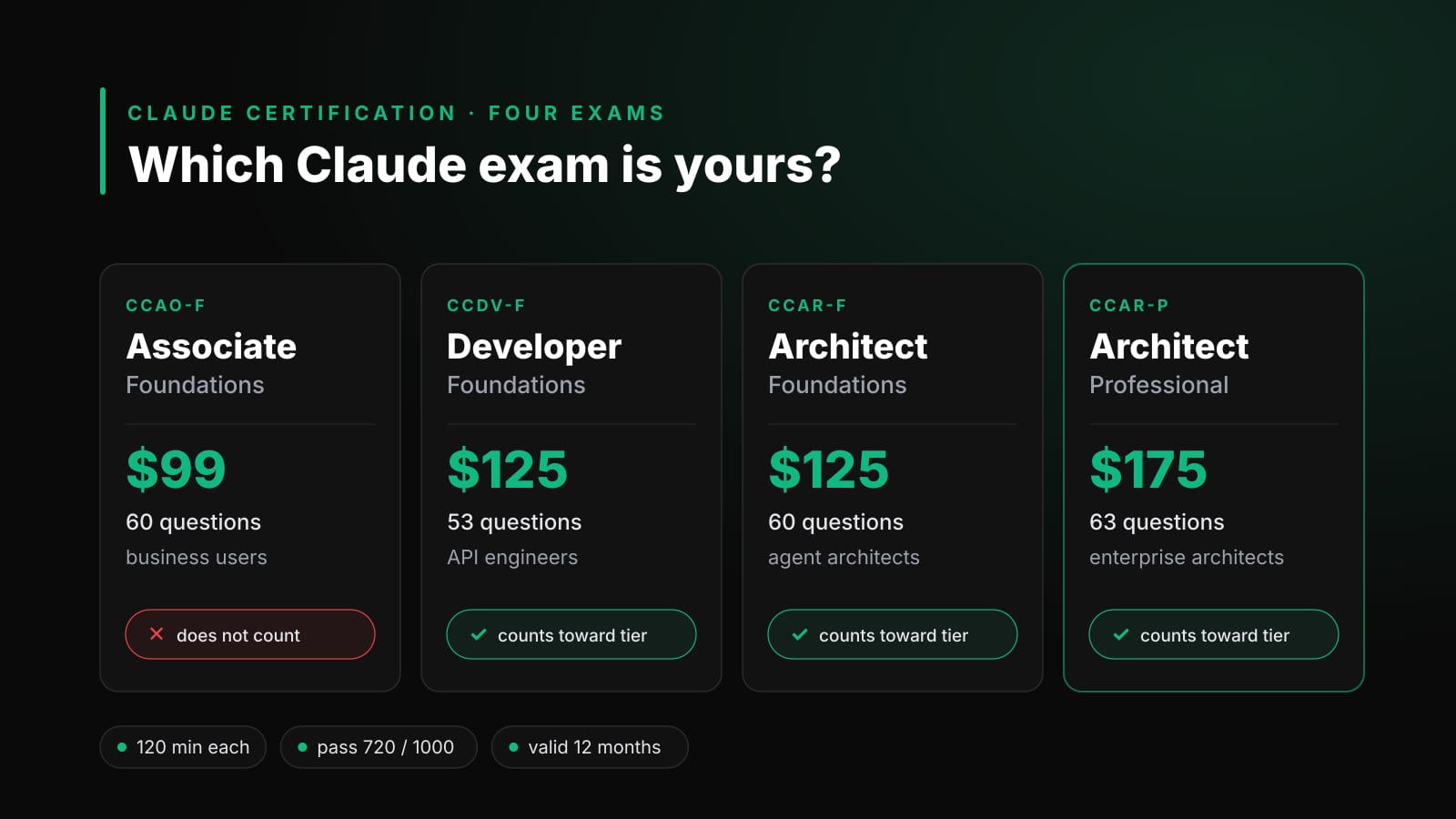
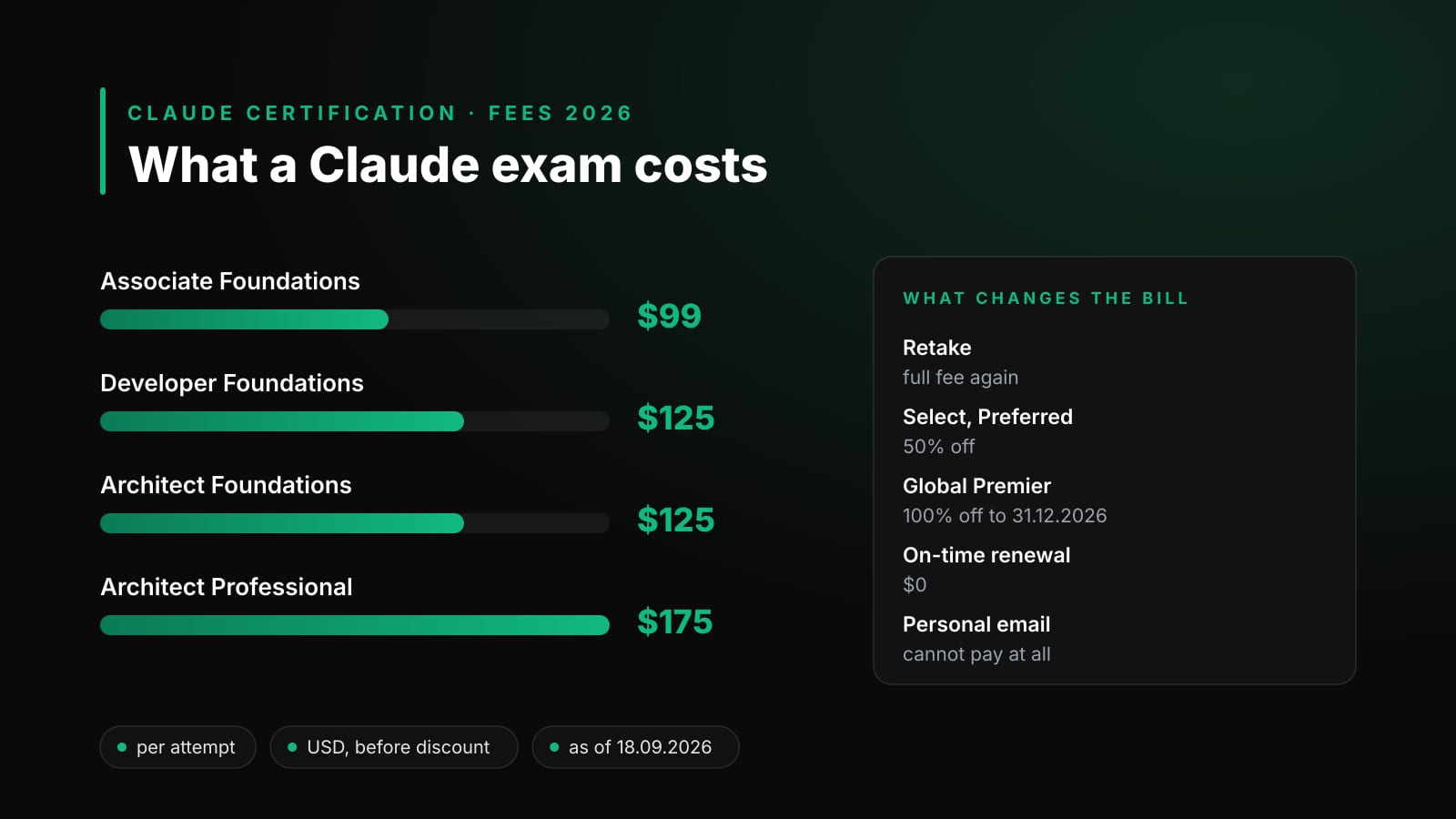
CCAR-P is Anthropic's advanced architect exam: 63 questions in 120 minutes, $175 per attempt, a pass at 720 out of 1000. Foundations tests how you build agentic systems. Professional tests how you run them inside an enterprise: integration, evaluation, governance and the conversation with stakeholders. Here is the blueprint domain by domain, three practice questions in its style, and how to prepare.
Claude Certified Architect Professional arrived on 23 July 2026, together with the Associate and Developer exams. It is the only professional-level Claude exam so far. I passed Architect Foundations in July and have not sat Professional. So this post rests on Anthropic's official exam guide for CCAR-P, read against the exam I did take, and I say which of the two I am speaking from.
The exam in numbers
The questions are multiple choice and multiple response, and each one tells you how many answers to select. Pearson VUE proctors the exam online or at a test center, in English only. The score report gives your scaled score and the percentage you got right in each domain. Those percentages help you plan a retake. They do not decide the pass, which rests on the total.
The guide recommends three or more years in systems architecture or platform engineering, six months with Claude or a comparable LLM system in production, and experience delivering an end-to-end system from discovery to operation. That is a recommendation. There are no formal prerequisites, Foundations included.
The seven domains
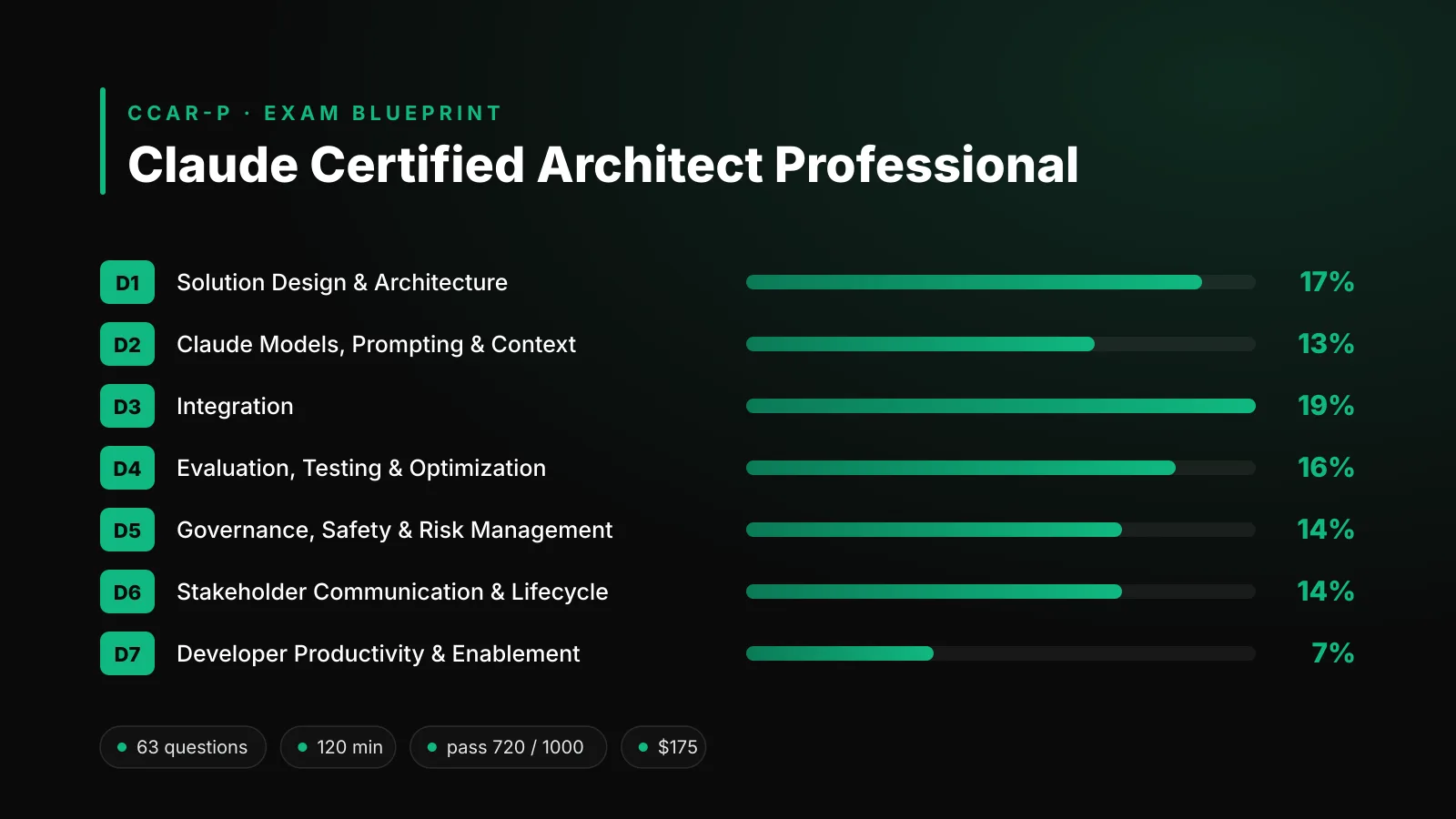
The blueprint splits the exam into seven domains. Here they are with their weights and a condensed version of the objectives the guide lists under each one.
| Domain | Weight | What it covers |
|---|---|---|
| 1 · Solution Design & Architecture | 17% | Turning a business problem into a Claude solution, choosing between a workflow, an agent and an augmented LLM, multi-agent orchestration. |
| 2 · Claude Models, Prompting & Context Engineering | 13% | Model choice on trade-offs, system prompts and guardrails, context windows, prompt caching, modular prompts and Skills. |
| 3 · Integration | 19% | Capability bloat and least privilege, authentication gaps, RAG pipelines and retrieval strategy, MCP versus API or CLI versus agent-to-agent, monitoring at scale. |
| 4 · Evaluation, Testing & Optimization | 16% | Metrics, evaluation datasets, A/B tests, diagnosing hallucinations and model mismatch, the cost and latency trade-off. |
| 5 · Governance, Safety & Risk Management | 14% | Guardrails, failure modes, human-in-the-loop validation, regulations such as GDPR, HIPAA and FedRAMP, bias and transparency. |
| 6 · Stakeholder Communication & Lifecycle Management | 14% | Discovery, explaining trade-offs, expectations and SLAs, documentation, handoff and iteration. |
| 7 · Developer Productivity & Operational Enablement | 7% | Configuring Claude Code and other Claude tools for teams, AI-assisted workflows, operational debugging. |
Integration is the largest domain, and it is broader than its name. Retrieval design and access control both sit inside it. Domains 5 and 6 together make up 28% of the exam, and most of what they test never shows up in code.
How Professional differs from Foundations
| Foundations · CCAR-F | Professional · CCAR-P | |
|---|---|---|
| Questions and fee | 60 · $125 | 63 · $175 |
| Structure | 4 scenarios drawn from a bank of 6 | 7 domains, no scenario bank in the guide |
| Center of gravity | Claude Code, Agent SDK, Claude API, MCP | Integration, evaluation, governance, stakeholders |
| Recommended experience | 6+ months building with Claude | 3+ years in architecture, 6+ months with LLMs in production |
| Claude Code configuration | 20% of the exam | part of a 7% domain |
Some topics appear in the Professional guide and not in the Foundations one at all: RAG pipelines, regulations such as GDPR and HIPAA, and stakeholder communication. My reading is that Foundations asks what you would build. Professional asks what you would build, how you would prove it works, and how you would get it approved.
The two overlap on model and prompt choices, tool design and context, and what I learned for Foundations carries over there. Most of that overlap is in the recurring design decisions I collected while preparing for Foundations.
Anthropic admits to its exams only people from Claude Partner Network organizations. Join our collective of AI consultants and sit all four exams through our partner organization.
Who should take Professional first
Go straight to Professional if you already lead enterprise deliveries and your week includes security reviews, eval design and steering committees. Start with Foundations if you build agents hands-on but have not yet owned the governance side. If you are unsure which role you are in, four questions that sort the Claude exams by the work you do settle it quickly.
For a partner firm the tier counts people with a current certificate, not certificates. A Foundations holder who adds Professional does not raise the firm's count, so the case for Professional is the skill and the client, not the tier.
Three practice questions in the CCAR-P style
There is no official practice exam for Professional: the one Anthropic had, for Foundations, was retired in the move to Pearson. The guide carries three sample questions, on integration, prompting and evaluation. The three below are my own, written for this post against the Professional blueprint. They are unofficial, and they cover domains the guide's samples leave out.
A healthcare client wants an agent that drafts replies to patient messages. Legal requires that no reply reaches a patient before a clinician reviews it, and the client wants to measure how often clinicians change the drafts. Which design meets both requirements?
- A. Instruct the model in the system prompt to mark every draft "for clinician review".
- B. Route every draft to a review queue where a clinician must approve it before sending, and log each edit against the original draft.
- C. Send drafts automatically when the model reports confidence above 0.9, and route the rest to clinicians.
- D. Have clinicians review a random 10% sample of sent replies every week.
Correct: B. The requirement is a hard gate, so it belongs in the workflow, not in the prompt. The queue enforces the review, and logging edits against the draft gives the client its measurement. The confidence threshold lets unreviewed replies through, and a weekly sample checks replies the patient has already read.
Option C is the tempting one, and it fails for a reason worth knowing beyond the exam: a confidence number the model reports about itself is not a calibrated gate.
Three weeks before go-live, the client's head of operations asks for a 99.9% accuracy SLA on an invoice extraction pipeline. Your evaluation set shows 96.4% field-level accuracy, and most errors come from handwritten documents. What should you do first?
- A. Accept the SLA and plan to close the gap with prompt tuning before launch.
- B. Refuse any SLA, because model output cannot be guaranteed.
- C. Present the measured accuracy by document type, propose an SLA per type with human review for handwritten documents, and agree how accuracy will be measured in production.
- D. Switch to the largest available model and commit to 99.9% once it is deployed.
Correct: C. The job here is to align the expectation with the evidence. Splitting the number by document type shows where the risk sits, a review path covers the weak segment, and an agreed measurement method makes the SLA testable. Accepting an unproven number and refusing outright both fail the stakeholder. A bigger model is a hope, not a plan.
A bank wants to classify incoming complaints into 12 fixed categories and route each one by a fixed rule per category. Volume is 40,000 complaints a month, and the categories and rules rarely change. Which architecture fits best?
- A. A multi-agent system in which a coordinator hands each complaint to a specialist agent per category.
- B. One model call per complaint with structured output restricted to the 12 categories, followed by deterministic routing in code.
- C. An autonomous agent with tools to read the complaint, look up policies and choose the route on its own.
- D. A separately fine-tuned model for each category.
Correct: B. Fixed outcomes and fixed rules make this a workflow, not an agent. One constrained call plus routing in code is cheaper, faster and easier to evaluate at 40,000 items a month. The agentic and multi-agent designs add cost and nondeterminism that the problem does not need.
How to prepare
PREP PLAN FOR CCAR-P
- 1. Grade yourself against the blueprint. Go through every objective in section 6 of the guide and mark the ones you have never done in a real project. The guide itself suggests this.
- 2. Build one system end to end, with RAG, evaluation and observability. That is the guide's own recommendation, and it covers domains 3 and 4 at once.
- 3. Take the official prep course. The Professional prep path on Anthropic Partner Academy has five courses. Finish with the guide's sample questions.
- 4. Drill the overlap with a mock. My practice exam targets Foundations. It covers agentic architecture, tools and context, and it does not cover governance or stakeholder work.
- 5. Explain trade-offs out loud. Domain 6 rewards the architect who can justify a decision to a sponsor who does not read code.
For the fourth step, the free 60-question practice exam runs in the browser and scores you per domain, which shows fast whether the shared ground is solid.
Access works the same as for every Claude exam: only through a Claude Partner Network organization. If your employer is not one, I laid out the routes past the partner gate and what to check on each.
Our own route covers Professional too. Members of the Certified AI Consultant Program sit all four Anthropic exams through our partner organization, CCAR-P included.
Frequently asked questions
How many questions are on the Claude Certified Architect Professional exam?
63 multiple-choice and multiple-response questions in 120 minutes. You pass with a scaled score of 720 on a scale from 100 to 1000.
How much does the CCAR-P exam cost?
$175 per attempt, before any partner-tier discount. A retake costs the full fee again.
Do I need Architect Foundations before Architect Professional?
No. There is no formal prerequisite, and a Foundations certificate does not upgrade into Professional. They are separate exams with separate fees.
Is there an official CCAR-P practice exam?
No. The only official practice exam, for Architect Foundations, was retired in the move to Pearson on 30 June 2026, before Professional launched. The official exam guide includes three sample questions with answers and explanations.
What are the CCAR-P exam domains?
Solution Design and Architecture 17%, Claude Models, Prompting and Context Engineering 13%, Integration 19%, Evaluation, Testing and Optimization 16%, Governance, Safety and Risk Management 14%, Stakeholder Communication and Lifecycle Management 14%, and Developer Productivity and Operational Enablement 7%.
Disclaimer. This post is independent and unofficial. It is not affiliated with, authorized or endorsed by Anthropic. Exam facts come from the Claude Certified Architect Professional exam guide (version 1.0, effective July 2026) and Anthropic's certification FAQ, checked on 18 September 2026. The three practice questions are original and are not drawn from the exam. Claude and Claude Certified Architect are names owned by Anthropic.