Is Claude Certified Architect worth it? Who hires certified people, and why
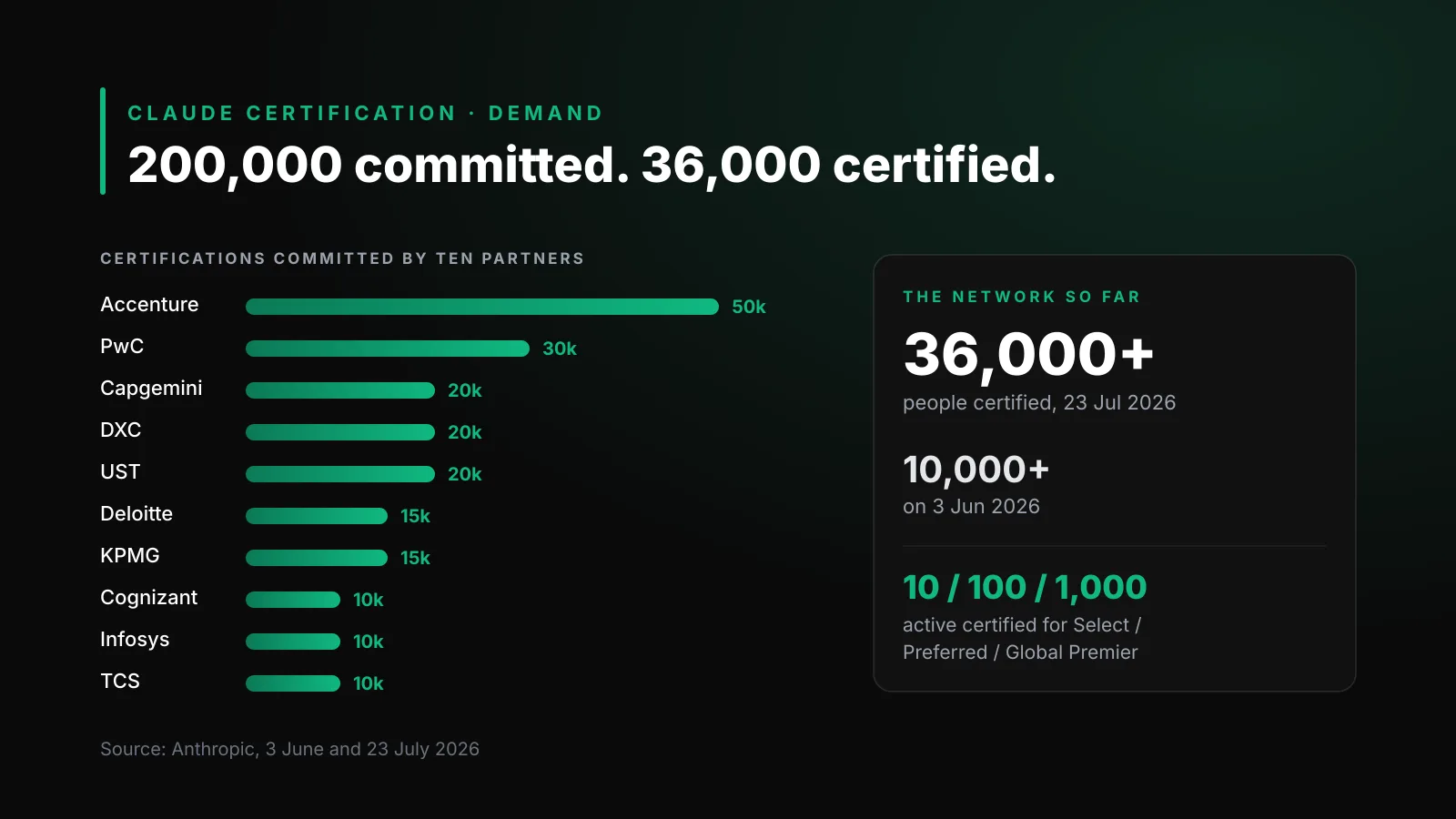
Yes, if you work in or around Claude partner firms, because their partner tier depends on how many certified people they employ. Ten of the largest partners alone have committed to 200,000 certifications. By late July the whole network had certified more than 36,000 people. The certificate gets you onto a shortlist. What you have built gets you the job.
I passed Claude Certified Architect Foundations in July 2026, and I now staff client projects from a collective of AI consultants. So I see the certificate from two sides: as a candidate who sat the exam, and as someone who reads the applications. This post looks at where the demand for certified people comes from, how big it is, and what the certificate changes in a hiring or staffing decision.
Where the demand comes from
Most of it traces back to one rule. In the Claude Partner Network, a firm's tier depends on three numbers: active certified people, customers running Claude in production, and public customer stories. The thresholds Anthropic published on 3 June 2026:
| Tier | Active certified people | Customers in production | Public stories |
|---|---|---|---|
| Select | 10 | 2 | 1 |
| Preferred | 100 | 15 | 3 |
| Global Premier | 1,000 | 100, in 3+ regions | 15 |
Global Premier also needs a joint business plan with named executive sponsors.
Two details turn this into steady demand rather than a one-off. First, active means a current certificate plus Claude use in the past 90 days, and a certificate lasts 12 months. Second, promotions happen on fixed dates, 1 January and 1 July, with an extra review on 1 October 2026. A firm that wants to move up has a deadline and a headcount to hit.
Anthropic also writes that firms across the network are prioritizing certification during the hiring process. That is the vendor's own claim, but it lines up with the incentive in the table.
What the largest firms have committed to
On 23 July 2026 Anthropic published the certification commitments of its largest partners:
| Firm | Committed certifications |
|---|---|
| Accenture | 50,000 |
| PwC | 30,000 |
| Capgemini · DXC · UST | 20,000 each |
| Deloitte · KPMG | 15,000 each |
| Cognizant · Infosys · TCS | 10,000 each |
| Total, ten firms | 200,000 |
Specialist firms are doing the same. EPAM expects to have more than 10,000 Claude-certified architects, Wipro plans 10,000 certifications within 18 months, Ascendion wants its whole 8,000-person engineering team certified before 2027, and Globant is building a practice of 5,000 certified architects.
Against that, the same announcement counted more than 36,000 certified people across more than 1,300 organizations. Seven weeks earlier, on 3 June, the figure was more than 10,000.
My reading of those numbers: the large firms will meet most of their commitments by certifying people they already employ. The hiring pressure lands on smaller partners. A 30-person firm needs 10 active certified people for Select, which is a third of its staff, and it has no bench of thousands to draw from.
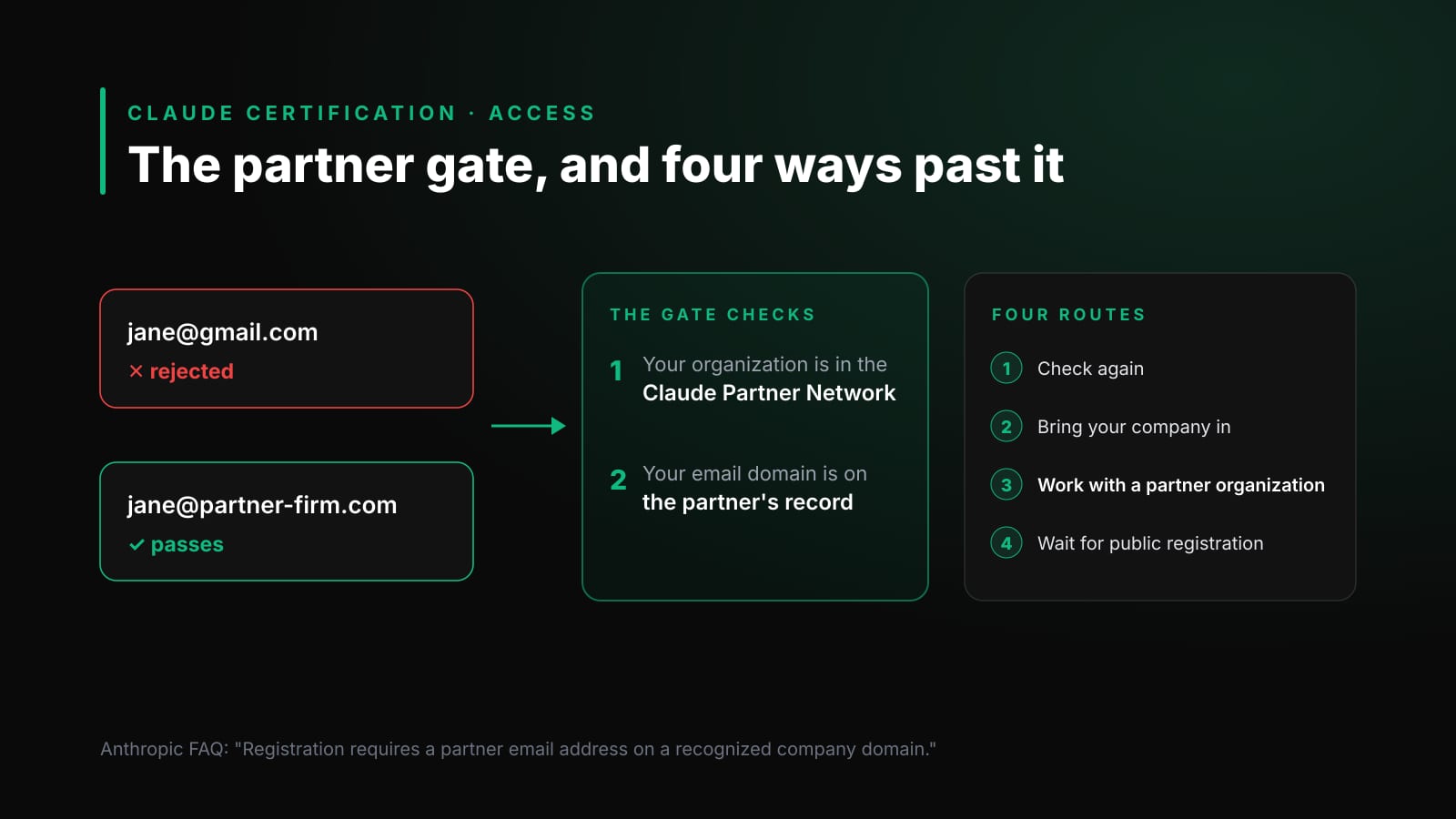
Anthropic admits to its exams only people from Claude Partner Network organizations. Join our collective of AI consultants and sit all four exams through our partner organization.
Where the roles are
- Large consultancies and integrators. They certify at scale and mostly from inside. For an outside candidate the certificate is a filter criterion there, not a door.
- Smaller partner firms. The best place for an individual. Every certified person moves them visibly toward the next tier.
- Companies deploying Claude for themselves. The tier means nothing to them, but the certificate tells them what a candidate was tested on.
- Independent consultants. Here the certificate works on a proposal, as a signal to the buyer. A client comparing partners sees each firm's certified team in the Partner Hub's public directory.
For consultants the exam pairs with Anthropic's partner training. The other credential I hold took eight courses and a scenario-based capstone, and I described it in what the Claude Code partner badge asks of a consultant.
What the certificate changes, and what it doesn't
When we staff a project from our collective, the certificate answers one question fast: does this person know the Claude stack at the level Anthropic tests. It does not answer the next one: has this person shipped something that survived production. For that we look at repositories, the projects on a CV and what someone has built with a language model.
So the certificate does the most in two situations: when you have no public portfolio yet, and when a buyer or a partner firm needs a number it can verify. It does the least as a substitute for shipped work. Between two candidates, the one who has shipped wins.
I still think it carries more signal than most vendor badges, because the exam tests decisions under constraints rather than recall. How that felt from the candidate's chair is in my notes from the two hours of the architect exam.
Is it worth it for you?
- You work at a Claude partner or want to.
- You sell implementation work to companies that compare vendors.
- You have no public portfolio yet and need a verifiable signal.
- Your shipped Claude work is already public and clients never ask for credentials.
- You have no route to a partner organization, so access is the first problem, not the exam.
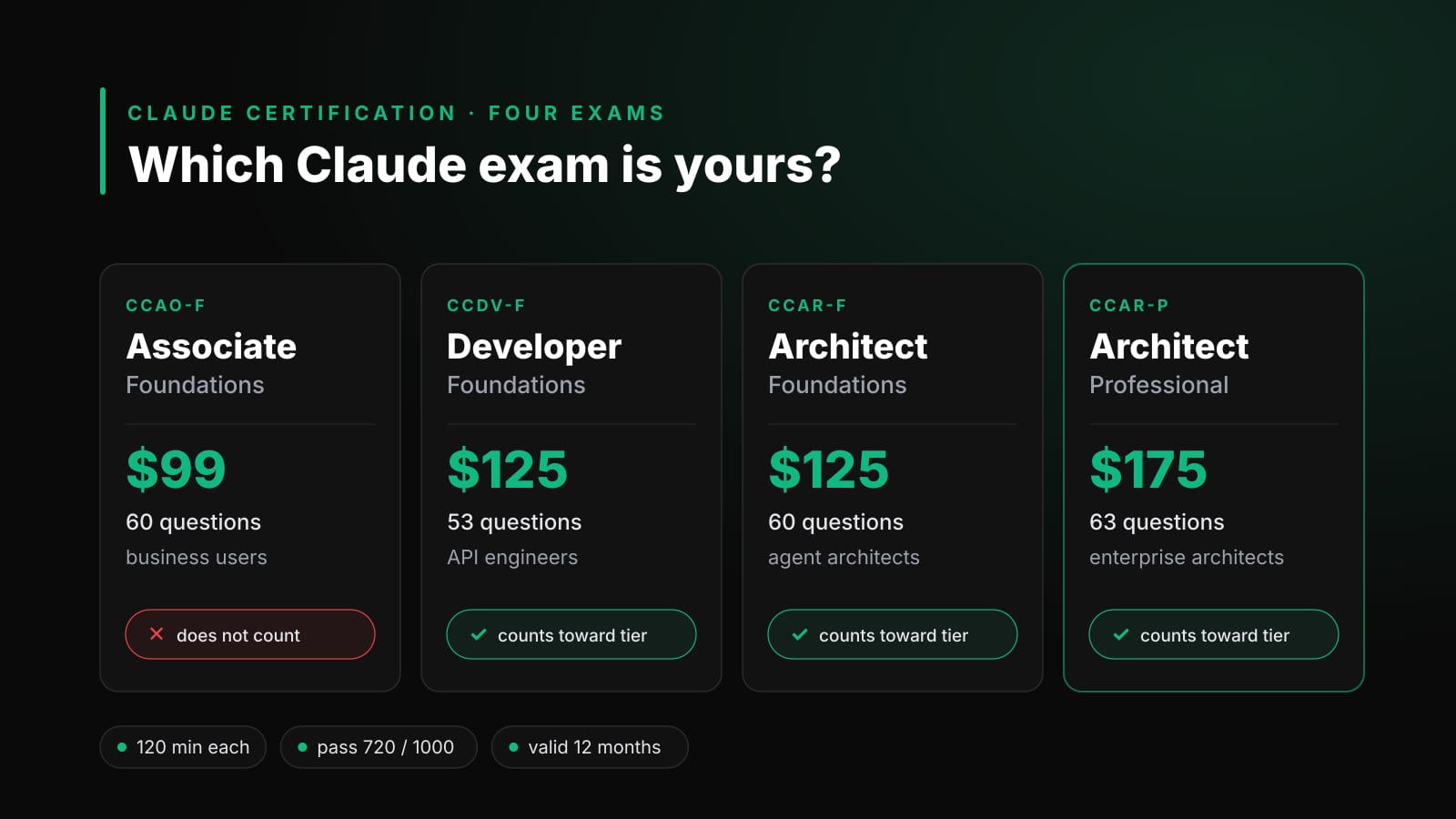
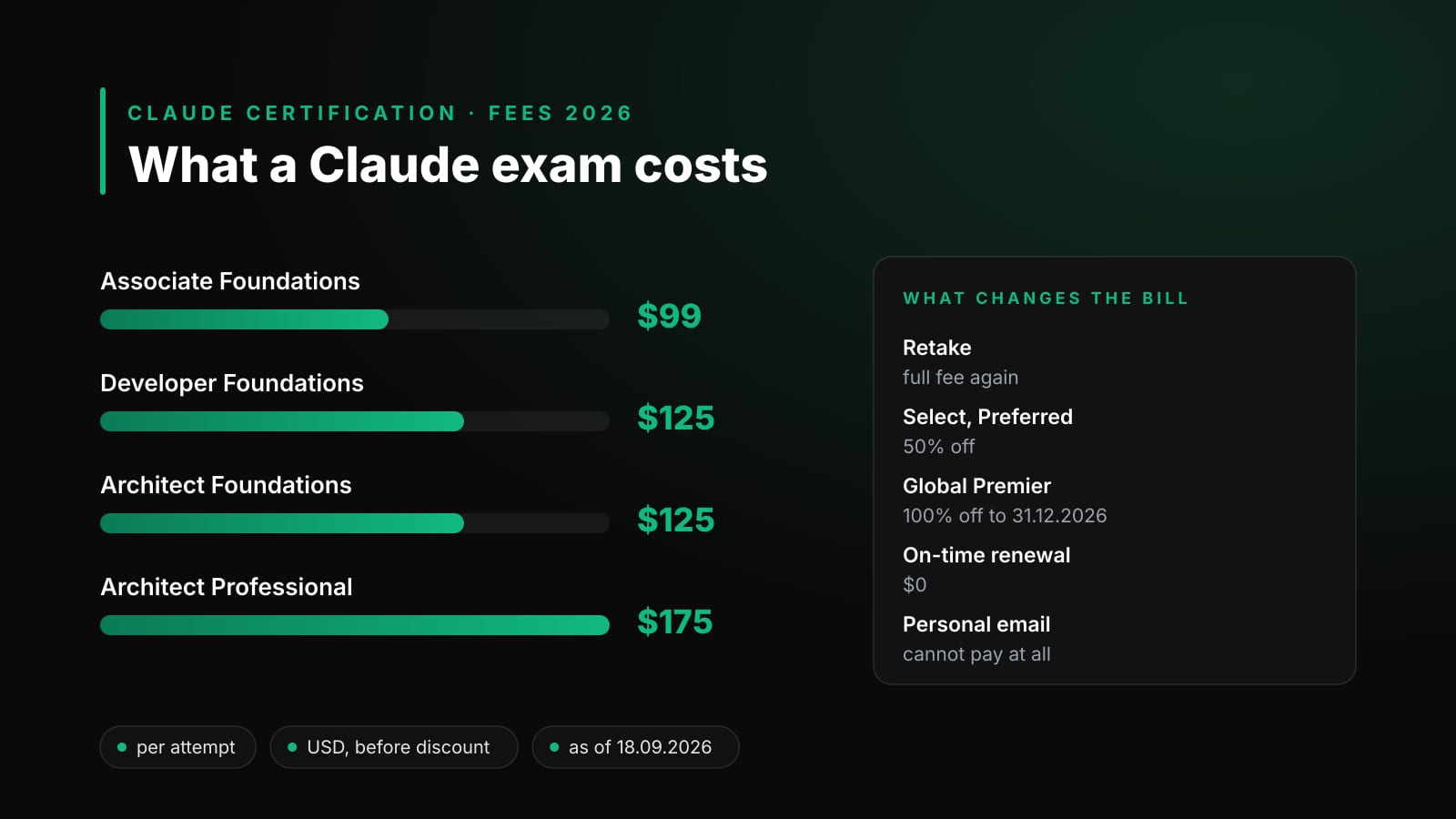
If access is the blocker, the four routes into the exam without a partner employer come first. The cost side is modest: $125 for Architect Foundations, $175 for Professional, and a free renewal as long as you keep it current.
Retakes, partner discounts and what the first year costs in four typical situations are in what a Claude certification costs, attempt by attempt.
After you pass
FOUR THINGS TO DO
- 1. Accept the Credly badge and add your personal email to the profile, so the badge stays with you when you change jobs.
- 2. Use the full name of the credential, for example Claude Certified Architect Foundations, and link the Credly verification.
- 3. Keep it active. Renew within 12 months, which is free, and keep using Claude, because partners count only people active in the past 90 days.
- 4. Put it next to something you built. A repository or a case study turns a badge into evidence.
If you want client work, our Certified AI Consultant Program staffs projects from the collective when a member's profile fits the brief, and gives members access to all four Anthropic exams.
Frequently asked questions
Is Claude Certified Architect worth it?
It is worth it if you work at or want to join a Claude partner firm, or sell Claude implementation work, because partner tiers depend on certified headcount. It adds the least if you already have visible shipped work and clients never ask for credentials.
Who hires Claude certified architects?
Mostly Claude Partner Network firms, which need active certified people to reach and keep their tier: 10 for Select, 100 for Preferred and 1,000 for Global Premier. Companies deploying Claude for themselves also use the certificate as a signal.
How many people are Claude certified?
More than 36,000 people across more than 1,300 organizations, according to Anthropic on 23 July 2026. On 3 June 2026 the figure was more than 10,000.
Does a Claude certification guarantee a job?
No. It helps you pass a first filter and gives an employer something it can verify. Shipped work that survived production still decides between candidates.
How long is a Claude certification valid?
Twelve months from the day you earn it. On-time renewal is free. For a partner firm's tier, a certified person also has to have used Claude in the past 90 days.
Disclaimer. This post is independent and unofficial. It is not affiliated with, authorized or endorsed by Anthropic. Figures come from Anthropic's announcements of 3 June and 23 July 2026 and its certification FAQ, checked on 18 September 2026. Firm commitments are as Anthropic reported them. Claude and Claude Certified Architect are names owned by Anthropic.