OpenAI Select Partner. What the status means and what it does not
My company has earned OpenAI Select Partner status. It is a tier in OpenAI's partner program, held by a company rather than a certificate held by a person. Here is what stands behind it and how to read it next to my Anthropic badges.
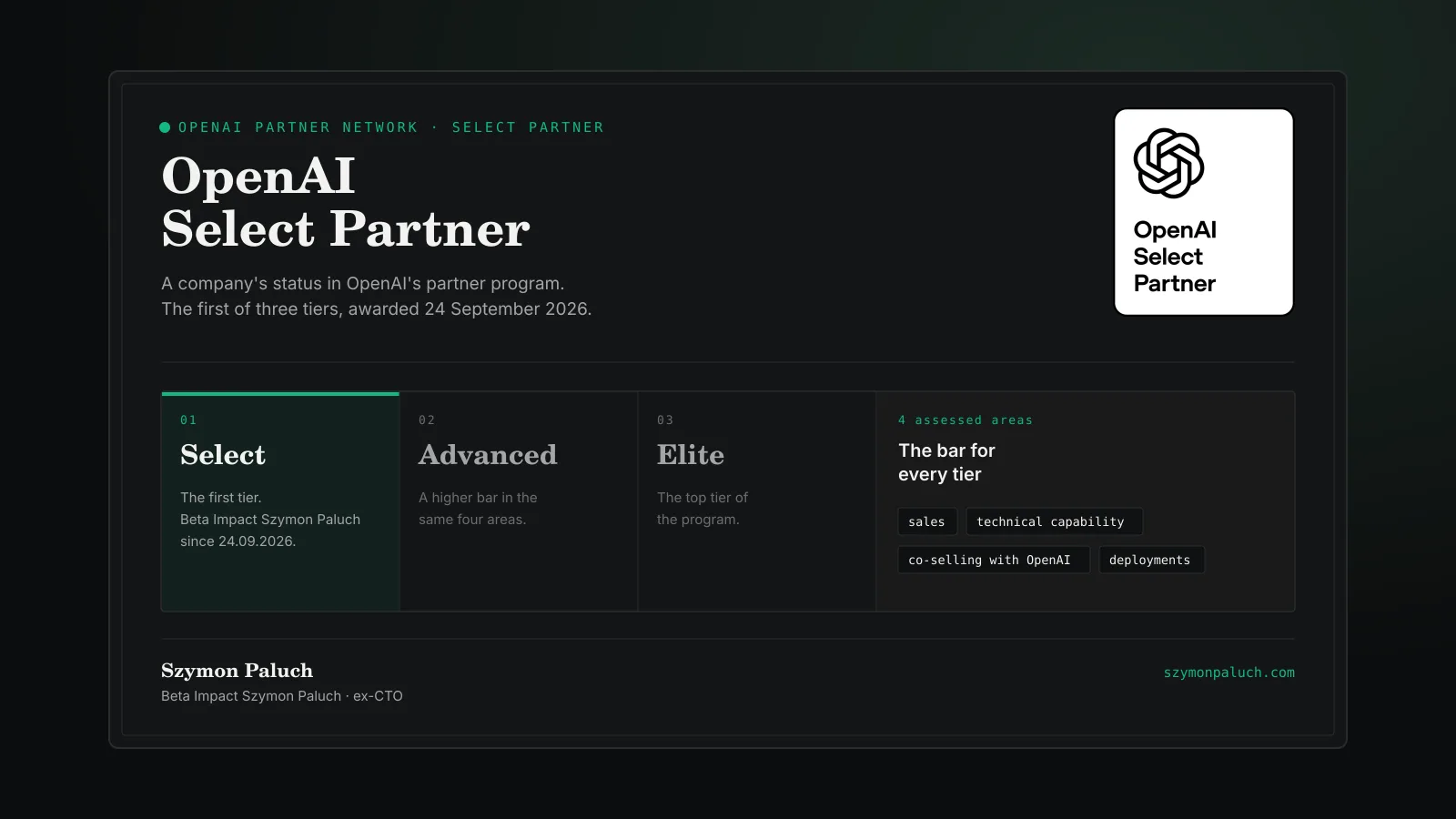
Since 24 September 2026, Beta Impact Szymon Paluch, the company through which I run my consulting and implementation work, has been an OpenAI Select Partner in the OpenAI Partner Network. I closed onboarding in the partner portal the same day. The status belongs to the company. My personal proof of skill is two badges from Anthropic. I cover those here too, because the three are easy to mix up.
Below I explain what the program is, how the road to the status went, and what it means for a company looking for someone to deliver an AI rollout.
What the OpenAI Partner Network is
OpenAI announced the program on 14 June 2026. It is a network of companies that build, sell and deliver AI solutions on OpenAI technology. At launch OpenAI committed $150 million to growing that network. It also set itself a goal: 300,000 certified consultants by the end of 2026. The first group of partners includes Accenture, Bain, BCG, McKinsey and PwC, among others.
The program has three tiers: Select, Advanced and Elite. According to OpenAI, each one sets a high bar in four areas. What counts is sales performance, technical capability, co-selling with OpenAI and deployment experience. Select is the first of the three. OpenAI does not publish numeric thresholds for the tiers, so I will not guess them.
OpenAI has also announced specializations. They are meant to signal deeper expertise in chosen areas, such as Codex, cybersecurity and agents. For now that is an announcement, not something you can already earn.
How the road to the status went
You cannot buy the status. A company applies, describes what it can do, what technical expertise it has and which clients it has worked with, and OpenAI reviews the application before it opens the partner portal.
OpenAI accepted my application on 23 July 2026, and from that day the company had 90 days to finish onboarding in the portal, because access expires after that. Training in PartnerU, the program's learning platform, started at the same time: first how to run the portal, then the basics of the program itself. I closed onboarding on 24 September. It took 63 days. The message about Select status arrived the same day.
After onboarding the portal opens OpenAI's sales and technical enablement material. The rest of the path runs from there: more training and, in time, specializations.
This is what I do hands-on: advising on AI strategy and building agents that survive the demo.
A company status, not a personal certificate
This is the most important point in the post. My site now shows three badges, and each one means something different.
Claude Certified Architect Foundations is an exam I passed in person. It is proctored: camera, microphone and a recorded screen for two hours. I wrote up what that exam actually demanded and how I prepared for it.
Claude Partner Badge Claude Code is also a personal badge. Behind it are eight courses and a scenario-based capstone. I broke down the five areas that track covers, from governance to the rollout playbook.
OpenAI Select Partner is a company's status in a partner program. You do not sit it like an exam. It says the company passed the application review and onboarding, and OpenAI placed it in the first tier of the program.
You also check each of the three differently. Both Anthropic badges have public pages on Credly. The OpenAI status is not a Credly badge but a company's tier in OpenAI's program. OpenAI's public Partner Locator lists Advanced and Elite partners, so a Select partner is usually not in it. OpenAI asks partners to refer to it exactly as "OpenAI Select Partner", and that is the name I use on this site.
Why I work with models from more than one provider
A client buys a working system, not a model provider's logo. I usually design the model layer so it can be swapped. In one rollout the same layer can be switched between OpenAI, Anthropic and Google. In another, described on the page about the AI rollouts I take from client data to production, a GPT model recognises the headers in tender spreadsheets.
That is why the OpenAI status sits next to the Anthropic badges rather than replacing them. Ask any contractor plainly how much work it takes to change the model. The answer depends on the architecture. I wrote up separately which layers of a system you rewrite when you change model provider.
What does a company looking for a contractor get from the status? Two things, both more modest than the word "partner" suggests. It knows the contractor made it through OpenAI's review and to the end of onboarding, and that the contractor has access to the sales and technical material OpenAI prepares for partners.
What does the status not give? It does not guarantee the outcome of any particular project. It also says nothing about how well the contractor understands your process. That gets tested in a conversation and in the first stage of the rollout.
If you are choosing a contractor, ask three questions. Which model provider fits your data? How will you measure quality before the system reaches people? What happens when, a year from now, you want to change the model?
OpenAI Select Partner
Status of Beta Impact Szymon Paluch in the OpenAI Partner Network · since 24 September 2026
The OpenAI Partner Network program