How to find AI consulting jobs and client projects
Choose the work you want to do, find firms or briefs that fit your skills and show one project someone can assess. Here are places to look and a way to prepare your application and first conversation.
Employment, contracting or a direct client?
When moving from IT consulting into AI, you still gather requirements, connect systems and agree on what good work means to the client. You also need to evaluate model outputs across examples and decide what happens after an incorrect response. With customer email, that means going beyond retrieving messages to assessing whether a drafted reply is safe to send.
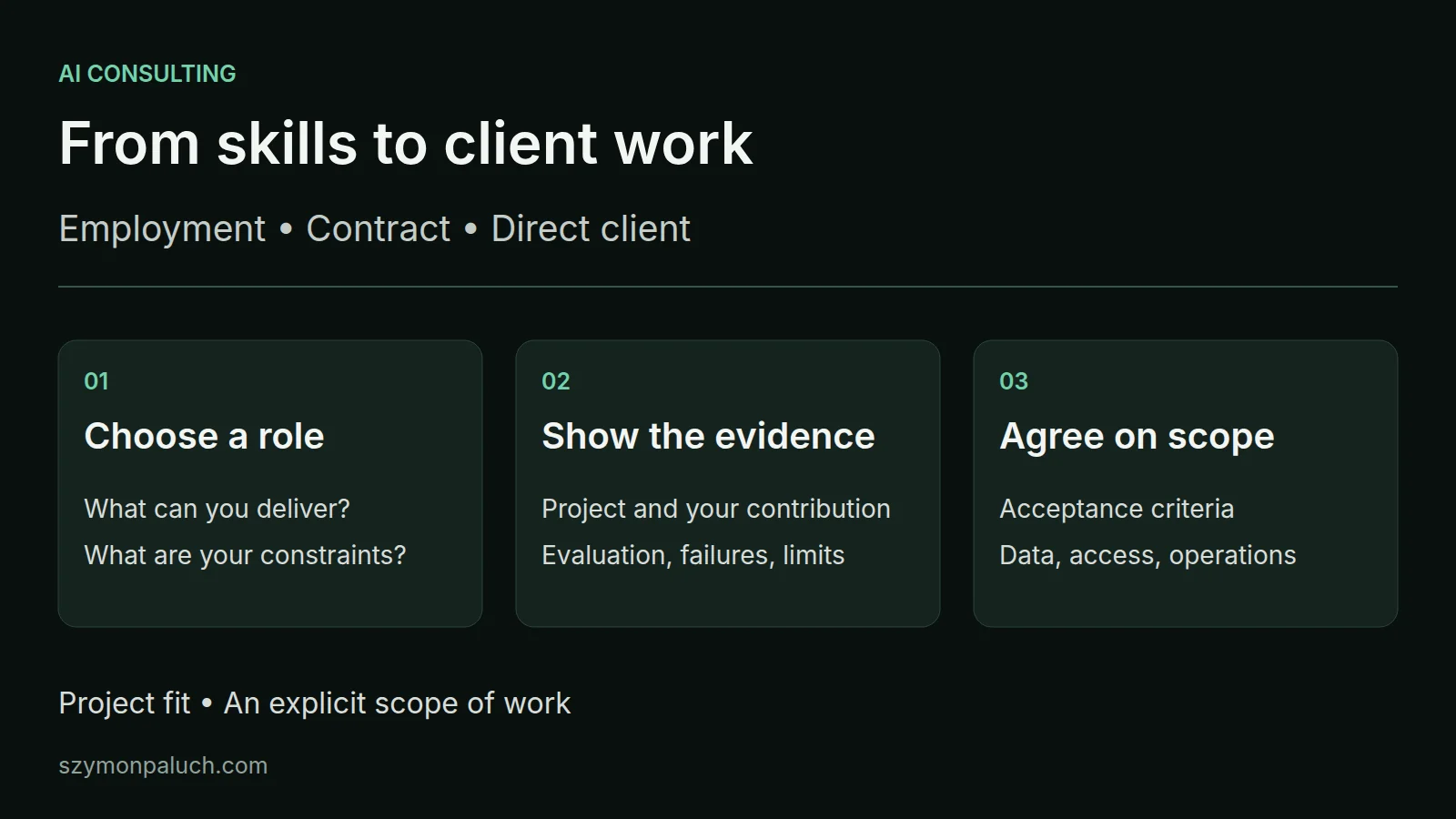
A search for “AI consultant jobs” can lead to three different arrangements. A firm wants to hire you into a team. An integrator needs help with part of a project. Or a client wants to improve a process and expects you to work out what should be done. Before sending a CV, decide which arrangement fits you.
Write down your availability, working hours and the languages you can use with clients. Add work you can already demonstrate: API integration, model evaluation, agent design or process analysis. “I know AI” will not help you reject a poorly matched brief. “I can build and evaluate document extraction” gives you something specific to compare with the request.
| Arrangement | What you are looking for | What to establish early |
|---|---|---|
| Employment | A team role with defined responsibilities and room to develop. | Tasks, autonomy, location and how your work will be assessed. |
| Contracting or subcontracting | Part of a project led by another firm. | Who sets requirements, accepts the work and speaks with the end client. |
| A direct client project | A problem you can investigate and solve within an agreed scope. | Data, access, budget, measurement and responsibility after delivery. |
Where to look for AI consulting work
These are starting points. I checked the links and page types on September 29, 2026; individual vacancies and participation rules change. Set your own country, language, working arrangement and experience level. For remote roles, read location and time-zone restrictions carefully.
| Where | What to use it for | How to prepare an application |
|---|---|---|
| LinkedIn Jobs: AI consultant | Finding roles and employers. The initial page may show a different country from yours. | Also try AI engineer, solutions architect or generative AI consultant. Match your CV to the listed tasks and include one similar project. |
| Employer career pages, such as EPAM | Checking current recruitment directly with an employer. | Read the role requirements and use the stated application route. Describe your contribution, tools and how you evaluated the result. |
| Upwork: Artificial Intelligence projects | Reviewing freelance briefs and billing arrangements. | Address the problem in the brief. Show similar work, ask about missing data and check current platform fees and rules. |
| Technology partner networks, such as Claude | Finding firms working in a particular ecosystem. A partner directory is not a vacancy list. | Check the firm’s services and careers page. If it accepts contractor enquiries, state the scope you can handle and your availability. |
| Your professional contacts | Talking with someone who already knows your work. | Choose a process you understand. Ask how it works today and where it takes time before proposing a model. |
You do not need to use every channel at once. Start with one where you understand the work and can assess the requirements. As you apply, record where conversations stop: no reply, different scope, insufficient experience or no budget. That gives you a specific part of the application to improve instead of rebuilding your whole portfolio repeatedly.
Anthropic admits to its exams only people from Claude Partner Network organizations. Join our collective of AI consultants and sit all four exams through our partner organization.
Build a portfolio another person can assess
Suppose you want projects involving customer email. Build a small example on test messages. The system assigns a category and drafts a reply, while a person approves sending it. This is a learning example: do not imply it came from a paying client if it did not.
Start the project description with the task and your contribution. Then show code or a document, setup instructions and results on a separate test set. Record which messages cause problems and how a person regains control. This gives an interviewer enough detail to examine your work without guessing what you did and what the tool supplied.
- Problem: what should change for the user and what you measured before the trial.
- Your contribution: what you designed, wrote or checked yourself, and what the team did.
- Decisions: why you chose the model, tool scope and point where a person takes over.
- Evaluation: the test data, error measures and cases you have not yet checked.
- Operations: how you will detect a failure, bound costs and return to the previous version.
If the project is meant to save time or money, write the measurement method before running the pilot. The article on measuring AI ROI explains how to approach benefits and costs you do not yet know. A portfolio needs an honest measurement and its limits; do not add a financial outcome you have not observed.
Use your own test data or material you can share in a public repository. Include a way to reproduce the trial. If client work cannot be published, agree on the scope of a permissible description instead of copying their documents into a demo.
How to respond to a brief
A useful response gives the other person a reason for a short conversation. Address one task, point to similar work and ask a question that determines scope. Avoid committing to delivery before seeing what the system actually needs to connect to.
For example: “I have a prototype that classifies messages and sends uncertain cases to a person. I can show the code, tests and remaining errors. Does your process only need category selection, or also drafting and sending replies?” Use that message only if you actually have the work it describes.
For employment, also show how you worked with a team and maintained code. For a contract, state your availability and the part of the project you can take on. With a direct client, start by asking about the process and who will accept the result. The same attachment may help in all three conversations, but each has a different purpose.
The Agentic Architect
Practical patterns, case studies and AI news. Zero spam, once a week.
You'll get one email to confirm. Unsubscribe with one click. Privacy policy
Agree on a focused first project
Before estimating the work, write down the answers with the client. When something is unknown, propose a short step to investigate it and agree on what that step should produce.
- Which part of the process does the trial cover, and who performs it today?
- What data will you receive, who may use it and which systems can you access?
- What will you submit for acceptance: a report, prototype, code or working integration?
- Which test set and criteria will you use to assess the result?
- What happens after an error, and who can stop the system?
- Who pays for tools and handles operations after handover?
A pilot does not need to cover the whole process immediately. In the email example, start with assigning categories without sending replies. The result gives you evidence for discussing the next step. The article on moving from an AI pilot to wider use examines the gap between a successful demonstration and an operating process.
When does a certification help?
If a role or client requires an exam, check its exact name and level. If you are choosing what to study, begin with selecting a certification for AI consulting work. A useful study scope should help you complete a project or learn a skill missing from your chosen brief.
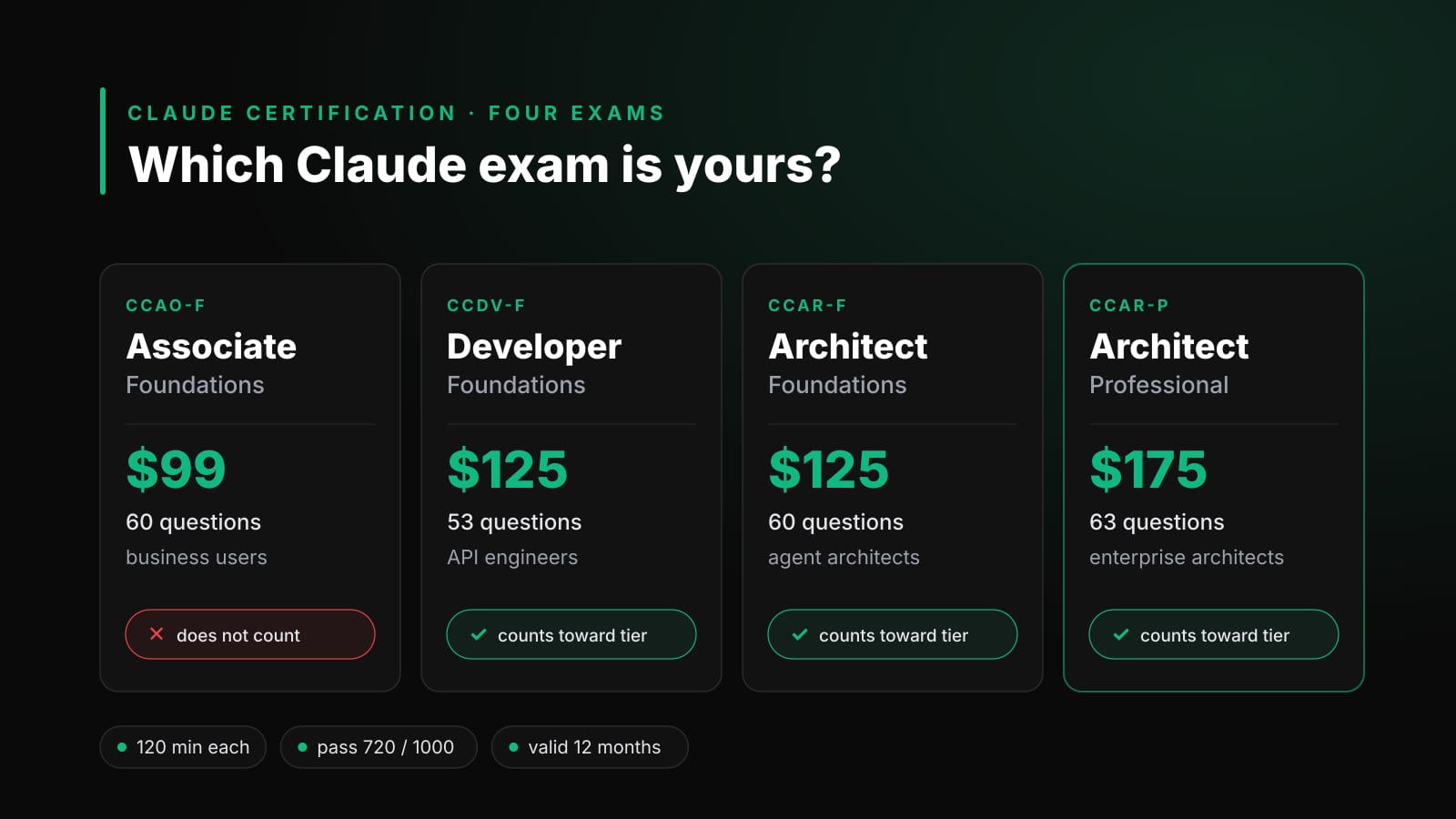
For Claude, people with a current Developer or Architect certification count toward a firm’s partner tier if they have used Claude in the past 90 days. That gives firms one reason to train their teams. The article on CCA’s value when looking for work explains that rule and its limits. A partner requirement is not a promise of employment.
Choose your next application or conversation
Open one opportunity that fits your experience. Highlight three tasks and put a piece of evidence beside each. If you lack evidence for the most important task, choose a small project to build. If you have it, prepare an application with that material and one question about scope.
In our consultant collective, matching depends on the client brief, experience and availability. Membership does not guarantee an assignment. If you want to consider that route, check the current program terms below, including the required LLM experience and selection process.
Frequently asked questions
Where can I find AI consulting jobs?
Start with job platforms and employer career pages. For freelance work, review project briefs; for subcontracting, look for firms in an ecosystem you know. Set location, language and role level, then match evidence of your work to the requirements.
How can I find a first AI project without paid client work in my portfolio?
Build a small project on test data and clearly describe it as your own exercise. Show code or a plan, how you evaluated the result and remaining errors. Then look for a task with a similar scope instead of claiming a client you never had.
How does a contract differ from a direct consulting project?
A contract often covers part of a project led by another firm. With a direct client, you also establish the problem, scope and acceptance. Actual responsibilities come from the agreed terms, so check them before accepting work.
Do I need a certification to get an AI project?
It depends on the client or role. A credential may be required or helpful, but you still need to demonstrate experience and work. An exam alone does not guarantee a project.
Does this page list current vacancies?
This is a guide to choosing channels and preparing an application. Current opportunities are on the linked employer and platform pages. The author’s program matches consultants to available projects without guaranteeing assignments.