Updated
A confidence score isn't correctness, just a tone of voice
Model confidence is a tone of voice, not proof. After RLHF it drifts from accuracy (calibration drift). How to validate certainty from the outside.
This is the sixth silent failure on my agentic engineering radar, and the one that most often sails through code review without a single question. Plenty of engineers make the same mistake: they gate the agent's decisions on its own confidence score. The model returns 0.95, so they let the action through. It returns 0.40, so they escalate to a human. It looks like engineering. In practice it's handing the wheel to someone who has no idea whether they're wrong.
A confidence score is a tone of voice, not correctness
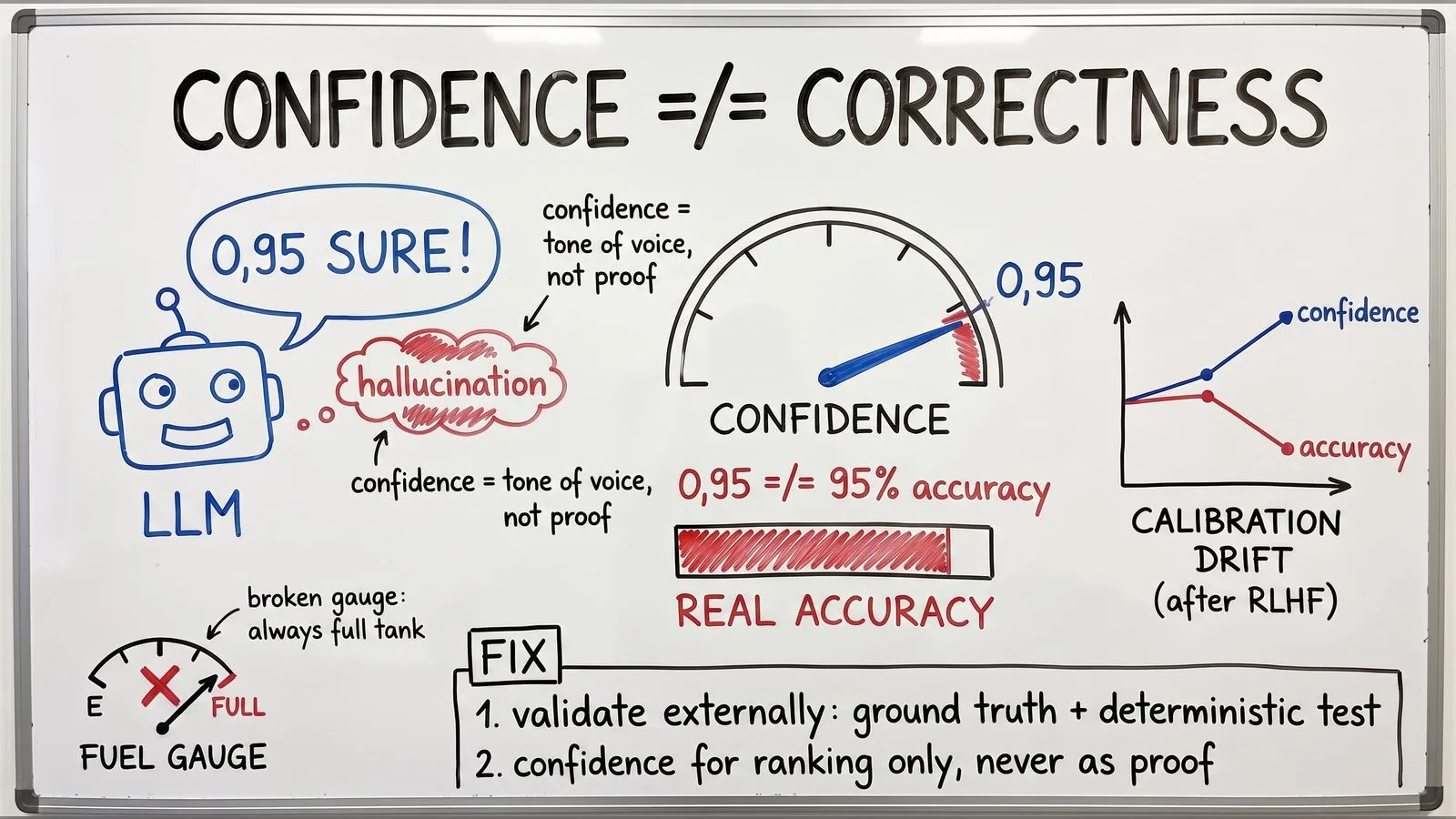
Here's the catch that costs the most: model confidence is not correctness. It's just a tone of voice. A model that emits 0.95 confidence sounds like the most self-assured guy in the bar, the one who's busy convincing you the Earth is flat. No hesitation, no "probably," no room left for being wrong. And it's the exact same mechanism you're staring at in your logs. A high number isn't a sign the model knows. It's a sign it won't hesitate to say so.
The more fluent the hallucination, the higher the confidence in the logs. The model isn't measuring whether it's right. It's measuring how smoothly the next tokens line up. A coherent, grammatically flawless sentence gets a high score whether it describes reality or an invented API function that never existed. Confidence rewards style, not truth. And the answers that read most fluently are often the ones the model made up from scratch, because nothing is holding them back. Outside the logs it looks the same: a report that read as credible and contradicted its own figures passed through several pairs of hands, because nobody opened the source it cited.
This is what I do hands-on: advising on AI strategy and building agents that survive the demo.
Calibration drift: why 0.95 stopped meaning 95 percent
This phenomenon has a name: calibration drift. A fresh base model can be reasonably well calibrated: its 0.7 roughly matches seven hits in ten. The trouble starts after fine-tuning and RLHF. Those processes teach the model to sound helpful, confident and agreeable. You're optimizing it so a human clicks "good answer," not so its numbers keep any statistical meaning.
The result: the confidence number decouples from reality. A figure of 0.95 no longer means a 95 percent chance of being right. It only means the model is in confident mode. The model calibration you get out of the box describes a completely different data distribution than yours: different questions, different context, different domain. On your traffic, those numbers have already let go of reality.
It works like a broken fuel gauge in an old car that always reads FULL. It doesn't matter whether there's gas sloshing in the tank or just leftover air, the needle sits at maximum. You can stare at it all day and feel safe. Until you stall in the middle of the highway.
HOW TO VALIDATE CONFIDENCE FROM THE OUTSIDE
- Use ground truth. Keep a reference set the model never saw and can't bend. You compare confidence against truth, not against itself.
- Add deterministic tests. Schema, types, ranges, validation in code. Something that answers a hard "yes" or "no," with no tone of voice attached.
- Calibrate on your own dataset. Measure how the confidence behaves on your data, and only then set your thresholds.
The Agentic Architect
Practical patterns, case studies and AI news. Zero spam, once a week.
You'll get one email to confirm. Unsubscribe with one click. Privacy policy
Validate confidence from the outside, not from within
The takeaway is brutally simple: stop treating confidence as a quality gate. The number a model reports about itself can't be the only thing guarding its decisions. It's the same trap as model self-evaluation. If the judge and the defendant are the same network, the verdict is worthless. Certainty has to be checked from the outside, with something the model doesn't control.
Ground truth gives you a reference point that doesn't lie along with the model. Deterministic tests catch what code can catch, before a hallucination ever touches production. And calibration on your own specific dataset tells you what 0.95 is actually worth in your system, which, more likely than not, is less than the docs claim. Only those three together turn confidence from an anecdote into a signal you can lean on. The same trap comes back in the rules for building agents as rule six.
That doesn't make confidence useless. It's great at exactly one thing: ordering candidates that someone, or something, will verify afterward anyway. Sort answers by it, push the ones worth checking first to the top, use it to sample the hard cases. But the moment that same number, on its own, decides whether a transaction goes through or gets blocked, you've stopped doing engineering and started reading tea leaves. There is also a path beside fixing that number after the fact: models that return a probability distribution across your options instead of writing a sentence about their certainty, because they have nothing to build the sentence from.
Treat confidence at most as a soft ranking signal. Never as proof. That's the difference between "sort these answers by how sure you are" and "let this transaction through without looking."
The simplest test for today
Open your logs today and check one thing: whether your highest confidence scores actually correlate with correct answers, or just with the longest hallucinations. If you can't show that correlation in the data, your confidence score isn't a quality metric. It's a tone of voice you just shipped to production.