Why give a robot legs? Because we built the world for people
We built homes and most buildings for people. Rebuilding them for machines costs space, time and money. A humanoid flips that calculation: the machine fits the building. Legs earn their place where the stairs begin. The hard part today is the robot's body itself, and the hardware still has to be bought and shipped. That is why robots will probably spread more slowly than AI did.
On the Polish podcast “I to się liczy”, Adrian Andrzejczyk asked me what I do in robotics. We got to an argument that comes up a lot these days: does a robot need a human shape and legs at all? Here I expand on what I said then and check it against sources.
The whole conversation is on YouTube, in Polish. This part starts at 45:11.
This is the third piece from that conversation. In the first one I wrote that robots today are mostly a novelty, the way drones were a few years ago. This one is about why some of them get a human body.
A washer, a dryer and a line nobody will build in a flat
There was a big sceptical trend that asked whether humanoids are needed at all, and whether drones, robotic arms or tracks would not be the better bet. On factory floors, automation with robotic arms is really very advanced, and each of those robots does one specific task.
Take laundry. You have a washing machine, maybe a dryer. You would like to drop your clothes in one place and later find them in the wardrobe, washed and folded. Technically it can be done. With the space and the resources, you could put a whole line in your home. It sorts clothes by colour, washes, dries, irons and folds them.
Except we do not have the space or the infrastructure for it. We do not have the time or the resources either.
Two ways to clean laundry
Rebuild the home for a machine
- 1. Sorting by colour
- 2. Washing
- 3. Drying
- 4. Ironing
- 5. Folding
Needs space, infrastructure, time and resources.
A machine that fits the home
A humanoid is meant to do the laundry in the flat you already have, at a washer and a wardrobe made for a person.
Nothing gets rebuilt.
So the thinking went the other way. Why adapt expensive infrastructure just to automate something? Let's build a humanoid that is like a person, because the infrastructure is adapted to people. A robot that works like a person will be able to work in infrastructure that we have so far designed for people.
Instead of redesigning the whole house or flat, you put one of these guys in and it just walks around in there.
A robot on its own is a tin can. Decisions are made by a program, by artificial intelligence. So trusting a robot really means trusting AI and the quality of its work. Robots or digital systems, at the end of the day it is the same thing.
Tracks are great until they meet the stairs
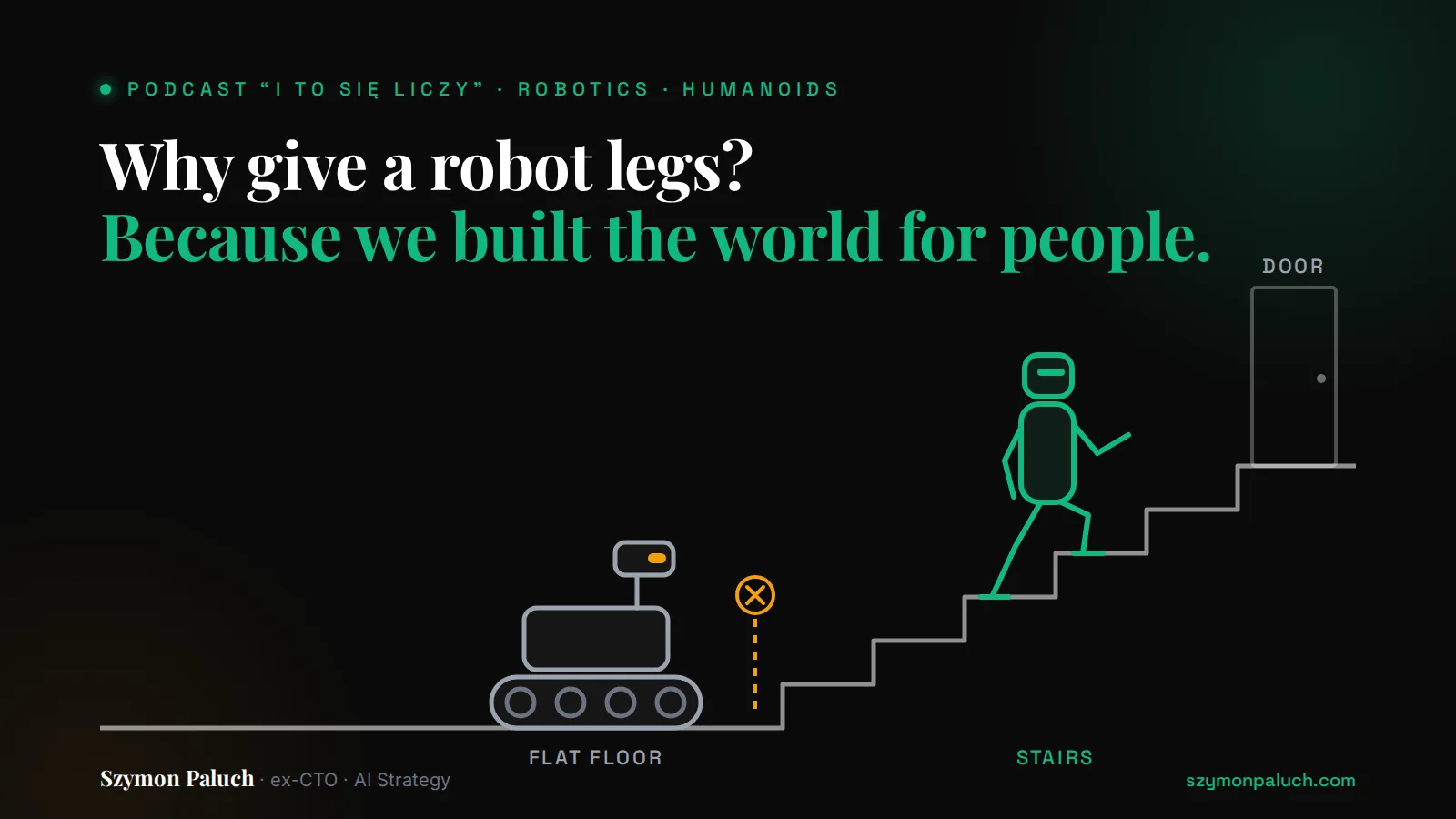
There is a lot of talk about whether a robot needs legs like ours. Maybe tracks are better: simpler, more efficient, they will not tip over. Everything is great as long as you have a simple, flat factory floor. Then stairs appear and the problem starts. Once again, it comes down to infrastructure.
Legs alone do not solve everything either. A humanoid on two legs will not get across every kind of terrain. A robot on four legs walks in the mountains and in forests and gets over a lot of obstacles. So a robot's shape follows from the route it has to cover.
Maybe decades from now various kinds of automation will make things happen on their own, and it will not be humanoids doing them. Adrian added that maybe we will start designing homes differently, and I agreed. Today, though, our infrastructure is adapted to people. We do not want to rebuild everything, because we do not have the time or the money for it. A humanoid is meant to automate exactly what would otherwise have to be rebuilt.
A humanoid instead of a robotic arm? Partly
In factories this is one of the main trends. An industrial robotic arm is expensive and specialised, and it stays in one place. The idea is to put a humanoid where a worker stands and, when needed, move it to another spot where it can also do something.
German factories have already started such tests. In February 2026 BMW announced a pilot of humanoid robots at its Leipzig plant, with the AEON robot made by Hexagon. It is to work on high-voltage battery assembly and in component manufacturing. BMW writes that AEON's human-like body lets a range of hands, grippers and scanning tools be attached, and lets it work dynamically on wheels.
Mercedes-Benz tested Apptronik's Apollo humanoids. In March 2025 heise reported that for about a year they had been working at the Berlin-Marienfelde plant and in Kecskemét, Hungary. There were fewer than ten of them. Workers taught them through teleoperation.
Humanoids in BMW and Mercedes plants, according to the sources
BMW, Leipzig
AEON (Hexagon), works on wheels
- Dec 2025
First test deployment at the plant - from Apr 2026
Further test deployment (planned) - from summer 2026
Actual pilot (planned): high-voltage batteries, components
BMW Group press release, 27 Feb 2026
Mercedes-Benz, Berlin-Marienfelde
Apollo (Apptronik)
- About a year of trials, also in Kecskemét, Hungary
- Fewer than 10 robots across both plants
- Test environment, taught through teleoperation
heise online, 19 Mar 2025
BMW moves in stages: first it assesses the robot on paper, then tests it in the lab and on the factory floor, and only at the end starts the actual pilot. Earlier, in 2025, the Figure 02 humanoid spent ten months supporting the production of more than 30,000 BMW X3s at the Spartanburg plant in the US. AI rollouts go a similar way, from discovery through proof of concept and pilot to scale.
Will the humanoid replace the arm? Partly, and certainly not every arm. Some arms are purpose-built and I think it will not replace them. BMW also describes humanoids as a complement to existing automation. It sees their potential especially in monotonous, physically demanding or safety-critical tasks.
This is what I do hands-on: advising on AI strategy and building agents that survive the demo.
Is thinking easier to teach a machine than walking?
Humanoids are at an early stage everywhere, not only in Poland. There are many reasons for that, above all the fact that the body itself is hard.
On the podcast I said that the large majority of our brain's work goes into running the body, and much less into abstract thinking. A number did come up, but I said right away that I did not want to give wrong numbers, so without a source I will not repeat it here. The roboticist Hans Moravec described a related observation in 1988. In his words, “it is comparatively easy to make computers exhibit adult level performance on intelligence tests or playing checkers, and difficult or impossible to give them the skills of a one-year-old when it comes to perception and mobility”. This is known as Moravec's paradox.
Moravec explained it with evolution. Large, highly evolved parts of the brain handle the senses and movement. A billion years of experience is encoded in them. Abstract thought is a new trick, perhaps less than 100,000 years old.
It is the same with robots. Artificial intelligence is developing well in software and does amazing things there. When you put it into a robot's body, the problems start. Balance alone is a very big problem today. We can do it and we have ways to do it.
Moravec's paradox is an observation. Arvind Narayanan points out that nobody has ever tested it empirically, and he finds the evolutionary explanation highly dubious. He also warns that telling ourselves robotics is a hard problem, so improvements will not happen overnight, is false comfort. A breakthrough can arrive suddenly.
The Agentic Architect
Practical patterns, case studies and AI news. Zero spam, once a week.
You'll get one email to confirm. Unsubscribe with one click. Privacy policy
Thousands of robots wobbling in simulation
How does a robot learn to move? In simulation, the robots first lie on the floor. They learn to get up and stay on their feet. You do not always have to start from zero. There are base models, open and closed, and you build on top of them.
It looks really funny. In the simulation you have, I don't know, a thousand or ten thousand robots standing. Each one tries to do something and wobbles in different directions until it succeeds. You see which ones are heading the right way and which are not, and you set the right quality gates. With agents a similar rule works: you fix the yardstick up front and keep only the changes that improve on it.
A 2021 paper by Nikita Rudin and co-authors shows the scale of such training well. They taught the four-legged robot ANYmal to walk using thousands of simulated robots in parallel, on a single GPU. The robot learned to walk on flat terrain in under four minutes, and on uneven terrain in 20 minutes. The authors then transferred the learned movement to the real robot.
The last step is a big problem. What the robot learned in simulation works in the digital world. You still have to load it into a real robot and check whether it does the same thing in the physical world. It often turns out that a lot of fixes are still needed.
Without AI, programming a robot like that would be impossible today, in my view. I cannot get the robot to do a somersault by steering each motor by hand, because it will fall over. The big growth of robotics in the last year or two is mainly thanks to artificial intelligence. AI is what unlocked these possibilities.
I am working on software that is meant to turn a video recording into a robot skill. Eventually from any video, though it does not work like that yet. I will describe it separately. I do not write its code by hand. In the team I work with on robots, agents often get tasks for the night, and in the morning we check what got in.
Robots will probably be slower than AI. Until it clicks
Robotics today is still very much at the lab stage. We are playing around a bit and looking a bit at what is already possible and what is not. It is not at the level where AI already is in everyday use.
With AI things went fast. With robots it may be a little slower. The hardware is more expensive. Ordering a robot is a whole logistics exercise. It has to fly in from the factory and then go through distribution. There may also be problems in the market for chips or microcontrollers, because that market shifts with the geopolitical situation.
That is why robots will probably not spread as fast as artificial intelligence did. Still, I think there is a good chance that in a few years, maybe not every one of us, but many of us will have our own assistant at home. Once it clicks, it will probably move fast. So it is probably worth watching what is already happening today.
SOURCES
- I to się liczy: conversation with Szymon Paluch (YouTube, in Polish, premiered 1 Oct 2026)
- BMW Group: BMW Group to deploy humanoid robots in production in Germany for the first time (27 Feb 2026)
- Hexagon Robotics: AEON
- heise online: Humanoid robots: Mercedes-Benz invests millions in Apptronik (19 Mar 2025)
- Wikipedia: Moravec's paradox (quoting Hans Moravec, Mind Children, 1988)
- Arvind Narayanan: Fact checking Moravec's paradox (29 Jan 2026)
- Rudin, Hoeller, Reist, Hutter: Learning to Walk in Minutes Using Massively Parallel Deep Reinforcement Learning (CoRL 2021)