I haven't written a line of code in two years. Agents write it
I haven't written a single line of code by hand in two years, and I produce a lot of code. Agents write it, mostly Claude Code and Codex, sometimes as a pair. In the team I work with, we often leave them tasks for the night, and in the morning we check what got in. Today not programming costs more than code that went the wrong way.
On the Polish podcast “I to się liczy”, Adrian Andrzejczyk asked me about a tool that shows what a workflow designed by an agent looked like. He wanted to know whether I wrote it myself or with AI. I answered that I haven't written a line of code in two years. This piece expands on that answer.
The full conversation, in Polish, is on YouTube. This part starts at 32:25.
This is the second piece from that conversation. In the first one I wrote about what Web3 left behind, where AI stands today and where robotics is heading.
Zero lines of code, a lot of code
For years I wrote code myself. I started with my own software houses, then came startups. A product I deployed ten years ago, written entirely by hand, has been running in a power plant ever since.
Today I don't program, and I produce a lot of code. Agents write it. While we were recording the episode, one of them kept writing something for me on a cloud server. My infrastructure is built so that something is always running.
The tool Adrian asked about is Workflow Studio. It was built the same way. It shows what a multi-agent Claude Code workflow actually did and lets you design a new one on a canvas.
The same way of working holds up with old code. Recently that power plant system needed a fix. I worked without network access, on local models. The agent rebuilt the environment and tested the fix. Only the finished, scripted solution went onto the server. That is a story for another time.
A year ago, senior engineers said: rarely even 50%
About a year before the recording I talked a lot with developers and data engineers. I did it for my own purposes. The sample was not representative, because these were people I know. The senior engineers all said the same thing. They would never let an agent write 100% of their code, and rarely even 50%. They wrote much of it by hand, because that way they would do it faster.
I argued with them. My argument was orchestrators and harnesses. They can check an agent's work step by step and bring it to a product of good quality. I covered how a harness differs from the model and what you swap along with an agentic CLI separately.
A measurement from that time painted a similar picture. The research organization METR ran an experiment on data from February to June 2025. 16 experienced open-source developers worked through 246 tasks in projects they knew well. With AI, mostly in the Cursor editor with Claude 3.5 and 3.7 Sonnet, they took 19% longer. Before the study they expected to cut their time by 24%. After it they still believed they had cut it by 20%.
In February 2026 METR described a second measurement. By its estimate, developers from the first study took on average 18% less time on tasks with AI, and new participants 4% less. METR thinks developers were likely more sped up by AI in early 2026 than in early 2025. It calls its own data, however, only very weak evidence of how much. Some developers no longer wanted to work without AI. Between 30 and 50% of participants told METR in a survey that they held back some tasks because they did not want to do them without AI. According to METR, the use of agentic tools such as Claude Code and Codex grew among open-source developers during 2025.
interval from +2% to +39%
interval from −38% to +9%
interval from −15% to +9%
Dot: result. Line: confidence interval reported by METR. Amber: first study, green: second measurement. METR itself treats the second measurement as very weak evidence of the size of the change, because some developers and tasks stayed out of the experiment. Source: METR, July 2025 and February 2026.
In METR's first study, developers worked with AI mostly in the Cursor editor. I mostly sit in the terminal, and the agent works on a server, even when I'm not watching.
This is what I do hands-on: advising on AI strategy and building agents that survive the demo.
Tasks for the night and the morning bin
With the team I work with on robots, the day often ends like this: around 4 or 5 pm we leave the agents a whole set of tasks for the night. In the morning we come in and look at what got implemented.
The night loop in the robotics team
4 or 5 pm
We leave the agents a set of tasks
Night
The agents implement
Morning
We look at what got delivered
Decision
It goes in or into the bin
Six months to a year ago
A large share of tasks fell away
Today
Most tasks get implemented
Six months to a year ago a large share of those tasks fell away. Something was implemented badly, or we had not thought something through ourselves. It still did not cost us. We would say: this goes in the bin, and this moved us forward. The two or three tasks that came out well saved us a day or two of pushing them.
Today most of the tasks we leave for the night get implemented. An agent can now work in the cloud while your laptop sleeps. I described what to settle before you leave it unsupervised overnight when I wrote about Codex in the cloud.
The Agentic Architect
Practical patterns, case studies and AI news. Zero spam, once a week.
You'll get one email to confirm. Unsubscribe with one click. Privacy policy
Not programming is the expensive part
The rules of the game have changed somewhat. Plenty of engineers who work with AI have written about it. You used to have to plan everything carefully, because code was expensive. Writing it took time, and developers were expensive. If the code came out bad, you burned money. The same went for code that was technically fine but rested on wrong business assumptions.
Today code is so cheap that burning money means not programming. Not programming costs more than programming even things that go the wrong way.
Cheap code does not excuse you from the morning review. If an agent also writes the tests overnight, a green run can be an empty signal. Whether such tests catch any bugs at all, mutation testing will tell you.
Claude Code and Codex as a pair, like pair programming
I'm deep in the terminal world, though that is changing now. My two tools are Claude Code from Anthropic and Codex from OpenAI.
I use them in turns. The models compete fairly fast, and sometimes one is better, sometimes the other. I try to stay agnostic. When something is better, I switch without sentiment. I also often work with both in parallel. Each has areas where it does better. I also use them to check each other.
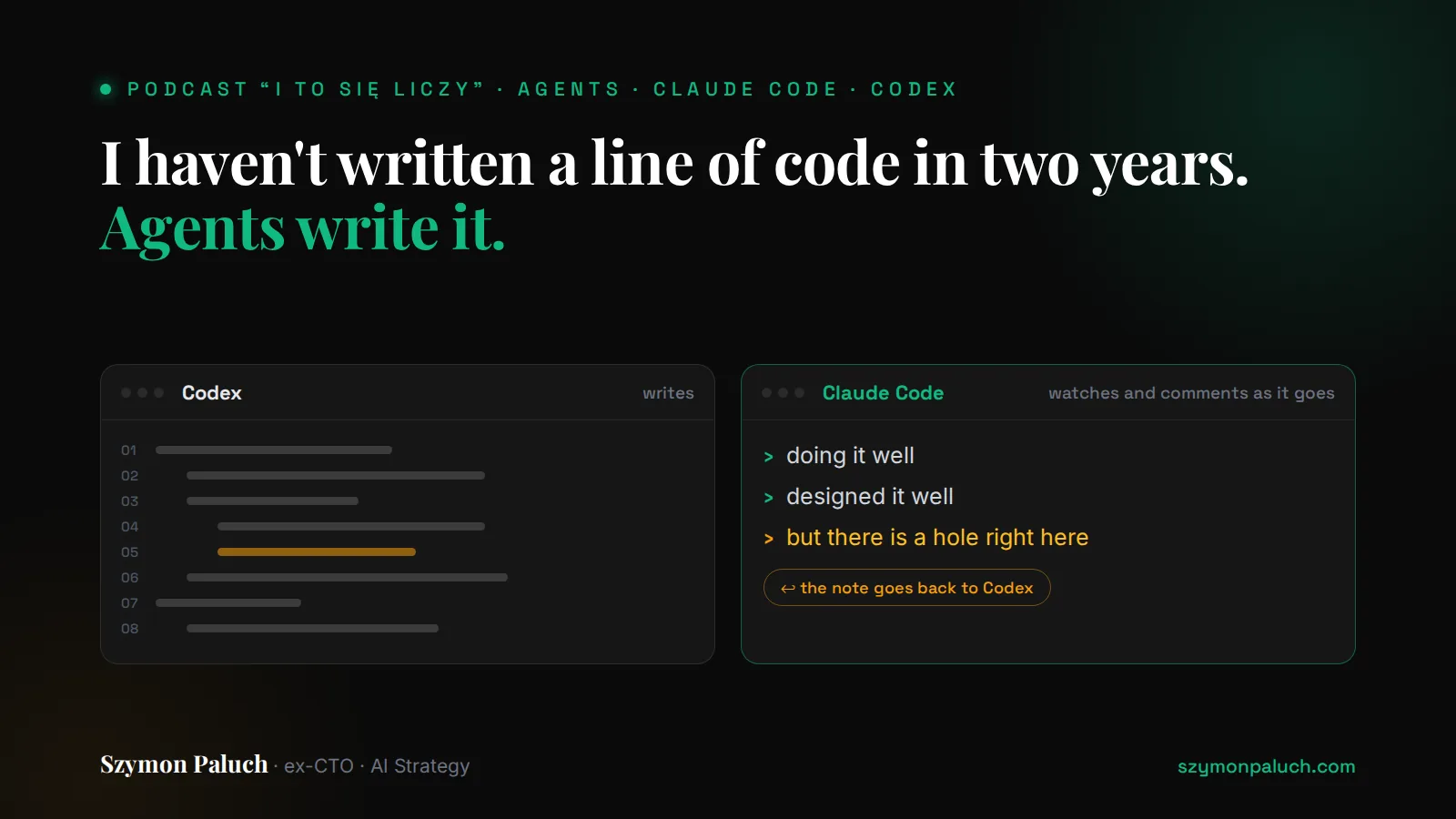
Recently one agent was working while the other got an instruction: watch what it is doing and comment as it goes. Codex was heading one way. Then Claude reported that Codex was doing it well and had designed it well, but had a hole right here. The note went straight back to Codex. It burned an awful lot of tokens, but it worked.
Anyone who has paired on code knows this setup. One person types, the other sits next to them, watches and suggests. That is exactly how I set up these two agents. On two different models, too, so each understood what was going on a little differently. The classic names for these roles are the driver and the navigator, as Birgitta Böckeler and Nina Siessegger describe them. The driver holds the keyboard and focuses on the step at hand. The navigator reviews the code as it is written and keeps an eye on the larger issues.
Orbit: the agent at hand, from my phone too
I built the third tool myself. It is called Orbit, and it runs agents. The agent programming for me right now sits in the cloud. Through Orbit I talk to it from my computer or my phone, by voice or by keyboard, and give it tasks.
I think that is enough. If the agent needs other tools, it picks them itself. Orbit is public on GitHub under the MIT license. You can install it by pasting one prompt into Claude Code or Codex.
Pick one task you keep putting off because it is not worth a day. Leave it to an agent overnight, and in the morning decide: it goes in or into the bin. If it lands in the bin, you have not lost a day of work.
SOURCES
- I to się liczy: conversation with Szymon Paluch (YouTube, in Polish, premiered 1 Oct 2026)
- METR: Measuring the Impact of Early-2025 AI on Experienced Open-Source Developer Productivity (10 Jul 2025)
- arXiv 2507.09089: the full METR study
- METR: We are Changing our Developer Productivity Experiment Design (24 Feb 2026)
- Birgitta Böckeler, Nina Siessegger: On Pair Programming (martinfowler.com, 15 Jan 2020)
- Anthropic: Claude Code overview
- OpenAI: Codex
- GitHub: Orbit