Web3, AI, robotics: what remains when the hype fades
Web3 left foundations behind, stablecoin payments for example, which Stripe and PayPal built into their products. Blockchain has come down to the level of a database that business does not need to think about. AI is going through the same cycle today, and robotics is where drones were a few years ago.
On the Polish podcast “I to się liczy”, host Adrian Andrzejczyk asked me what the Web3 hype and today's hype around AI agents have in common. This piece expands my answer and adds sources to what I said off the cuff.
The full conversation, in Polish, is on YouTube: 2 lata bez pisania kodu, od Web 3.0 do robotyki (two years without writing code, from Web 3.0 to robotics). The hype part starts at 3:47.
Flitting from flower to flower? One thread since 2016
Someone might say I flit from one trend to the next. First blockchain, then AI, now robots. From a distance it looks like chasing fashion. Up close I see one thread.
In 2016 I spoke at Noc Informatyka about Wit.ai and artificial intelligence for everyone. In 2018, at 4Developers, I showed how to write your own mini cryptocurrency in JavaScript. In 2022 I co-founded Web3 Festival. From 2023 to 2025 I led product strategy at Golem Network, a decentralized computing network. At the HardFork meetup in Kraków I talked about decentralized AI back then.
One thread: AI, blockchain, robotics
2016
Noc Informatyka: Wit.ai, artificial intelligence for everyone
2018
4Developers: your own mini cryptocurrency in JavaScript
2022
Web3 Festival: co-founder and host
2023 to 2025
Golem Network: product strategy for a decentralized compute network, a talk on decentralized AI at HardFork Meetup
2026
Next Block Expo: could an AI agent and a robot have stopped the Louvre theft; today agent deployments and robotics
Green: AI. Amber: blockchain and Web3.
In March 2026, at Next Block Expo, Arkadiusz Cybulski and I took apart one question. Could an AI agent and a robot have prevented the theft of the jewels from the Louvre? Today I work in consulting and implementation: AI agents and robotics. The common denominator has not changed. I check where a new technology delivers real value and where it is only overhype.
Hype is necessary, even when it grates
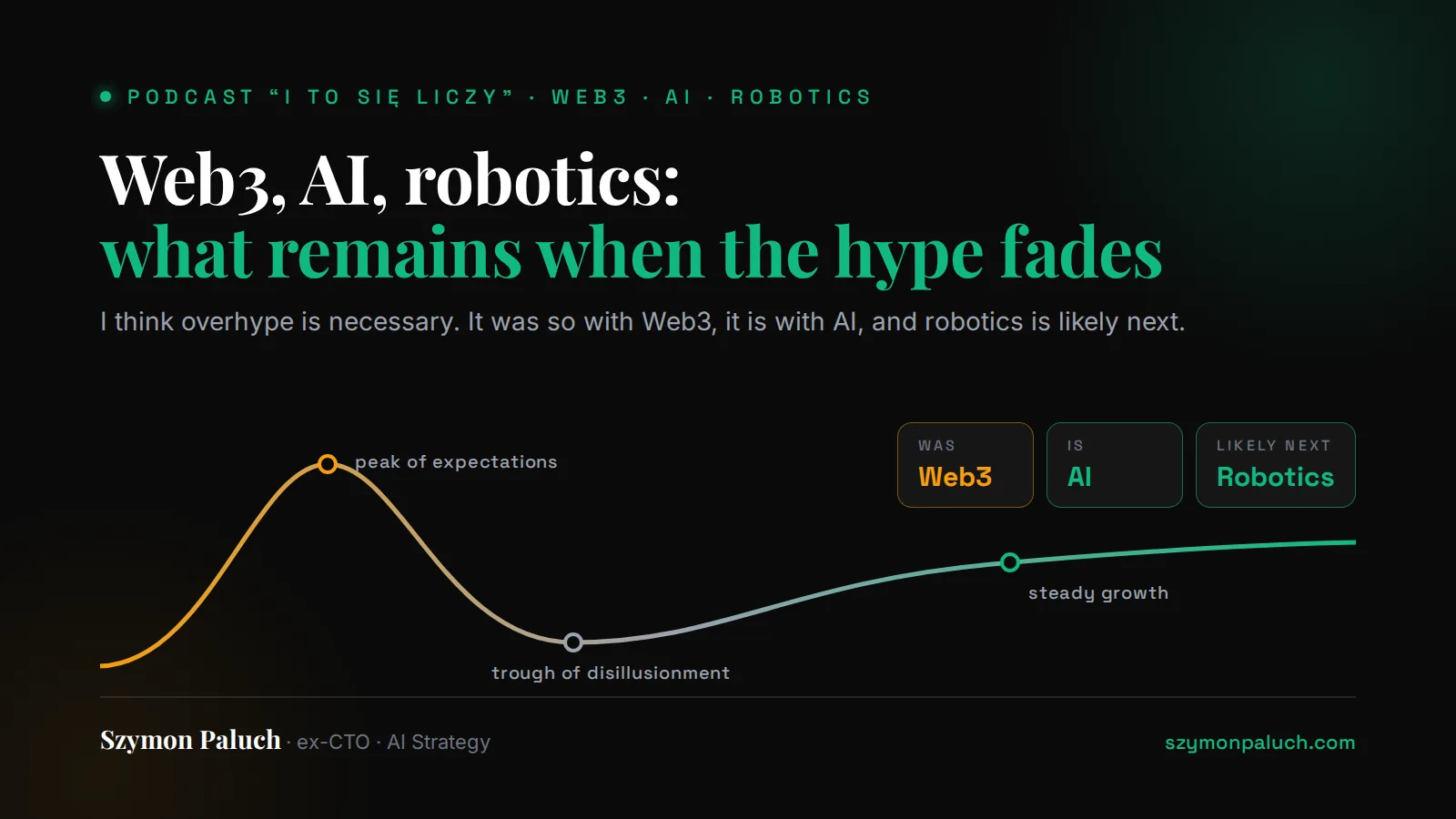
On the podcast I referred to the Gartner hype cycle. It was described in 1995 by Gartner analyst Jackie Fenn. The cycle has five phases: the trigger, the peak of inflated expectations, the trough of disillusionment, the slope of enlightenment and the plateau of productivity.
In practice it goes like this. A technology appears and everyone is thrilled. Expectations rise, and marketing rises with them. Often scams and hustles too. Then comes the letdown. It was supposed to be wonderful, and instead you fix things and do them by hand. Only after that does steady growth begin, along with an understanding of what the technology can really do.
You can complain about it. I still think overhype is necessary. Without it, a technology would not reach that many people. It would not reach the specialists who start building on it for real once the hype fades. That is how it went with Web3. That is how it goes with AI today. Soon it will probably go the same way with robotics.
Where AI sits on that curve in your company today is your call. I collected the numbers on the gap between an agent pilot and production in a separate piece.
What Web3 left behind: a database you do not need to know about
Web3 promised ownership of data. Today a photo posted to Instagram, X or LinkedIn lands on the servers of the company that runs the platform. That company can change it. GDPR gives us rights, but we use them through a form. Web3 wanted to guarantee the same thing with technology. I put something online, so it is mine. I can delete it, edit it and move it to another platform.
That turned out to be hard. Many companies had no interest in such mechanisms. The technical foundations stayed, though. Payments show them, for example.
In February 2025 Stripe completed its acquisition of Bridge, a stablecoin platform. A stablecoin is a cryptocurrency pegged to a traditional currency, the dollar for example. According to Stripe's documentation, a customer can now pay with a stablecoin such as USDC. The business receives the money in its Stripe balance in its local currency. Businesses in the European Union, Poland included, get access through a private preview.
In August 2023 PayPal launched its own stablecoin, PayPal USD. In November 2024 it announced that the first payout partners of its Xoom remittance service would settle cross-border transfers in PYUSD. Without the limits of traditional banking hours. On the podcast I said that the payment rails between banks stopped after hours, while a blockchain never sleeps. PayPal says the same thing in its own words.
That is why I say blockchain has come down to the level of a database. You know it is there somewhere and that it can be useful. As a shop owner you do not need to deal with it. Whether you need it is for your CTO or your software house to judge. That is the job of the translator between business and technology, the first of the CTO roles in the AI era.
An agent cannot open a bank account
This is where Web3 meets AI agents. More and more operations are done by agents instead of people. Such an agent cannot open a bank account for itself. You can give it access to your card. It will not open an account of its own.
That is why there are many experiments, and even deployments, in which agents settle with each other directly. Coinbase published x402, an open standard built on the HTTP 402 “Payment Required” status code. The agent sends a request and gets payment instructions in the response. It pays with a stablecoin and retries the request. No account to open and no form to fill in.
In July 2026 Coinbase handed the protocol to the x402 Foundation at the Linux Foundation. Its 40 members include Google, Mastercard, Stripe and Visa. The foundation already talks about payments from cards to stablecoins. In September 2025 Google announced AP2, a protocol for payments initiated by agents. It supports cards, stablecoins and real-time bank transfers. Together with Coinbase and other companies, Google extended AP2 and launched the A2A x402 extension for crypto payments by agents.
I feel the direction every day. Recently I was ordering LED profiles and strips. I asked an agent which shops it would recommend. The agent also drafted my request for quotes. When the offers came back by email, I had it compare them. For now I make the decision myself. The agent does the research and the comparison.
Before you give an agent access to your card, decide what an agent with access to money may do without your approval.
This is what I do hands-on: advising on AI strategy and building agents that survive the demo.
Golem: computing power without a giant data center
I worked where Web3 meets AI at Golem Network. Today AI runs in two worlds. The first is the large models from Google, Anthropic and OpenAI. They live in huge data centers. We send a request there, the model computes, and we get an answer. That is also where new models are made.
The second world is open models. Anyone can run such a model on their own graphics card. Then no data goes to a corporation. These models are weaker because they have less computing power. One example: in August 2025 OpenAI released the open-weight model gpt-oss-20b. According to the company, it runs on a device with 16 GB of memory. Want to use it at work? First check whether your tool lets you swap in a local model.
At Golem we wanted to build a network in which computers around the world connect and share their computing power. The aim was for ever stronger models to run without the big data centers of the largest players. Golem describes itself as an open-source, decentralized platform where everyone can use and share each other's computing power. The point was to make AI more accessible and less dependent on a handful of corporations.
On the podcast, though, I was asked whether we use a distributed network or a blockchain to train robots. I said not at the moment. The data is too big and too heavy. Training works best in one data center, with fast links between the graphics cards. That is why the big players win today.
The numbers show the scale of the gap. A graphics card with the latest generation of NVLink exchanges data with other cards at 3 TB/s. According to the August 2026 Speedtest Global Index, the median fixed internet connection in Poland gives 215 Mb/s down and 61 Mb/s up. Even counting one direction only, the difference is more than 30,000 times.
NVLink: bandwidth per card, both directions combined, according to NVIDIA. Internet: median from the Speedtest Global Index, fixed broadband in Poland, August 2026 edition (215 Mb/s and 61 Mb/s converted to GB/s). The most cautious comparison, one direction of 5th generation NVLink (900 GB/s) against the median download, gives more than 33,000 times.
This is a good example of what remains after the hype. You now know where the technology works and where it does not yet.
The Agentic Architect
Practical patterns, case studies and AI news. Zero spam, once a week.
You'll get one email to confirm. Unsubscribe with one click. Privacy policy
Robotics: a curiosity today, drones tomorrow
I got to robots through AI. It started with partners abroad, in Japan and the United States. Embodied AI, also called physical AI, was becoming more important. That is artificial intelligence that helps in the physical world, beyond digital operations. Concrete topics came up. How do you automate a patrol? How do you move heavy things? How do you clean?
In Poland people probably know this market mostly from Unitree robots. I had a robot dog of that brand at the recording. There is also Edward Warchocki, a humanoid built on the Unitree G1, who walks around Warsaw and talks with passers-by. Today such robots are mostly a curiosity. They show up, say hello, chat, entertain. Abroad, people are betting on them more and more.
A few years ago a drone was also a toy with a camera. Today it works. Polish police drone pilots flew more than 6,600 operations in 2025. Police use drones for searches, securing mass events and monitoring road traffic, among other things. I think robots will go the same way. In a few years some of us will have a home assistant that washes the dishes, does the laundry, vacuums and maybe even walks the dog. Along the way, robotics will probably go through the same hype cycle as Web3 and AI.
How not to burn money on the next wave
The acceleration is big, and probably almost nobody asks any more whether to invest in AI. It is worth doing deliberately. Buying employees access to ChatGPT and stopping there is not innovation. You can also burn money foolishly. Just hire a firm with the brief “implement AI for me” without knowing why yourself.
My order is simple. First get to know the technology inside the company and start using it. You will see what is possible today and what is not. Then bring in someone who lives this, from outside or from inside. Sit them down with an expert in your industry. I think that pairing gives the biggest acceleration today.
Before you sign a contract for an implementation, answer the first question: what specific problem are we solving. “We want to be innovative” is not an answer.
Take one task from your own week, a comparison of offers for example, and do it with an agent. You will learn more from the experiment than from reading about the next hype.
SOURCES
- I to się liczy: 2 lata bez pisania kodu, od Web 3.0 do robotyki (YouTube, Polish)
- Wikipedia: Gartner hype cycle
- Stripe: Stripe completes Bridge acquisition (Feb 4, 2025)
- Stripe Docs: Stablecoin payments
- PayPal: PayPal Launches U.S. Dollar Stablecoin (Aug 7, 2023)
- PayPal: PYUSD and Xoom (Nov 19, 2024)
- Coinbase: Introducing x402
- Linux Foundation: x402 Foundation launch (Jul 14, 2026)
- Google Cloud: Agent Payments Protocol (AP2) (Sep 16, 2025)
- Golem Network
- OpenAI: Introducing gpt-oss
- NVIDIA: NVLink
- Speedtest Global Index: Poland
- Benchmark.pl: Who is Edward Warchocki? (Polish)
- Dlapilota.pl: drones in the Polish police (May 29, 2026, Polish)