How to become a forward deployed engineer: five steps that match the job postings
Ship a system built on a large language model (LLM) that real users depend on. Learn discovery: sit with the people who do the work and agree what success means before you build. Build one end-to-end portfolio project in a realistic stack, with permissions, evals and a measured result. Structure your study of the model you build with. Then get client delivery experience, where the data, the tools and the acceptance criteria belong to someone else. Those five steps cover what current forward deployed engineer (FDE) postings ask for.
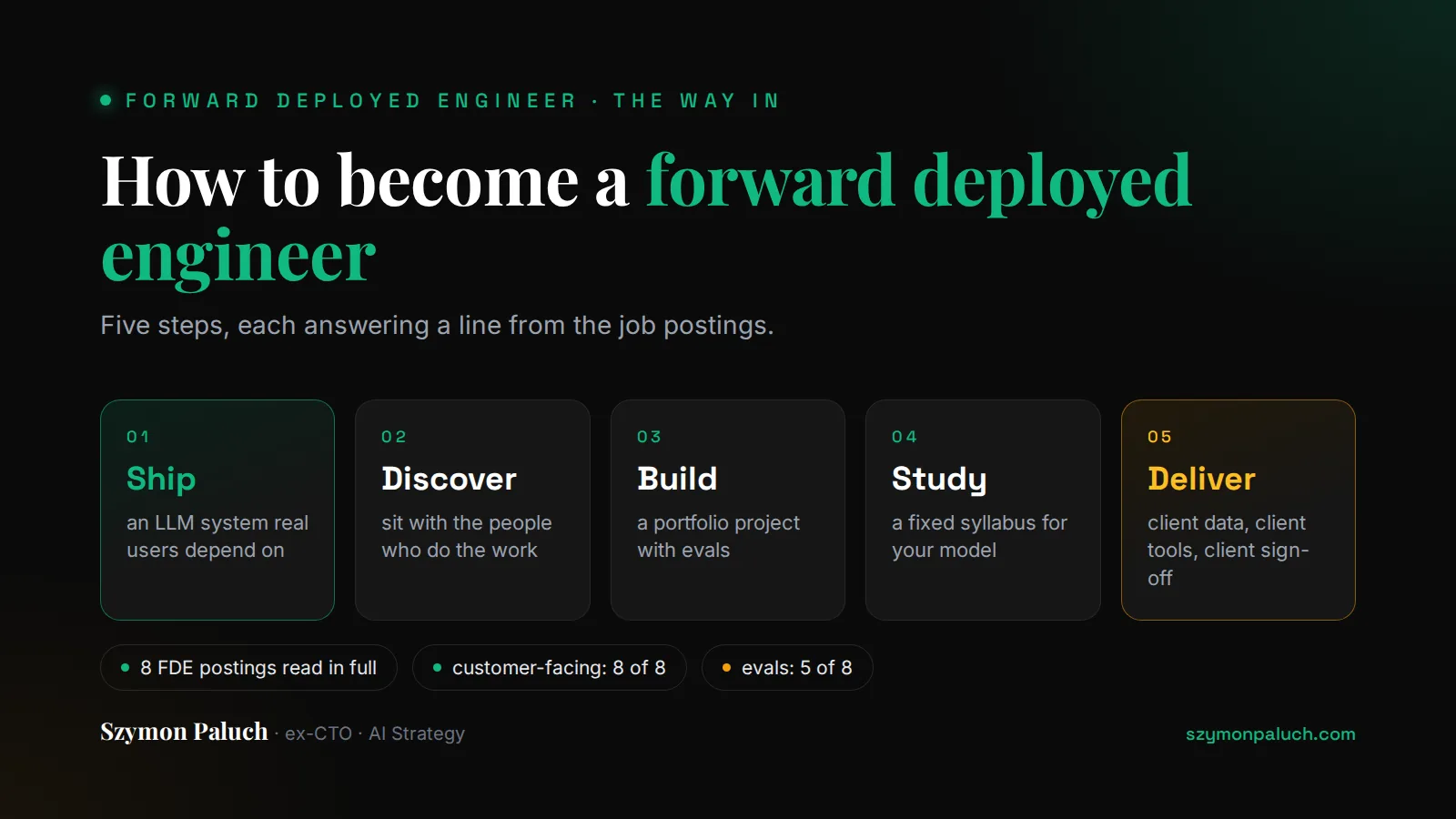
On 2 October 2026 we read eight live FDE postings in full, at Palantir, OpenAI, Anthropic, Scale AI, Ramp, Salesforce, Cohere and Google. We also scanned 220 forward deployed postings at the same eight employers for any certification they name. Each step below answers a line from those postings, and each one ends in something you can show an interviewer.
What FDE employers ask for, counted from eight postings
The table is our count from the eight postings, read on 2 October 2026. A skill counts when the posting names it as a duty, a requirement or a preference.
| What the posting names | Postings | Detail |
|---|---|---|
| Customer-facing work with stakeholders | 8 of 8 | Every posting |
| Owning delivery end to end, from prototype to production | 8 of 8 | Every posting |
| Python | 7 of 8 | Ramp names no language |
| LLM or agent experience asked of the candidate | 7 of 8 | Palantir mentions AI only in the duties |
| Travel | 7 of 8 | From 20% to 50% of the time |
| Agents, named explicitly | 5 of 8 | Anthropic, Ramp, Salesforce, Cohere, Google |
| Evaluations (evals) | 5 of 8 | OpenAI, Anthropic, Salesforce, Cohere, Google |
| A certification | 1 of 8 | Salesforce, its own platform certifications, as a nice-to-have |
The top two rows set the direction. All eight employers want an engineer who works with customers and owns delivery from the first prototype to production. The experience bar varies more. Palantir asks for one year after college, Ramp prefers three years, Salesforce asks for three, Anthropic for four, and OpenAI, Scale AI and Google for five. Cohere states no minimum.
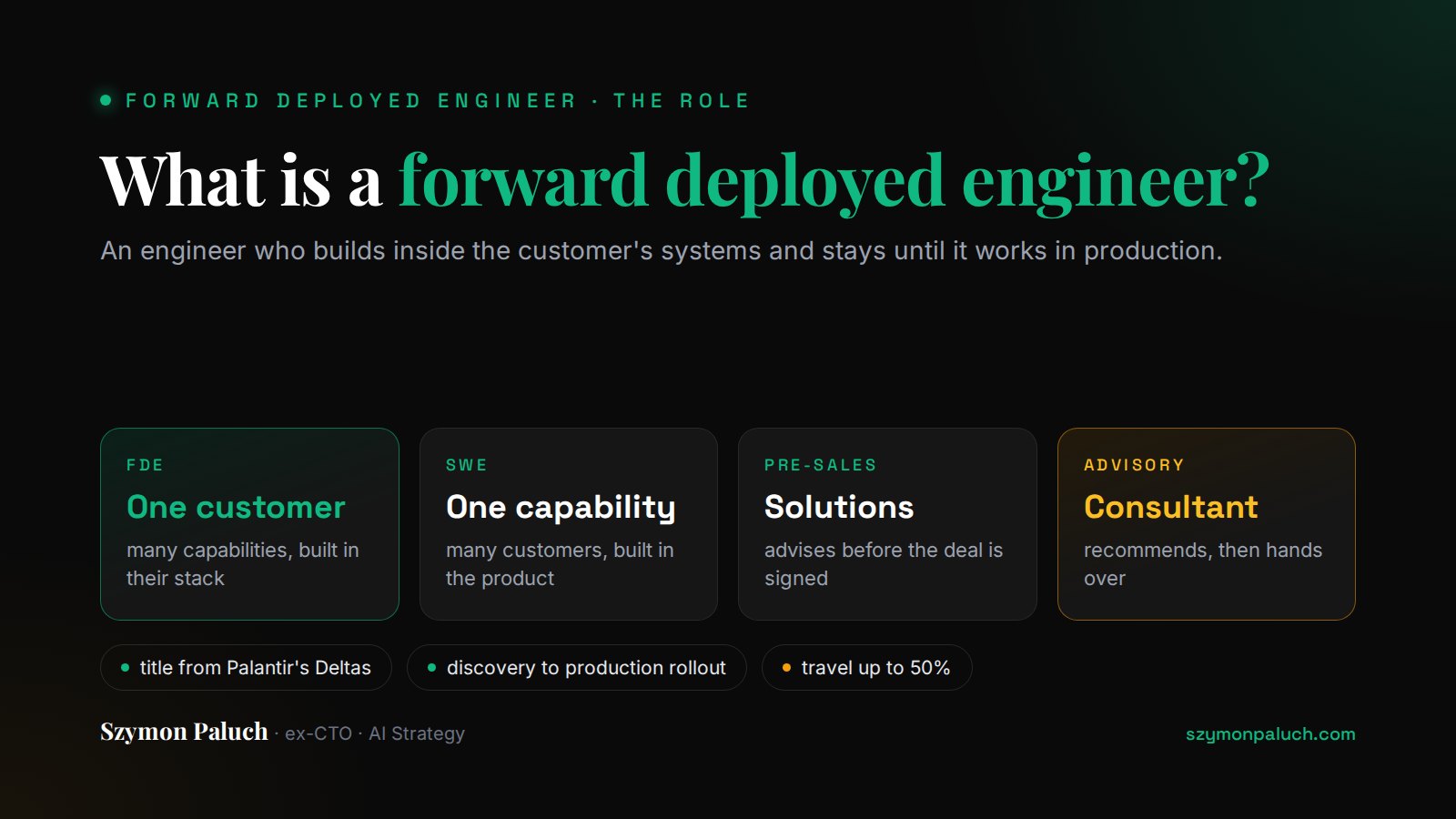
The title comes from Palantir, which still says it pioneered the position. If you first want the role itself, read how the job started at Palantir and what a forward deployed engineer does. This guide covers how you get there.
Search beyond the exact title. Ramp posts the job as Software Engineer, Forward Deployed. Palantir and Scale AI use Forward Deployed Software Engineer, and Google levels it as Forward Deployed Engineer III. Some AI companies use no FDE title at all: Sierra hires Software Engineer, Agent, and Decagon posts Agent Deployment Engineer. None of OpenAI's FDE-titled postings was located in India on 2 October 2026, but its Applied AI Engineer posting for Delhi, Mumbai and Bangalore lists forward-deployed engineering among the relevant backgrounds.
Step 1: ship an LLM system that real users depend on
Production experience is the line that repeats. OpenAI wants engineers who "have built or deployed systems powered by LLMs or generative models and understand how model behaviour affects product experience". Anthropic asks for "production experience with LLMs including advanced prompt engineering, agent development, evaluation frameworks, and deployment at scale". Salesforce puts it in the headline of its posting: "Production experience required. Builder mindset non-negotiable."
Start in the job you already have. A backend engineer can put a model behind an internal API. A data engineer can extract fields from documents the team still copies by hand. A QA engineer can generate test cases and measure how many survive review. A DevOps engineer can summarise and route alerts. A support or solutions engineer can draft ticket replies for a person to approve. The condition is the same for all of them: someone uses the output every week and notices when it breaks.
Backend experience carries over. Palantir calls its FDEs forward deployed software engineers (FDSEs), and its blog features one who joined in September 2020 after almost two years as a backend engineer at a Nigerian fintech company.
Then keep your system in production for a few months. Log every input and output. Write down each failure a user reports and the change you made. Track cost per request and latency. Salesforce asks candidates to "explain why a prompt failed and what you'd change". You answer that question well only from failures you have seen yourself.
If you can, make it an agent that calls tools. Five of the eight postings name agents, and Anthropic's London posting lists the deliverables: "MCP servers, sub-agents, and agent skills that will be used in production workflows". We describe what a forward deployed engineer builds and measures on LLM and agent projects in a separate article.
Step 2: learn discovery with the people who do the work
OpenAI's FDE posting lists the job in order: "You will own discovery, technical scoping, system design, build, and production rollout". Discovery comes first. Scale AI says it in plainer words: "You'll sit with the people whose problems you're solving". Ramp's engineering blog gives the FDE mantra as "always be scoping".
You can practise discovery now. Pick a team outside engineering: finance, operations or sales support. Ask to watch one person do a task for an hour. Write down each step, how long it takes, where they copy data between systems and where errors creep in. Then ask what a good week looks like and which part of the task they would trust a tool with.
Choose one process with high volume, text or documents as input, and mistakes a person can catch before they cost money. Write the success criteria before you write code: the share of cases the system handles without a person, the error rate the team accepts, and the cases where a person always takes over. Cohere's FDE posting describes the job as translating "high-value, ambiguous business problems into well-framed agentic workflows with clear success criteria and evaluation methodologies". Check your notes against that sentence.
Ramp's blog is direct about the people side: "Though previous experience in a customer-facing role helps, it's actually not necessary." It looks for another signal: "folks who have been instructors or teaching assistants (and actually enjoyed it)". If you have mentored juniors, run onboarding or taught a class, put it in your application.
Our collective of AI engineers works on client AI projects. A member whose profile fits a brief gets an offer to join, and every member can sit all four Claude certifications through our partner organisation.
Step 3: build a portfolio project an employer can assess
A notebook demo proves you can call an API. An FDE employer looks for delivery: a system in a realistic stack, the controls around it and a result someone measured. Build one project end to end and document it as if a client had commissioned it. It needs five parts.
- A realistic stack. Connect the model to the systems companies run: a database, a document store, a ticketing or CRM tool, a login. OpenAI describes the FDEs of its Deployment Company connecting models "to the customer's data, tools, controls, and business processes".
- Permissions. Decide what the system may read, what it may write and which actions need a person's approval. Cohere sets the bar for its agents: they "must be reliable, observable, safe, and auditable from day one".
- Evals. Build a golden set of realistic cases with expected answers. Run it as a regression suite on every change of prompt, model or tool. Scale AI's Frontier Agents Engineer posting, a role in its forward deployed engineering team, lists "golden datasets, regression suites, and LLM-as-a-Judge" among the evaluation harnesses to deploy.
- A measured result. Measure the process before and after on the same cases: time per case, error rate, share of cases handled without a person. Report what you observed, including the cases that still fail.
- A handover note. Write how to run the system, how to roll back to the previous version, how to spot a failure and who owns what after you leave.
Pick a domain you can explain in one sentence: invoices, support tickets, contracts or internal documentation. Use synthetic or public data and say so in the README. Never present a learning project as client work.
Put the evals and the measurement at the top of the README. Google's FDE III posting lists this among the duties: "Build high-performance evaluation (Eval) pipelines and observability frameworks to optimize agentic workloads". An interviewer who sees your golden set, your regression results and your open failures can judge the work without guessing what you did.
Step 4: structure your learning
Shipping teaches you what broke on your own project. Structured study fills the gaps around it: the model's API, tool use, context management, agent design and evaluation. Tie every topic to your portfolio project. When you study tool use, add a tool. When you study evaluation, extend the golden set.
A vendor certification is one way to give that study a fixed syllabus. Anthropic has four role-based Claude certifications, aimed at different kinds of work, and makes the exams available to members of the Claude Partner Network. We compared which Claude exam fits which kind of work, from business users to enterprise architects, so you can pick the one closest to what you build.
Treat it as learning. Of the 220 forward deployed postings we scanned on 2 October 2026, none names a Claude, Anthropic or OpenAI certification. Salesforce lists its own platform certifications in 55 of its 66 postings, one of which also prefers AWS, Google Cloud or Azure data or ML engineer certifications. One Palantir posting prefers security and Linux certifications. Employers hire on shipped work. Ramp's FDE team treats technical performance as "a bar to pass" and avoids optimizing it further. Clear the bar, then spend your time on delivery.
Step 5: get client delivery experience
This is the step most postings make explicit. Five of the eight ask for prior customer-facing experience. Salesforce makes customer-facing technical delivery in consulting, professional services or forward deployed engineering a hard requirement. Anthropic accepts "a Software Engineer with consulting or product experience" and encourages former technical founders to apply. Ramp's blog reported in August 2025 that 7 of its 16 FDEs were previous founders.
On a client project the data, the tools and the acceptance criteria belong to someone else. The client decides when the work is done. You negotiate scope, work with access you do not control and hand the system to a team that has to run it. Freelance projects, a systems integrator, a consultancy and a collective that takes client work all give you that experience.
Our collective of AI engineers staffs client AI projects. When a member's profile fits a client brief, the member gets an offer to join the team that delivers it.
Your first client project starts with a reply to a brief. Read how to answer a client brief and agree a focused first project before you send one. Inside a company, the same practice works with another department as the client, with its own sign-off.
Start this week. Pick one process in your company, book an hour with the person who runs it, and write three success criteria before you open your editor.
The Agentic Architect
Practical patterns, case studies and AI news. Zero spam, once a week.
You'll get one email to confirm. Unsubscribe with one click. Privacy policy
Frequently asked questions
Is there a forward deployed engineer course?
The postings do not ask for one. None of the eight FDE postings we read in full on 2 October 2026 mentions a course. They ask for production experience, customer-facing work and code. Anthropic announced its Claude Frontier Academy the same day, but participation is by employer nomination, and there FDE stands for Frontier Deployed Engineer. A course is worth your time when it ends with a project you ship and can show.
Do I need a certification to become a forward deployed engineer?
No. Of 220 forward deployed postings we scanned at eight employers on 2 October 2026, none names a Claude, Anthropic or OpenAI certification. Salesforce lists its own platform certifications, mostly as a nice-to-have. Employers hire on shipped work. A certification is useful as structured study of the model you build with.
Do I need customer-facing experience to become an FDE?
Five of the eight postings we read ask for it explicitly, and Salesforce makes it a requirement. Ramp's engineering blog says it helps but is not necessary, and counts teaching experience as a signal. If you have none, run discovery with a team in your own company and take one internal project through to sign-off.
How much experience do FDE postings ask for?
In the eight postings we read: one year after college at Palantir, three years at Ramp (preferred) and Salesforce, four at Anthropic, and five at OpenAI, Scale AI and Google. Cohere states no minimum. Palantir also hires new graduates and interns as forward deployed software engineers.
How much do forward deployed engineers travel?
Seven of the eight postings state travel, from 20% to 50% of the time. Ramp's posting states none.
SOURCES
- Palantir: Forward Deployed Software Engineer, New York (job posting, read 2 October 2026)
- Palantir: Forward Deployed Software Engineer, New Grad, Commercial, New York (job posting, read 2 October 2026)
- Palantir: Forward Deployed Software Engineer, Internship, Commercial, Chicago (job posting, read 2 October 2026)
- Palantir Blog: Who Wants to be a Delta? (21 October 2021)
- OpenAI: Forward Deployed Engineer (FDE), San Francisco (job posting, posted 11 September 2026)
- OpenAI: Applied AI Engineer, India (job posting, posted 3 August 2026)
- OpenAI: OpenAI launches the OpenAI Deployment Company (11 May 2026)
- Anthropic: Forward Deployed Engineer, London (job posting, first published 14 September 2026)
- Anthropic: Four role-based certifications for the people who put Claude to work for customers (23 July 2026)
- Anthropic: Anthropic invests $100 million to train 10,000 engineers and tackle the enterprise AI talent gap (2 October 2026)
- Scale AI: Forward Deployed Software Engineer, Public Sector (job posting, read 2 October 2026)
- Scale AI: Frontier Agents Engineer, Forward Deployed Engineering (job posting, first published 15 May 2026)
- Ramp: Software Engineer, Forward Deployed (job posting, posted 8 September 2026)
- Ramp Engineering Blog, Leo Mehr: Forward Deployed Engineering (5 August 2025)
- Salesforce: Forward Deployed Engineer (FDE), Mid/Senior Level, JR349466 (job posting, read 2 October 2026)
- Cohere: Forward Deployed Engineer, Agentic Platform (job posting, posted 1 September 2026)
- Google: Forward Deployed Engineer III, Google Cloud, Applied AI (job posting, read 2 October 2026)
- Sierra: job board (titles read 2 October 2026)
- Decagon: job board (titles read 2 October 2026)
- Certification count: forward deployed postings on the job boards of Palantir, OpenAI, Cohere, Scale AI, Anthropic, Ramp, Google and Salesforce, scanned 2 October 2026 (220 postings)