Forward deployed engineer certification: credentials and who issues them
Anthropic runs a program leading to a Claude Frontier Deployed Engineer badge. Here FDE stands for Frontier, and participation requires an organization’s nomination. It is separate from Claude exams and open courses. When choosing training, check the credential’s full name and how it is earned.
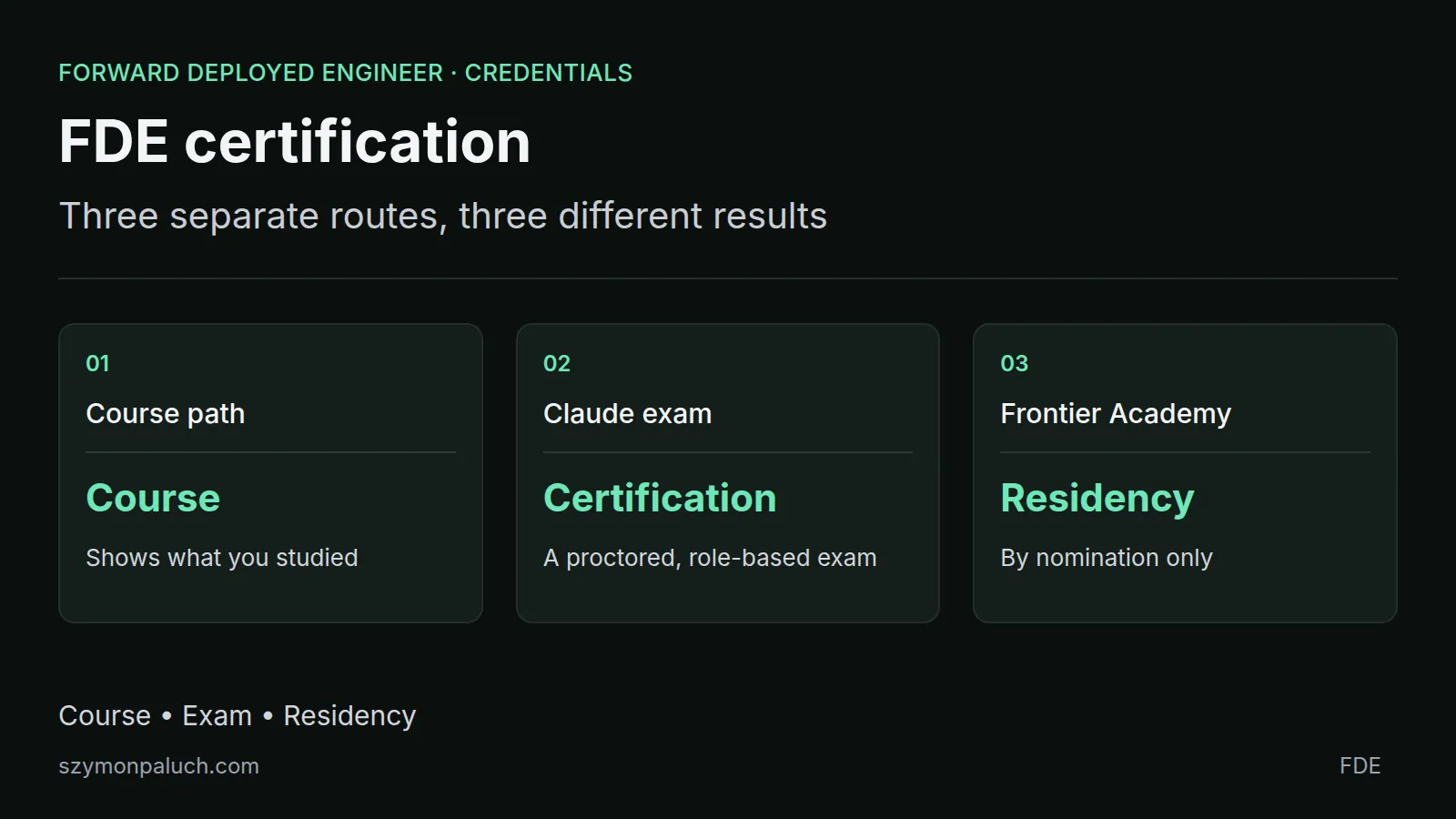
The phrase FDE certification combines several questions. Who issues the credential? How are skills assessed? Who can take part? Those answers make training offers comparable. The abbreviation alone does not.
I checked the names and access rules below against provider sources on November 2, 2026. The suggestions for choosing learning materials and describing them in a CV are my recommendations. I make no claim that a credential changes hiring outcomes.
Forward and Frontier mean different things here
Forward Deployed Engineer is a job title associated with customer deployment. I describe its scope through an engineer’s responsibilities inside customer systems. The job title itself identifies neither a certification issuer nor an assessment method.
In its Claude Frontier Academy announcement, Anthropic expands FDE as Frontier Deployed Engineer. Organizations nominate participants and ask their Anthropic account team or Partner Account Manager about eligibility. This is a specific program from one provider.
Partner Academy also lists a learning path called Claude Forward Deployed Engineer. On November 2, 2026, its page offered free registration and listed ten courses. It named neither a separate exam nor a badge for the whole path. This is a learning path, separate from the Frontier Deployed Engineer badge.
For a training offer using the letters FDE, I would look for its full name on the issuer’s site. Then I would check entry rules and the final assessment. A similar course title does not establish that the issuer awards the same credential.
How Claude Frontier Academy works
The official program page describes a four-day intensive. Participants spend three days in person building a Claude system for a simulated company. On the fourth day, they take a graded practical assessment on a new scenario. Passing earns the Claude Resident Engineer badge. Participants then lead a project in their own organization for 12 weeks. A final assessment leads to the Claude Frontier Deployed Engineer badge. Anthropic expects the first final badges in early 2027.
Before discussing a nomination, I would prepare a project description and name its owner within the company. I would add the time I can commit and the systems I need to access. The organization should confirm eligibility and dates with its Anthropic account team or partner manager.
Claude certification exams cover separate scopes
Anthropic lists four exams in its partner certification catalog: Associate Foundations, Developer Foundations, Architect Foundations and Architect Professional. Each has its own scope. Their names should not be replaced with FDE certification in a CV.
The catalog connects these exams to advisory, developer and architect work. You can choose based on the work you want to practise. For a particular exam, begin with its guide and topic list.
The comparison of the four exams’ coverage and requirements helps select one study path. An exam can provide a framework for checking your knowledge of Claude.
Open courses and completion badges
The Claude Academy FAQ describes free courses accessible with a personal Claude account. Completion badges depend on passing quizzes. Paid partner exams operate separately: Pearson delivers them, and credentials are issued through Credly.
In a learning record, I would keep the course name and a link to its badge. I would add a short account of the topic practised. That keeps the entry verifiable without adding broader claims of competence.
| Type of learning | What to record in a profile |
|---|---|
| Course | Exact course name, issuer and completion badge, if awarded. |
| Exam | The full name of the exam passed and a verification link. |
| Practical program | The badge earned and the stage completed under the issuer’s rules. |
| Independent study | Project topic, your contribution, tests and known limitations. |
Our collective of AI engineers works on client AI projects. A member whose profile fits a brief gets an offer to join, and every member can sit all four Claude certifications through our partner organisation.
Choose learning around a specific gap
I would start with a task that is currently difficult. It might be handling a tool error, choosing test data or understanding a customer’s requirements. Then I would select material that lets me practise that task. Finally, I would return to the project and check the change.
For example, a system writes an answer without a source when retrieval found nothing. The learning objective can be explicit handling of that outcome. A test should check that the system reports missing data and hands the case to a person. That is a concrete result regardless of the course selected.
A broader project plan appears in the guide to moving from study to a tested deployment and handover. It requires both code and a clear account of the user’s problem.
Our Certified AI Consultant Program is a separate collective offer. It includes preparation and exam access through a partner organization after admission and payment of membership. It does not sell entry to Frontier Academy or its badges. It also guarantees neither a job nor a project.
The Agentic Architect
Practical patterns, case studies, agentic projects taken apart and AI news. Zero spam, once a week.
You'll get one email to confirm. Unsubscribe with one click. Privacy policy
Describe progress without changing a badge’s meaning
In a CV, I would separate credentials already earned from studies in progress. If a credential names a specific exam, keep that name. For a course you have started, state that study is ongoing. A project example can sit alongside it with an account of your own contribution.
Before buying training, I would record the final credential’s full name and the issuer’s website. Then I would check the assessment method, access rules and what the fee includes. If the offer combines several stages, each needs its own answer.
Choose one task from your own project now. Add a study topic and a test that will show whether the problem has been resolved. The plan then ends with a result of your work that can be checked.