Updated
A robot dog at work: what it is good for and what it costs
A four-legged robot makes sense where the ground is uneven and where sending a person is dangerous. At the end of 2025 a Polish retailer sold the basic versions for PLN 12,000 and PLN 22,000. A robot that can take dust and water is in a completely different price bracket. What you pay depends on the job.
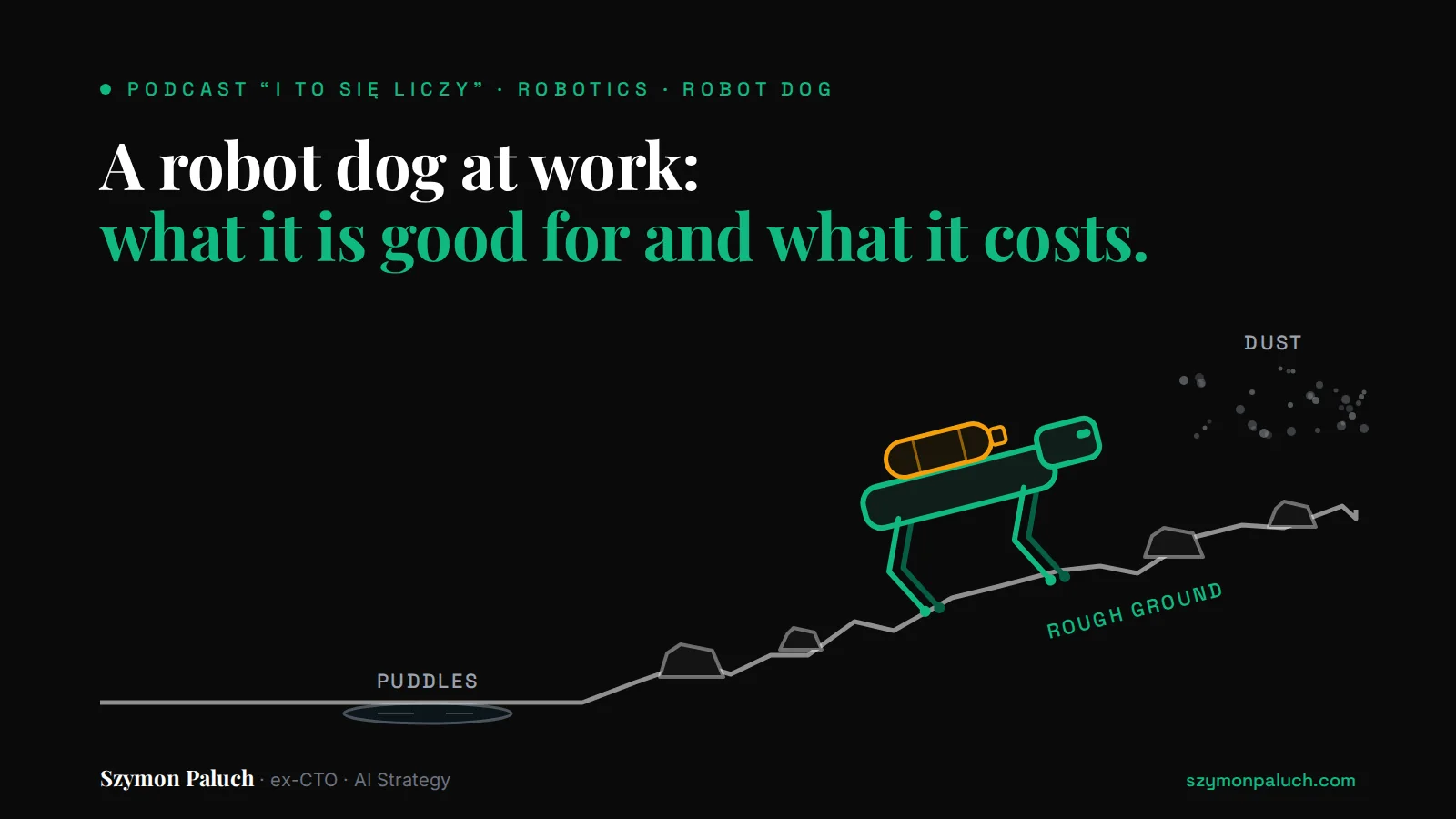
On the Polish podcast “I to się liczy” I had a Unitree robot dog with me, and the host, Adrian Andrzejczyk, asked what the robot can do and what it is actually useful for. Here I expand on my answer. The prices I check against sources.
The whole conversation, in Polish, is on YouTube. This part starts at 53:12.
This is the fourth piece from that conversation. In the previous one I wrote about why a humanoid gets legs and why tracks lose to stairs. This one is about a robot on four legs, which gets to places a humanoid cannot.
Uneven ground is its main strength
A robot dog can move around and walk. Its main strength is uneven ground. A humanoid on two legs will not get onto every kind of terrain, while a robot on four really does walk in the mountains and in forests, getting over a lot of obstacles on the way.
It can carry gas cylinders to mountain huts, for example, and if needed it will pull a cart with supplies or cables.
How much can it carry? That depends on the model. Unitree gives a payload of about 7 to 8 kg for the Go2, and more than 40 kg while walking for the larger B2.
A thermal camera, and places where lives are at risk
These robots come with a basic set of sensors that you can always extend, with a thermal camera for example. With one, the robot can go into a warehouse full of smoke and support the work of firefighters or the police. It can search for people in a forest, too. Of course you can do that with drones, but a drone cannot fly into every place.
Adrian added the arithmetic. If the robot gets damaged because something collapses on it, you lose equipment and the loss can be calculated, and you do not have the same moral obligation towards a robot as towards a person. So you can direct it to places where you would not send a person. I agreed that this is probably one of the more interesting uses: places where lives are genuinely at risk. You can safely send a robot like this into difficult areas and have it do all kinds of tasks there.
Unitree is heading that way. It shows the larger B2 in power and industrial inspection and in rescue work. On its fire rescue page it describes two B2 robots that joined the fire service in Qingdao.
Remote, phone or code
You can treat a robot dog as a platform that gets to a given place. Add an arm controlled by an operator, and suddenly it turns out the robot can do a great many things.
You control the dog itself with a remote, with an app on your phone, or programmatically, by connecting to the robot. The last option gives you the most control over what happens, because you can drive practically every motor separately.
An operator can also record a sequence of moves. At the end of the day, though, we want the robot to have repeatable actions loaded that I just trigger: now do a somersault. I could not do that by hand, motor by motor. The robot would fall over. It learns moves like that in simulation, with the help of AI.
The cheaper versions come with a catch. In Unitree's comparison table for the Go2 series, only the EDU version gets a full circle for secondary development, meaning your own software. The X, at $4,500 before tax and freight, gets a circle three-quarters filled, and the Air and Pro an empty one. The X and EDU ship with the remote, which is optional on the Air and Pro. Unitree does not list a price for the EDU on its site. It sends you to a sales expert.
This is what I do hands-on: advising on AI strategy and building agents that survive the demo.
What a robot dog costs
Adrian mentioned that in Poland you can now simply buy robots like this. That is true. At the end of 2025 Unitree robots arrived in the range of x-kom, a Polish electronics retailer. According to android.com.pl the cheapest was the Go2 Air at PLN 12,000, and the Go2 Pro cost PLN 22,000. Unitree lists these versions at $1,600 and $2,800 on its own site, excluding tax and freight.
So a basic version costs from twelve to a little over twenty thousand złoty. Beyond that, everything depends on the use.
One topic that came up for me was patrolling an aggregate quarry, where there is a lot of dust and there are puddles. There you need hardware sealed so that dust and particles do not get inside. Prices go up.
For the B2 Unitree gives an IP67 rating. In the IEC 60529 standard the 6 means dust-tight, and the 7 means the enclosure survives immersion down to one metre for 30 minutes. The Go2 product page gives no IP rating. The B2 with a 3D LiDAR cost between PLN 270,000 and PLN 349,000 at x-kom, twelve to sixteen times the price of the Go2 Pro.
Unitree robot prices at x-kom
thousand PLN, according to android.com.pl, November 2025
The solid bar is the low end of the range, the hatched part runs to the high end. Shop prices from November 2025; today they may differ.
android.com.pl, 25.11.2025
Go2 and B2: Unitree specs and x-kom prices
| Go2 Air | Go2 Pro | B2 | |
|---|---|---|---|
| Price at x-kom (Nov 2025) | PLN 12,000 | PLN 22,000 | PLN 270,000–349,000 (with 3D LiDAR) |
| Price on Unitree's site (excl. tax and freight) | $1,600 | $2,800 | not listed |
| Payload | about 7 kg | about 8 kg | over 40 kg while walking |
| Battery life | 1–2 h | 1–2 h | 4–6 h |
| Ingress protection | not listed | not listed | IP67 |
unitree.com/go2, unitree.com/b2; PLN prices: android.com.pl
The Agentic Architect
Practical patterns, case studies, agentic projects taken apart and AI news. Zero spam, once a week.
You'll get one email to confirm. Unsubscribe with one click. Privacy policy
A curiosity for now. Like drones once were
In Poland these robots are still mostly a curiosity: they show up, say hello, chat, entertain. Abroad, people are betting on them more and more. A few years ago drones were also a toy with a camera, and today they are starting to do real work, police work included.
The barrier to entry is higher here than in AI, because it is hard to play with a robot without a robot. You can try simulation. That costs money too, because you need graphics cards.
It is also hard today to plan a robotics rollout in a company from A to Z, because it is still early and everything is moving so fast. You have to set assumptions and start from them, but they may change while the work is under way. It is best to do smaller, shorter, faster rollouts and iterate, starting with a small experiment that shows which way to go next. I wrote separately about how an experiment moves through proof of concept and pilot to scale.
If you want to see robots like this in person, come to a robotics breakfast, which in a way I co-organise with my team in Warsaw. It takes place once a month and people come from all over Poland. You will see the robots and hear talks. Above all, you will meet people who work with robots every day. Adrian recommended these meetings especially to students of technical subjects.
SOURCES
- I to się liczy: conversation with Szymon Paluch (YouTube, in Polish, premiered 1 October 2026)
- Unitree: Go2, comparison table of the Air, Pro, X and EDU versions
- Unitree: B2
- Unitree: Fire Rescue Solutions (Qingdao fire service)
- android.com.pl: Polski sklep sprzedaje humanoidy i psy roboty. W tej cenie kupisz Porsche (in Polish, 25 November 2025)
- Wikipedia: IP code (IEC 60529)