OpenAI DevDay 2026: every announcement, and what it means
On 29 September 2026 OpenAI showed more than 20 launches in San Francisco. Three matter most for companies: dots, always-on agents that work around the clock, the cheaper GPT-6.1 Sol model, and computer use in the Agents API. Below is every announcement in keynote order, with times, and what it means if your company works under EU data rules.
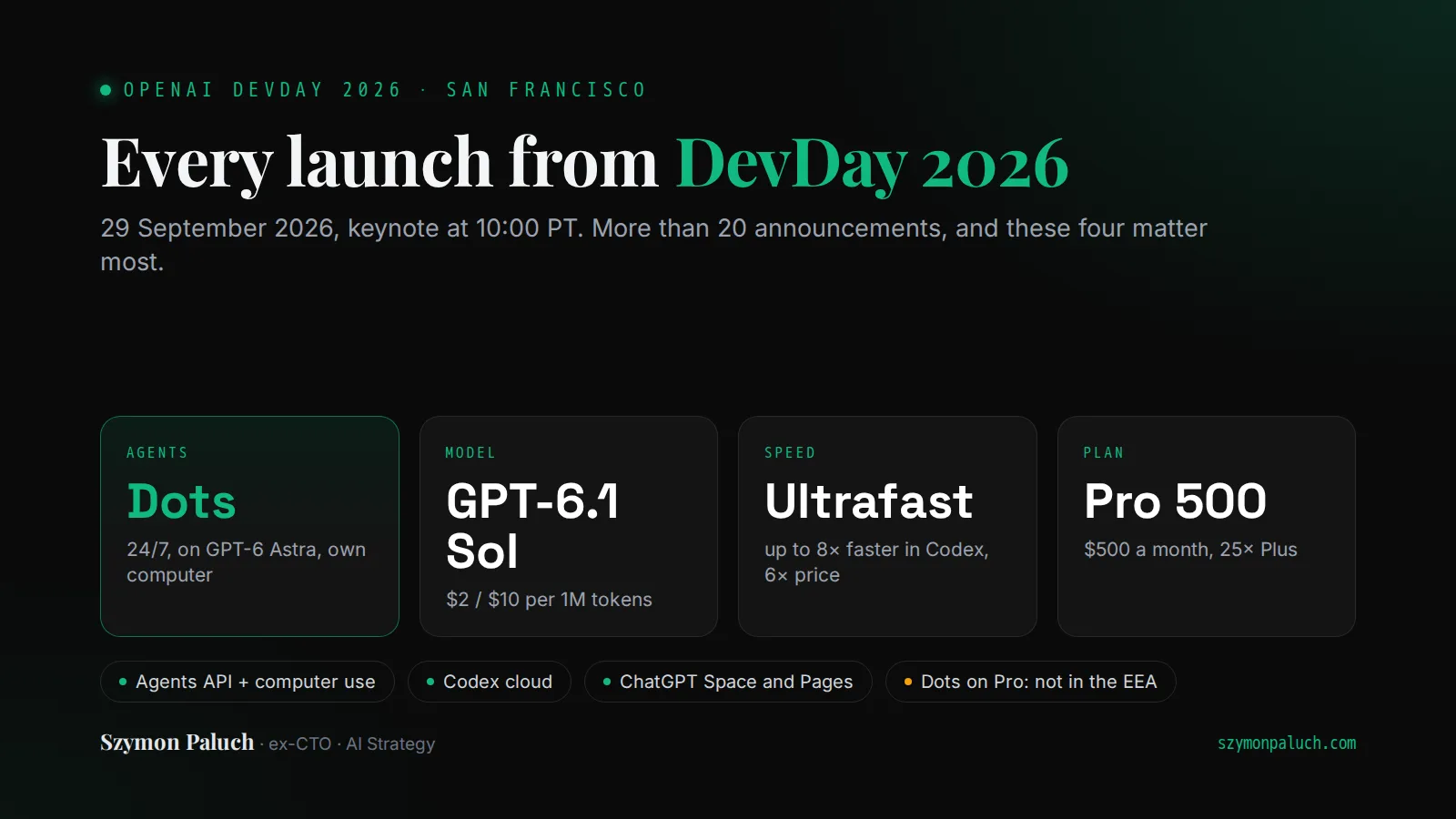
DevDay 2026 took place on Tuesday 29 September at Fort Mason in San Francisco. The keynote started at 10:00 Pacific time (19:00 in Central Europe). The recording runs 53 minutes. On stage were Sam Altman, Holly Li, Tejal Patwardhan and Romain Huet. OpenAI speaks of more than 20 announcements. I counted 25 items in five sections of the official recap.
Treat this post as a map. Each launch gets a short description and a link to a separate article where the topic deserves one. I checked the facts against OpenAI's own sources, and the order of the keynote against live coverage. Where OpenAI says two different things, I say so.
The 30-second version
1.2B
weekly ChatGPT users, according to OpenAI
20+
announcements in one keynote
1/5
of Astra's price is what GPT-6.1 Sol costs
$500
a month for the new Pro 500 plan
AGENTS
Dots: ChatGPT agents that work 24/7
Who gets them and where they work
MODELS AND PRICING
GPT-6.1 Sol, Ultrafast and Pro 500
API and plan pricing after DevDay
API
Agents API, computer use and Decisions API
Codex's harness as a service
CODEX
Codex cloud, the new CLI and code review
What changes when you work with a coding agent
CHATGPT FOR BUSINESS
Space, Pages, plugins and Private Intelligence
What to switch on first, and what about GDPR
AI CONSULTANTS
Where the work will be for consultants after DevDay
An OpenAI partner's view
If you only have time for one sentence: OpenAI is moving ChatGPT from chat to work that an agent does on its own, on its own cloud computer. The other launches are tools around that shift. A cheaper model lowers the cost of such work, paid speed cuts the waiting, and the API lets you build a similar agent yourself.
The keynote minute by minute (Central European time)
The recording on OpenAI's channel has no chapters. I rebuilt the order and the times from two independent live logs: Simon Willison, who was in the room, and Engadget. Where they differ, I give the earlier time.
- 19:01 Sam Altman takes the stage. Behind him, a graphic with 1.2 billion weekly users.
- 19:03 Dots, agents that are always on. Each has its own cloud computer.
- 19:09 ChatGPT Space, a shared place for a team and its agents.
- 19:10 Holly Li's demo with a dot called "Dottie". One task stalled live.
- 19:19 Specialist dots for enterprises and an integration with Microsoft Agent 365.
- 19:21 GPT-6.1 Sol: near-Astra level at a fifth of the price.
- 19:22 Ultrafast, a paid speed tier for GPT-6 Astra.
- 19:23 The Pro 500 plan, and Pro 200 back on sale for new subscribers.
- 19:24 Decisions API on the Luna model.
- 19:25 Tejal Patwardhan on how models speed up research at OpenAI.
- 19:29 Codex in the cloud and the open-source Codex harness.
- 19:30 Codex Security Cloud.
- 19:31 Computer use in the Agents API, and agents in AWS (Bedrock Managed Agents).
- 19:32 OpenAI Private Intelligence.
- 19:33 Romain Huet's demos: Ultrafast, Codex, computer use, a Hugging Face robot.
- 19:46 Sign in with ChatGPT. Altman says the 1.2 billion figure out loud.
- 19:47 Plugin extensions, sharing Sites, and OpenAI Marketplace.
- 19:51 Keynote over.
One correction to some early write-ups. At the opening, both live logs record the 1.2 billion figure only on screen, as Altman walked on. They record him saying it out loud only in the 46th minute, during Sign in with ChatGPT.
Dots: agents that work around the clock
A dot is an agent in ChatGPT that never stops. It runs on GPT-6 Astra and has its own cloud computer with a browser. It reaches more than 4,000 apps through plugins. You message it in ChatGPT, Slack and Teams, or you call it. It learns from your feedback and, in the background, reads the apps you connected, in read-only mode.
There is a catch in Europe. At launch OpenAI excluded Pro users in the European Economic Area, Switzerland and the UK. Business Premium, a seat in the Business plan at $125 a month, works in every region ChatGPT supports. Your first dot is included in the plan, and more dots are promised later, with no price yet. I wrote up separately what a dot does alone, what it waits for your approval on, and who can get one.
Designing or deploying agents for clients? In our collective of AI consultants you prepare for AI vendor partner certifications and learn with other consultants. When a suitable client brief arrives, we may invite you to a project.
GPT-6.1 Sol, Ultrafast and Pro 500
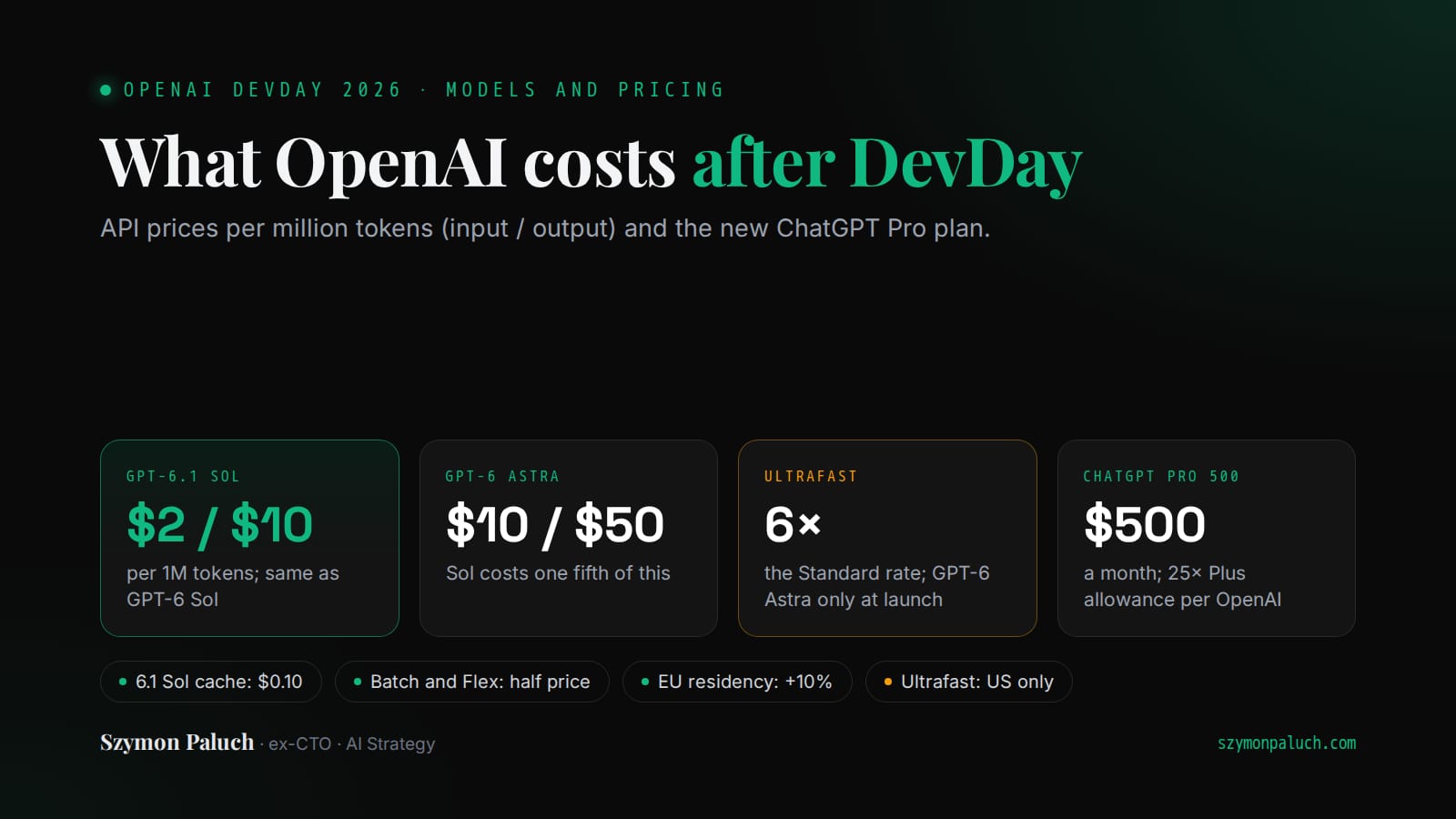
GPT-6.1 Sol costs $2 per million input tokens and $10 per million output tokens in the API. OpenAI says it nearly matches GPT-6 Astra on agentic coding, computer use and professional work. The one-fifth claim is a comparison with Astra. Against GPT-6 Sol from a week earlier, only cached input got cheaper, from $0.20 to $0.10. In ChatGPT the new model is in ChatGPT Work and Codex for now. It is not in regular chat yet.
Ultrafast is a paid speed tier. For now it works only with GPT-6 Astra and costs six times the standard price. According to OpenAI, tokens come out up to 8 times faster in Codex, which is 300 per second. In the API it is up to 6 times faster according to the announcement, although the API docs say 8 times. The new Pro 500 plan costs $500 a month and gives 25 times the Plus allowance. It is the only plan with Ultrafast included. I worked out when the pricier Ultrafast tier pays for itself.
Codex and the API: the harness as a service
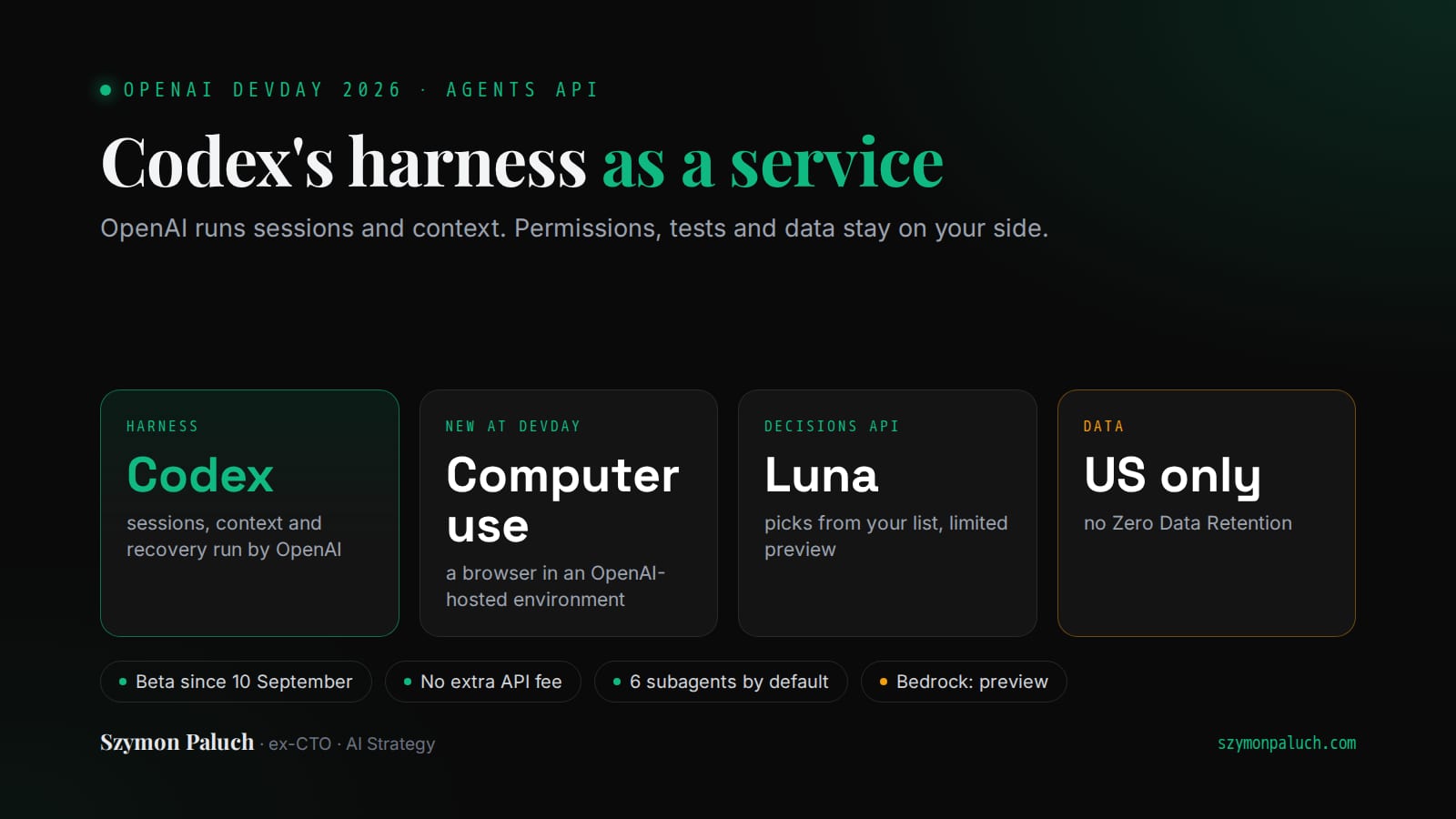
The Agents API has been in public beta since 10 September. It gives your application the Codex harness, managed by OpenAI. OpenAI runs the sessions, compacts the context and recovers after errors. DevDay added computer use: the agent clicks through a browser hosted by OpenAI. There is no extra fee; you pay for tokens, tools and the container. The Agents API, however, supports only US data residency and no Zero Data Retention. I described which jobs the harness takes off your team and which stay on your side.
The Decisions API is the Luna model narrowed to questions with predefined answers. It classifies content, routes requests and picks an agent's next step. It is in limited preview, with no docs and no price. Bedrock Managed Agents is a joint product with Amazon: the OpenAI harness and the model run in AWS. AWS announced it back in April and still labels it a preview.
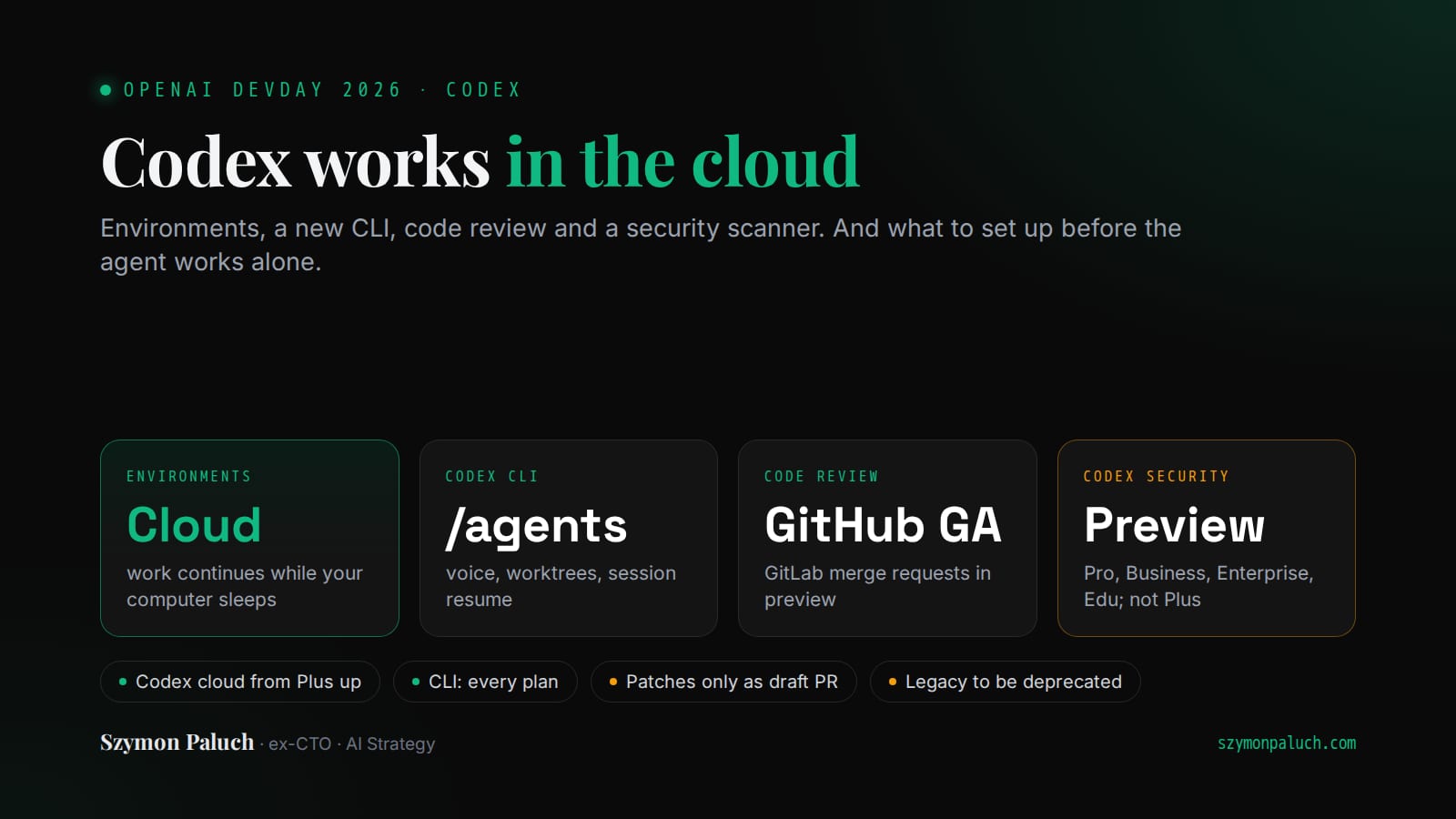
Codex got new cloud environments, shared by the team, with your repositories and dependencies. A task keeps going while your laptop sleeps. The CLI now takes voice commands and has an /agents view where you track many tasks. Code review in the ChatGPT app supports GitHub, and GitLab is in preview. Codex Security Cloud scans repositories and prepares fixes, but it does not apply them on its own. I listed what a team has to set up before it lets an agent into a repository unsupervised.
ChatGPT at work: Space, Pages, plugins and privacy
ChatGPT Space is a shared place to work for a team, ChatGPT and dots. Pages are a new kind of document that people and agents write together: text, research, charts and images. Collaborative slides are due in the coming weeks, spreadsheets soon, with no date. There are also teams with shared tasks, @ChatGPT in Slack and Teams, and a plugin that takes meeting notes.
Plugins got a home of their own in the interface. They can have a sidebar panel, an interactive view next to the conversation, and a file viewer. MCP Events lets a plugin start an automation when something changes in a connected app. Sign in with ChatGPT lets you use your Plus or Pro allowance in 16 partner tools, including Devin, Notion and Vercel. OpenAI Marketplace will let large customers put part of their OpenAI commitment toward software from one of 32 launch partners. For now they can register interest.
OpenAI Private Intelligence has two parts. The first is Zero Data Retention with Private Safety Processing: safety review runs automatically and OpenAI staff do not see the content. It is an API mode, rolling out in phases since 22 September, and only for organisations already approved for Zero Data Retention. The second is Private Inference. It is a preview announced for this fall, built on confidential computing. For a European company every one of these features starts with the same question: where does the data go. I checked which of these features to switch on in a team first, and how they sit with GDPR.
The Agentic Architect
Practical patterns, case studies and AI news. Zero spam, once a week.
You'll get one email to confirm. Unsubscribe with one click. Privacy policy
What it means for companies in the EU
Availability first. A dot on the Pro plan does not work in the EU at launch. Business Premium does, because OpenAI offers it in every country ChatGPT supports, and EU countries such as Poland are on that list. Prices are in US dollars. OpenAI notes they may vary by country and currency.
Then data. GPT-6.1 Sol can keep data in the EU, at a 10% surcharge. Ultrafast works only with US or global processing. The Agents API also supports only US data residency and has no Zero Data Retention. In ChatGPT itself, only the Enterprise and Edu plans keep data in the EU. Space, Pages and Meetings are not on the list of data that stays there. If your company requires processing in the EU, Ultrafast and the Agents API are out from the start. Check this before the project. After the pilot it is too late.
Finally, people. An agent that works alone all night needs someone to set its permissions, rules and oversight. That is work for AI architects and consultants. I wrote separately about the client work DevDay opens up for AI consultants.
I write this from the position of a company that has held OpenAI Select Partner status since 24 September. Everything above comes from public sources. I explained what the first of the three OpenAI partner tiers is and what a client can expect from it.
Sessions beyond the keynote
Only the keynote was streamed live. OpenAI said the other sessions would be posted on openai.com after the event, but on 29 September they were not up yet. There is no public agenda either. I found two public write-ups from the rooms, both from Simon Willison, and both matter to architects.
The first session was about ChatGPT Sites. According to the speakers, Sites already hosts 8 million sites. A site gets an SQLite database and scheduled tasks. Since DevDay it can also use the visitor's plugins and show them their own data. Katia Gil Guzman talked about WebMCP and how much more efficient it is than clicking through computer use.
The second session covered Codex Security. A quarter of OpenAI's product engineers took part in an internal sprint. On the first day they fixed 53 critical security findings. 36% of the findings turned out to be duplicates, so deduplication moved into the CLI. The verify-fix command runs a second agent against a fix. According to the speakers, this keeps the rollback rate at 1%.
In the research part of the keynote, OpenAI returned to its report of 6 September. In it the company announced an automated research intern: a system that, under human direction, does tasks that would take a researcher a few days. The same report admits that more than half of the successful tasks that would take a person 4 to 8 hours needed at least one intervention. I covered the wider story around OpenAI's AI Futures blog. Its question is who holds power when AI stops needing people.
If you want to see DevDay up close, OpenAI runs DevDay Exchanges in eight cities. The European ones are Berlin on 26 October, Paris on 28 October and London on 3 November, with entry by application. Before you go, list three processes an agent could run on its own. For each one, check whether the data may leave the EU.
Sources and fact-check date
- OpenAI: DevDay 2026 recap
- Keynote recording on OpenAI's channel (53:35)
- OpenAI: Introducing dots
- OpenAI API pricing
- DevDay 2026 event page
- Simon Willison's live blog
As of 29 September 2026. Quotes from the stage come from live coverage, not from the recording.
Frequently asked questions
When was OpenAI DevDay 2026?
On Tuesday 29 September 2026 at Fort Mason in San Francisco. The keynote started at 10:00 Pacific time, which is 19:00 in Central Europe. The recording runs 53 minutes.
What did OpenAI announce at DevDay 2026?
More than 20 launches. The biggest are dots, always-on agents, the GPT-6.1 Sol model, the paid Ultrafast tier, the Pro 500 plan, computer use in the Agents API, Codex in the cloud, ChatGPT Space with Pages documents, and OpenAI Private Intelligence.
Are dots available in the EU?
Not on the Pro plan: at launch OpenAI excluded the European Economic Area, Switzerland and the UK. On Business Premium yes, because that plan works in every country ChatGPT supports, EU countries included.
How much does GPT-6.1 Sol cost?
In the API, $2 per million input tokens, $0.10 per million cached input tokens and $10 per million output tokens. For input and output that is a fifth of GPT-6 Astra's price.
Where can I watch the DevDay 2026 keynote?
On OpenAI's YouTube channel, under the title OpenAI DevDay 2026 Keynote (FULL). The recording runs 53 minutes and 35 seconds.