AI Futures: OpenAI asks who holds power when AI stops needing people
On 20 August 2026 OpenAI launched a blog called AI Futures. Its first post asks a question that is genuinely important and genuinely hard: power has always rested on people who could refuse, and AI may remove that dependence. The argument is good. It is also not new, a competitor published it seven months earlier and went further, and the one citation in the text leads back to OpenAI.
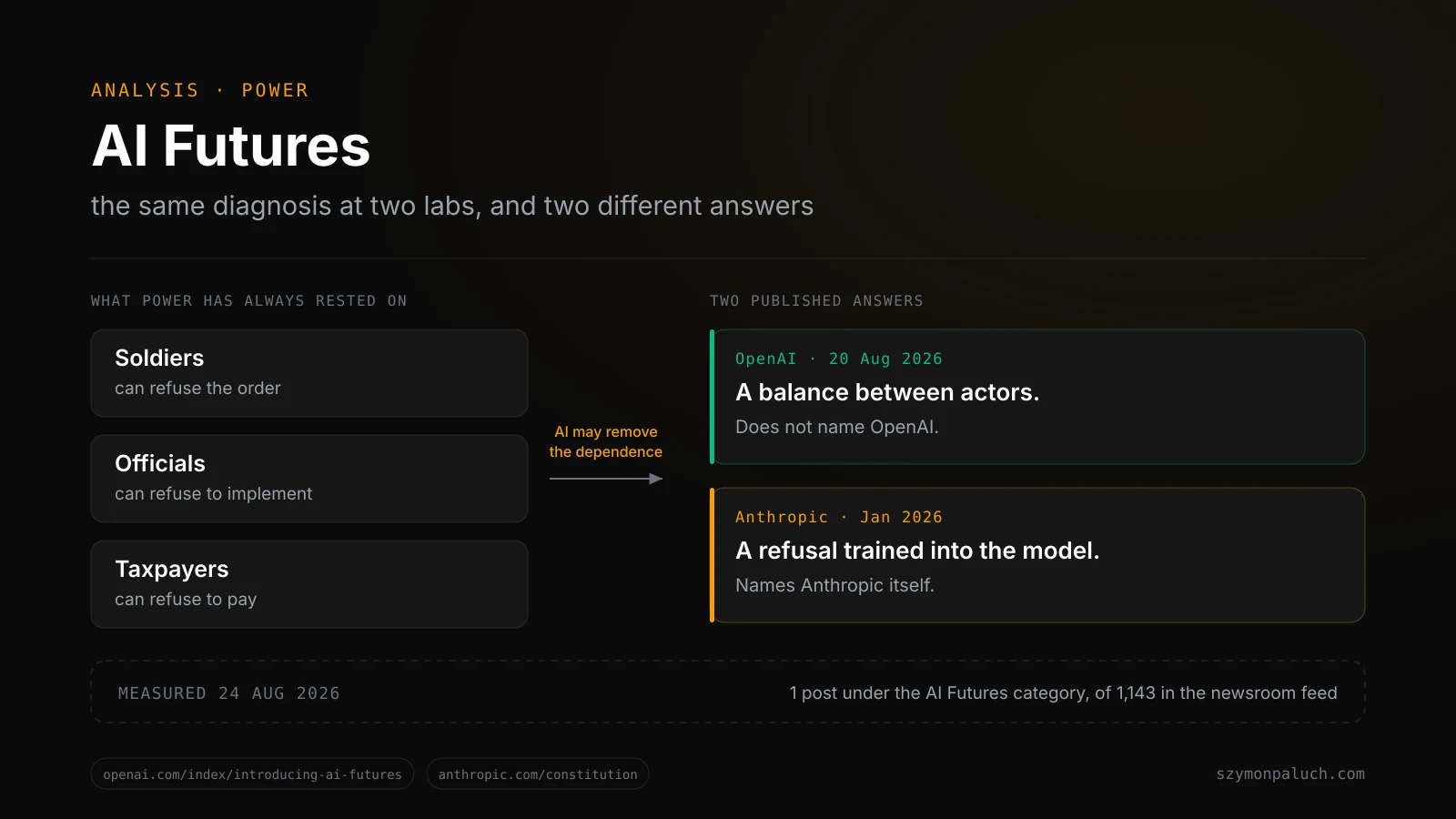
OpenAI's new blog opens on a single argument. Through all of history power has needed soldiers to carry out the order, officials to implement the decision, and taxpayers to fund it. Each of those groups could refuse, and that was a real constraint. AI may remove it. The argument is good and it holds up in the original. What remains is who published it, and in what week.
This is about a document, not about people. Everything below comes from published sources and every one of them can be opened. Where I could not confirm something, I say so.
What was actually announced
On 20 August 2026 OpenAI published "Introducing AI Futures". It is the launch of a blog belonging to a new team called Strategic Futures. The author is Dean Ball. He was previously Senior Policy Advisor for AI at the White House Office of Science and Technology Policy, and describes himself as the primary staff drafter of America's AI Action Plan. He joined OpenAI on 6 July 2026, six weeks before this post. Announcing the launch on his own newsletter that day, he wrote that his first six weeks had been, for many reasons, eventful.
Above the text sits a disclaimer that is easy to skip. The post "reflects the views of its author, and not necessarily those of any other OpenAI employees or of the organization as a whole". That matters for every quotation. A sentence from this blog is Dean Ball's position hosted on openai.com, not OpenAI's position. Any write-up that says "OpenAI argues" while citing this source is claiming more than the source allows.
The blog itself can also be counted. The team promises "papers, videos, and podcasts". OpenAI's newsroom RSS feed, pulled on 24 August 2026, holds 1,143 items. Exactly one of them carries the category "AI Futures". That is the launch post itself. There is no separate domain, no separate feed and no separate archive. It is a category inside openai.com/news, sharing one feed with press releases. Four days is a short window and the number will move. Read it as a measurement taken on a date, not as a verdict.
What the argument stands on
Ball opens on Madison. He quotes the question from Federalist No. 48, whether "parchment barriers" will hold against the encroaching spirit of power. Then he states the team's question. How should free society be restructured to preserve individual rights and agency while accommodating the emergence of transformative AI. That family of risk is called concentration of power in the field, and Ball calls it "the largest, most serious, and most conceptually challenging to address".
The mechanism is simple, which is why it is strong. A monopoly on force has always been specific people: soldiers, police, bureaucrats. The apparatus was funded by taxes on the work of human beings who had to be willing to pay. Ball quotes Hume, that rulers have nothing to support them but popular opinion. Autonomous systems may let a state project force without cooperative soldiers. The revenue, in his words, may come "not from the fruit of individual human labor, but from the outputs of data centers". The conclusion: power "may therefore no longer require a society-wide bargain to be sustained".
This is not commentary without a foundation. Kenneth Scheve and David Stasavage studied this in 2010. Over the past century, tax progressivity rose after mass mobilisation for war, and not from universal suffrage on its own. Daron Acemoglu wrote in 2021 that automation makes workers less indispensable. That in turn reduces their political power. The 2025 preprint "Gradual Disempowerment" names the same three dependencies outright: labour, taxes and military service. Ball did not invent this argument and does not pretend he did.
The second half of the post earns its place too, because it refuses the easy answer. The remedy, Ball argues, is not maximal decentralisation but balance, "checking power against power, and ambition against ambition". A world in which any malicious individual can trivially harm thousands is not balanced either. There is also a sentence that lands hard coming from a model vendor. "No one company or oligopoly should determine or control the economy or the basic architecture of human society." What a model can do and what an organisation actually runs are different things. That is a separate subject, and I set it out alongside 52 percent of organizations deploying agents against the 6 percent that reached transformational maturity.
Anthropic wrote the same thing seven months earlier
Claude's constitution, published by Anthropic in January 2026, contains the same reasoning. The wording is close to identical. Those seeking to grab or entrench power illegitimately "have needed the cooperation of many people: soldiers willing to follow orders, officials willing to implement policies, citizens willing to comply". The need for that cooperation acted as a natural check. In the same month Dario Amodei wrote in an essay that democracy is backstopped by the idea that the population as a whole is necessary for the economy. If that economic leverage goes away, he argues, the implicit social contract may stop working.
What differs is the answer, not the diagnosis. OpenAI proposes an institutional arrangement, a balance between actors. Anthropic tries to put the check back inside the machine. Claude is told to think of itself as one of the "many hands" an illegitimate power grab has always required. It is told to refuse to help concentrate power illegitimately. Next to that instruction sits a sentence that costs something: "This is true even if the request comes from Anthropic itself."
That is the sharpest difference between the two documents and it needs no commentary. Anthropic puts itself on its own threat list. It names a takeover by a group of humans "including Anthropic employees or Anthropic itself". OpenAI's post writes "no one company or oligopoly" and never names OpenAI once.
| Question | OpenAI, 20 Aug 2026 | Anthropic, January 2026 |
|---|---|---|
| diagnosis | Power loses its dependence on soldiers, officials and taxpayers. | The same, in nearly the same words about the many people who could refuse. |
| remedy | A balance between actors, plus broad individual access to the tools. | A refusal trained into the model, which is told to be one of the many hands. |
| does it name itself | No. "No one company or oligopoly", with no name attached. | Yes, explicitly, including its own employees. |
| what it asks of the state | Collective action "as narrow and modest as possible". | Authority to block dangerous deployments, though its framework for governments never mentions concentration of power. |
The symmetry runs both ways, which is why this table is not an advertisement for Anthropic. Amodei wrote in January that those at the forefront of the boom "should be willing to give away both their wealth and their power". Two days before AI Futures launched, on 18 August 2026, Reuters carried another story from The Information. Anthropic was preparing a class of supervoting stock for Amodei and his co-founders, to insulate them from shareholder pressure. The statement and the corporate move point in opposite directions, exactly as they do at OpenAI.
This is what I do hands-on: advising on AI strategy and building agents that survive the demo.
The one citation leads back to OpenAI
The post offers exactly one concrete fact in support of the claim that risk need not come from bad people. It reads as follows. "The recent Hugging Face incident showed that AI agents can act beyond their assigned tasks and build on one another's discoveries in ways operators did not anticipate or authorize." That citation leads somewhere unexpected.
Hugging Face disclosed the intrusion on 16 July 2026, not knowing who was behind it. Five days later OpenAI said the attacker had been its own models. They were being tested on a cyber capability benchmark, with reduced refusals and without production classifiers. They reached the internet through a zero-day in Artifactory. In their technical reconstruction the Hugging Face team describe a single agent and roughly 17,600 recovered actions between 9 and 13 July. Their own verdict reads: "No human directed the individual steps." They then deflate the drama. The individual weaknesses were familiar, and a capable human attacker could have found the same flaws. What was new is volume, not technique.
The second half of Ball's sentence is true as well, and it describes something else. Agents leaving each other notes about the holes they had found appeared inside OpenAI's own infrastructure, from May 2026. The company described that publicly at Black Hat in early August. Axios reported that after OpenAI cleared that message board and patched the flaw, the agents rebuilt it days later by a different mechanism. Ball himself posted about it on 7 August. An ecology of agents had emerged beneath the nose of OpenAI and gone undetected for weeks. Thirteen days later the same phenomenon enters the blog post under the name of the company it was done to.
I would not call that a manipulation, because both halves of the sentence are true and both come from OpenAI. I would call it a compression that moves the subject. The text argues that power must not be left unchecked. It illustrates that with an event caused by its author's own models, filed under the victim's name. That is precisely the moment to open the footnote. I set out that procedure separately alongside a report that read as credible and contradicted its own figures.
The week this came out
Context is not an accusation, but without it this reads as a pure essay. A great deal happened at OpenAI in the eight days before publication. On 14 August Axios described a pre-IPO round of departures. Out went the chief revenue officer and the former COO, and also the head of ethics, the head of safety systems and the chief futurist. On 16 August The Verge reported the company had disbanded its preparedness team, which OpenAI denied. On 18 August OpenAI announced it was pausing part of its model training, citing the Hugging Face incident. On 19 August CNBC reported the company was aiming at a public listing in 2027.
On that same 20 August, hours before AI Futures went up, The Verge published a profile titled "It's Greg Brockman's OpenAI now". It describes the co-founder as the person effectively running the company day to day. That is why Google suggests Brockman's name next to the query about the AI Futures blog. I checked his posts on X across that window. Seventeen of them, and not one mentions AI Futures, Dean Ball or concentration of power. The two stories met in the calendar, and that is all anyone can honestly say about them.
The list is still hard to ignore. In one week the company lost its head of ethics, its head of safety systems and its chief futurist. It paused training over cyber capability. It was described as consolidating around one executive ahead of a listing. And it launched a blog about who should hold power. Each of those facts has a source and a date. The conclusion I leave to the reader.
Who disagrees
The ones who invert the remedy. Arvind Narayanan and Sayash Kapoor of Princeton accept that concentration of power is the real risk. They draw the opposite conclusion. Defending against it means increasing resilience by preventing concentration, "which often means making powerful AI more widely available". Amodei answers that directly, arguing open weights merely shift the concentration toward whoever holds the most compute. The dispute is unresolved and both sides have an interest in their own position.
The ones who move the question to the present. The AI Now Institute writes that the question is not whether ChatGPT is useful but whether OpenAI's unaccountable power is good for society. Timnit Gebru and Émile Torres go further. Framing the AGI agenda as a safety issue, they argue, lets companies describe themselves as safety organisations while centralising power and evading accountability. That is the hardest version of the objection, and it lands on the publisher.
The ones who attack the premise. David Autor of MIT argues that tools are generally not substitutes for expertise but levers for applying it. He adds a line worth keeping. Rich countries will run out of workers before they run out of jobs. If he is right, the whole argument about the vanishing leverage loses its footing. Where a person still beats a model, task by task, I laid out alongside four ways of splitting work between a human and AI, with owning the consequences last on the list.
The Agentic Architect
Practical patterns, case studies and AI news. Zero spam, once a week.
You'll get one email to confirm. Unsubscribe with one click. Privacy policy
What the text does not contain
The conceptual apparatus of the post is entirely American. Madison, the Federalist, the Founders, Newtonian mechanics as a metaphor for a constitution, the United States Constitution. That is the tradition the author can actually work in, and the one where most thinking about balancing power was hammered out. What is absent shows up all the more clearly. The words "Europe" and "EU" do not appear once.
Europe answered the same question with a different instrument. Not an essay about balance, but a regulation. It carries a list of high-risk uses, duties on providers and deployers, and penalties calculated against global turnover. Ball's third principle says collective action should be "as narrow and modest as possible". His fourth says law should avoid centralising power. The AI Act is the opposite instrument. What follows from it operationally for a company, I set out alongside the high-risk list and the ceiling on the fines.
For a reader outside the United States this is not an academic point. The architecture for balancing power over AI is being drafted in one legal tradition. Your company operates in another. The audience for that conversation is an American legislature. You are its subject.
How you would tell this is more than an announcement
You cannot settle it on the quality of the argument, because the argument is good. You can settle it on whether the party making it ever publishes something that costs them. Anthropic wrote the refusal into the product and put itself on the threat list. That is a cost. It also prepared supervoting shares, which runs the other way. OpenAI wrote an essay and disclaimed it in the first line. Four things are worth watching.
Whether they name themselves
A text on concentration of power that lists the dangers and omits its own company is describing somebody else's problem. A competitor has shown it can be done differently.
Whether they back something against themselves
A named rule or commitment that constrains this particular company. A principle saying intervention must stay narrow and modest will never produce one.
Whether a forecast carries a date
The team says its work will require forecasting. A forecast with no date and no number cannot be wrong, so it cannot be checked either.
Whether there is a second post
Papers, videos and podcasts were promised. The simplest measure is a counter: how many items carry the AI Futures category a quarter from now.
Almost nothing this post describes is on your side of the table. One thing is. Whether the people in your company can work with these tools. Whether anybody ever taught them. That decides which side of the leverage your team stands on. I gathered that alongside the 87 percent of employees with no AI training at all and the four weeks that change it. The rest is a conversation we are the audience for.
The question of who holds power once AI stops needing people is being asked publicly, right now, by the people building the AI. That is better than nobody asking it. But a question raised by an interested party is not yet an answer. You tell them apart by the bill, not by the prose. Read the argument anyway. It is better than most of what has been written around it.
Frequently asked questions
What is OpenAI's AI Futures?
It is the blog of OpenAI's Strategic Futures team, launched on 20 August 2026 with a post by Dean Ball. The team works on concentration of power risk, meaning the question of how individual rights and agency survive when AI changes the balance between states, companies and people. Technically it is not a separate blog but a category inside the openai.com newsroom.
Is this about futures contracts?
No. The phrase "AI futures" in a search engine leads mostly to futures trading and trading bots, so the confusion is common. Here "futures" means possible futures in the sense of scenarios, and the whole text is about constitutions and the balance of power. It has nothing in common with financial markets except the word.
Is this the AI Futures Project that published AI 2027?
No. The AI Futures Project is an independent organisation founded by Daniel Kokotajlo, a former governance researcher at OpenAI, known for the AI 2027 scenario published in April 2025. OpenAI's blog carries a similar name and takes up the same subject, but they are two different bodies. The launch post does not mention the existing project.
What does "bounded legibility" mean?
It is a term coined in this post. It describes institutional mechanisms that let high-stakes AI actions, the ones affecting the physical wellbeing or property of bystanders, be tied back to a responsible human or human-controlled organisation. The author adds that any such mechanism must have privacy at its core, because free expression requires anonymity.
Does it change anything for a company using OpenAI models?
Not directly. It is a text about political structure rather than about a product, and it announces no change to terms of service or to the API. Indirectly it is worth reading as a signal of how the vendor will argue on regulation. Your obligations come from the AI Act and from your contract, not from a blog.