Updated
The AI GTM stack: five stages you can buy, four handoffs you define
AI tools for sales and marketing are sold by funnel stage. The work happens between the stages. Vendors sell plumbing for those joins and a lot of it works. One thing they do not sell: the decision about what exactly one stage passes to the next, and who signs for it. That stays on your side, and it decides whether a pile of subscriptions turns into a funnel.
Go-to-market is not the marketing department and not the sales department. It is the chain of decisions running from the choice of market to the customer who stays. AI reaches deeper into that chain than into any other business function. You mostly see it at the top of the funnel, though, and the closer you get to a signature the less of it survives. The reason is unglamorous. Every stage starts from whatever the previous one left behind, and the previous one usually leaves nothing the next one can read.
This is not a piece about which tool is best. Tools turn over every quarter, and the list I maintain is always a month behind. Something else stays put: what one stage has to hand the next, and the moment an agent stops proposing and starts acting.
So I go in order. First what go-to-market actually covers. Then the four handoffs and what travels through them. Then the three floors of the funnel and what AI really does on each. At the end, six things I look for in a deployment that delivers, and what my own map does not tell you.
What go-to-market actually covers
Go-to-market answers five questions at once. Who you sell to. What exactly. At what price and in what packages. Through which channel. And in what order you approach that person. Marketing is one input into this, sales is the other. GTM sits a floor above both. That is where you trade one against the other. Whether the next thousand buys a rep or a campaign. Whether a segment is served by a person or by the product itself.
Which is why a mistake at the front does not stay at the front. A badly written definition of the customer produces a list of the wrong companies. That list produces a message that fits nobody. The message produces a meeting with somebody who does not decide. The meeting produces a forecast the team believes for a quarter. Each step looks correct on its own. Added up, they cost you a quarter of work with no pipeline.
Sales and marketing is also where AI lands most often. Census Bureau researchers counted it in an April 2026 working paper, on a sample of US firms. Sales and marketing came out as the most common function, at 52 percent. That count covers firms which reported using AI in at least one of fifteen surveyed business functions. See CES-WP-26-25. That is self-reported use and not a measurement of results, so it says only that everybody is trying something.
I wanted to see what is actually on the shelf, so I collected it into an open list ordered along the funnel rather than alphabetically. I wrote up why a map behaves differently from an index of links alongside 138 tools ordered by what each one hands to the next stage. Here I care about what the map is missing.
What one stage has to hand the next
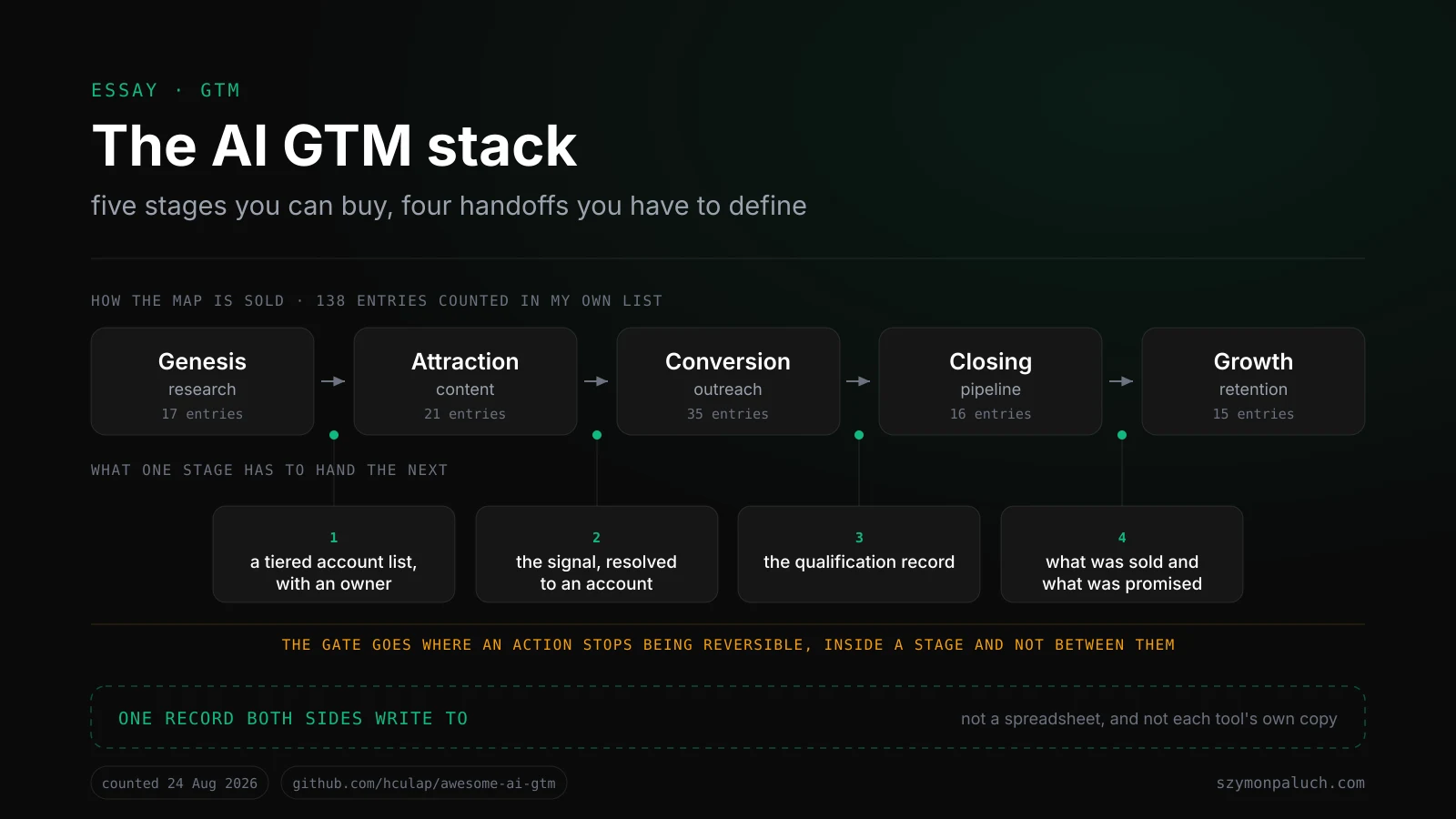
The stages in my list are called Genesis, Attraction, Conversion, Closing and Growth. The names are arbitrary and no sales floor talks that way. The order is what matters: research, content, outreach, closing, retention. Tools sit inside those boxes because that is how they are sold. The work travels between the boxes.
A handoff is not a metaphor. It is a concrete object, a moment when it changes owner, and somebody who either accepts it or sends it back. You can buy plumbing for that: signal platforms, enrichment, reverse ETL, orchestration. What you cannot buy is the content of the contract between two stages. The four handoffs look like this.
| Handoff | What travels | What breaks without it |
|---|---|---|
| research → content | The tiered account list: who, in whose territory, on which buying trigger you are betting, and from what date. | Marketing spends against accounts nobody is allowed to work. |
| content → outreach | The signal resolved to an existing account and its owner: what happened, when, how you know, and whether an opportunity is already open. | Two reps call the same logo, and speed to lead is measured in days. |
| outreach → closing | The qualification record: why this is real, who pays, what is forcing the decision, plus a rejection reason and a deadline to answer. | Meetings that should never have been booked enter the forecast and wreck the quarter. |
| closing → retention | What was sold and what was promised, including anything agreed outside the order form, then real usage against what the customer pays for. | Onboarding rebuilds the deal from the rep's memory, and renewal becomes a conversation about price. |
Two handoffs fell out of that table and both are expensive. First: the rep handing a quote to whoever approves it, with every commitment made outside the order form. Second: lost-deal and churn reasons travelling back into research. They are invisible because they do not sit on a boundary between stages. A funnel drawn as a line has no return path by construction.
Each of those objects needs one place where it lives. The CRM is where reps work and that is where the output belongs. The truth about a customer lives somewhere else, because product events and billing data will not fit in a CRM. That is why my list carries a separate category for reverse ETL. The warehouse models it, then pushes into the CRM the part a rep is meant to see. Internally this is the same problem as any other deployment, and I broke it into the three internal layers you need before buying anything else.
Top of the funnel: research and content
This is where AI does best and where there is least to lose. A model reads twenty pages about a company in a minute and leaves a note nobody would have written by hand. It also writes the first draft of an email, a description, a post. Both of those are reversible. A bad paragraph gets fixed before it goes out, a bad brief goes in the bin.
What costs money is different: a field somebody filled with an invented value. Ask a model for headcount, tech stack or seniority and it answers every time. OpenAI's last published PersonQA numbers, on the benchmark that asks about specific people, are in the o3 system card of April 2025. There o3 returned a hallucinated answer to 33 percent of the questions asked, against 16 percent for o1. Part of that gap is that o1 answered fewer of them at all: it got 47 percent right where o3 got 59.
In practice something plainer hurts more often than invention. The provider matched the record to the wrong legal entity, the record is fourteen months old, or a correct value landed on the wrong account. The fix is three columns beside every field rather than a better model: source, confidence and the date it was measured. When an agent hands you a finished document with footnotes, checking it costs less than you expect. I wrote down nine checks that catch a footnote which looks like a source and is not. The same set works on a brief about a customer.
As much has changed on the other side of the table. The first read of your offer is increasingly a model rather than a person. Somebody asks an assistant to summarise your site and reads the summary. That is why this site serves an llms.txt file and the same content as JSON. It is cheap work and it needs nobody's approval.
Middle of the funnel: when the agent starts sending
The line of autonomy does not run between stages. It runs across every one of them, where an action stops being reversible. An agent reading LinkedIn and an agent emailing a CEO are formally doing the same thing, and they differ in everything. The first is allowed to be wrong, because somebody will read it. The second is not.
Reversibility is only the floor, though. Above it, two things decide: how many records a mistake touches, and how long before anybody notices. An agent that quietly rescores four thousand accounts costs more than four hundred awkward emails. No gate fires, because nothing left the building. For the same reason, sending one message and sending the same message five thousand times are not the same action. A gate needs a volume threshold, not only a rule per event.
Volume was never the constraint here, and since a model writes the copy it is not even a cost. The constraint is domain reputation and the filter on the receiving side. The rule everybody quotes is worth reading in the original. Google's sender guidelines govern mail to personal Gmail accounts. They do not govern Google Workspace, and that is where most of your B2B email lands. The guidelines FAQ holds the rule that actually bites. Send close to five thousand messages to personal Gmail accounts in a day, once, and you are permanently a bulk sender. The count covers the whole primary domain, subdomains included.
The measure is not what the dashboard shows either. Open rate stopped meaning anything once mail clients began fetching images on the reader's behalf. What is left is replies, and meetings that survived the first conversation. An agent reporting volume and opens is reporting its own output.
The third problem is specific to agents. A GTM agent reads text written by strangers by definition: company sites, profile blurbs, replies to email, support tickets. Then it reaches for the tools you handed it. That is an attack channel, not only a data channel. I listed which agent actions have to be gated in code instead of asked for in the prompt. In a funnel that list is short and always the same: sending a message, changing a customer record, anything involving a discount.
Where the contact came from, and whether you may use it
Data enrichment is one of the most crowded categories in GTM. It is also the least thought through legally. In December 2024 the French regulator CNIL fined KASPR 240,000 euros. KASPR sold an extension that returned contact details from the LinkedIn profiles its customers visited, and had built a database of around 160 million contacts. There were four grounds, and two of them apply to the company buying such data as well.
First: on request you have to be able to state where a record came from. The answer "from publicly available sources" is one the CNIL rejected outright. Second: data you did not get from the person requires you, not your supplier, to inform them, in a language they understand. A contract does not move that duty. The decision does not say buying contact data is unlawful. It says you have to be able to show where every record came from.
National law adds to that, and member states differ. Poland has article 398 of the Prawo komunikacji elektronicznej, in force since 10 November 2024: commercial email requires the recipient's prior consent. There is no B2B exemption, and no soft opt-in for existing customers of the kind other member states allow. The statute protects any subscriber or end user, so an address like kontakt@firma.pl counts the same as a named one. The head of the telecoms regulator sets the fine. It reaches 3 percent of the previous year's revenue or one million zloty, whichever is higher. In fairness: I found no published decision applying that article to email. The penalties on record so far were for mass phone and SMS campaigns under the older telecoms act.
In practice this comes down to one column in the CRM and one question to the supplier before you sign. Where does this record come from, and will I get that per record or only in the terms of service. If the answer is "public sources", you already know what you will be able to tell the person who asks.
This is what I do hands-on: advising on AI strategy and building agents that survive the demo.
Bottom of the funnel: closing and support
The best documented productivity gain from AI happened in customer support. It is five years old by now. Brynjolfsson, Li and Raymond described it in the Quarterly Journal of Economics. At one Fortune 500 firm, 5,172 support agents were given an assistant built on a recent version of OpenAI's GPT family. The rollout ran through the autumn of 2020 and the winter of 2021. They then resolved 15 percent more issues per hour on average. The least experienced gained about 30 percent, the most experienced almost nothing. A gain shaped like that shortens ramp-up for new people; it does not let you release the veterans.
Closing runs on different arithmetic. An agent's answer about price, terms or an SLA is a statement by the company. In February 2024 a Canadian tribunal ruled on Moffatt v. Air Canada. The argument that a chatbot answers for itself was called "a remarkable submission". The airline was found not to have taken reasonable care, and damages came to CAD 650.88. In B2B the stake is not that amount. An agent that enters a discount outside the approval matrix creates a commitment. So does one that answers a security questionnaire on your behalf. Both end up inside a signed contract.
Since 2 August 2026 there is a formal duty on top of that. Article 50 of the EU AI Act requires that a person knows they are talking to an AI system, unless that is obvious. The chat on your site, running under your brand, puts that duty on you rather than on your vendor. An email from a sales agent does not trigger the labelling duty in that article. A commercial offer is not text published to inform the public. The ceiling on a fine is 15 million euros or 3 percent of worldwide turnover, whichever is higher.
Which part of a reply goes out without a person and which does not is decided case by case, not stage by stage. I set that out as the 80/20 split that decides which replies an agent sends and which reach a person. The rule is plain: the more a mistake costs and the rarer the case, the earlier a person enters.
The Agentic Architect
Practical patterns, case studies and AI news. Zero spam, once a week.
You'll get one email to confirm. Unsubscribe with one click. Privacy policy
What a deployment that delivers looks like
Over the past two years I have watched a lot of AI deployments in sales and marketing. The ones that survived the first quarter had more in common with each other than the ones that died. Six traits come back every time, and each of them can be tested during a demo.
You judge it on the next stage
Not on messages generated, but on meetings that reached the next stage within thirty days. Ask whether the vendor will take payment on that.
Every field carries source, confidence and date
Ask for a screenshot of one record, not a page listing data providers. A correct value from a year ago costs you the meeting just as an invented one does.
It fails loudly
Ask what it does when the data provider returns nothing. If the answer contains "infers" or "estimates", the evaluation is over.
It writes to your objects, not its own
Does it write on your Account or create one of its own. Does it respect validation rules, and what happens when two records are merged.
The gate is visible in the permission model
Everyone says "human in the loop". Ask to see permissions: who can move the gate, whether approvals are logged, and whether the agent can change its own rights.
You know the unit cost
Not the subscription, but the cost of one enriched account or one handled conversation. And what that number does when volume triples.
The first one costs the most, because it kills the nicest slides. Klarna announced in February 2024 that its assistant had handled 2.3 million conversations in its first month. Handling time fell from eleven minutes to under two. Those are Klarna's own figures, and both of them measure speed rather than outcome. In May 2025 Bloomberg reported that the CEO considered the cost-cutting in customer service to have gone too far. He was planning to recruit, so that a customer could always reach a human.
The third trait can be measured before the agent sends its first email. That is how it went with an email agent for a company that sells custom-printed apparel B2B. Before its production core was written, it went through a benchmark on 146 threads. Every thread landed on the right decision path, and the agent flagged every gap in critical data out loud. I wrote that project up with four others in case studies whose numbers come from the code.
Add one more question to that list, the one that wins arguments with procurement. What stays on your side when you stop paying. If the enriched data, the sources and the reasoning live in the vendor's system, you are paying to build somebody else's asset. The general version of that calculation, together with why most agent demos never leave the test environment, I have written up separately.
What this map does not tell you
The numbers in this piece I counted on 24 August 2026, inside my own list rather than across the market. It held 138 entries then: 35 in outreach, 10 in the data layer. That says a category with a demo is easier to sell and easier to catalogue. The section I had named the connective tissue held none at all. That was my own unfinished section rather than a market finding, because companies selling exactly that layer exist and are doing well. I filled it while writing this.
The stage split has a worse flaw. It ends at closing, and in a subscription business most of the money arrives after the signature. The right shape is a loop whose thickest arrow runs from onboarding into expansion, not a line finishing in a box marked Growth. Nobody buys by funnel stage either; they buy around the system where they keep their customers. For about a third of the tools, which stage they sit in is an editorial decision of mine rather than a fact about the tool.
There is a heavier objection worth stating plainly. If everyone deploys the same agents against the same data, message volume rises and reply rates fall in proportion. The durable effect is a higher noise floor, not an advantage. I think that is true of everything you can buy on a card. Two things stay outside that calculation. Whether your handoffs are written down. And whether somebody owns the data layer. Neither comes on a subscription, so a competitor cannot copy them in a week.
Where to start
Take a sheet of paper and write out the handoffs in your funnel. One sentence each: what exactly travels, who receives it, and which system it lives in. Three of the four will turn out to be a conversation in Slack or an export to a spreadsheet. That is your deployment list, in order, and each deployment takes exactly one handoff.
Then mark, on the same sheet, the points where something leaves the building, changes a customer record or issues an invoice. That is where the gate goes, before you buy any tool at all. An invoice raised wrongly after the signature is the least reversible thing in the whole arrangement. It also sits past the stage where most maps stop.
The map is open and you can fix it
The list is ordered along the funnel, CC0 licensed. If you use something that genuinely delivers, add it with a pull request. I have just filled the orchestration section and it is certainly still missing something.
Frequently asked questions
What is GTM and how is it different from marketing?
GTM is the plan for reaching a chosen market and turning it into revenue: the segment, the offer, price and packaging, the channel, and the order in which you contact a customer. Marketing is one input into that plan and sales is the other. GTM sits a floor above both, because that is where you trade one against the other and where price and channel are decided.
Which funnel stages can an AI agent run on its own today?
An agent runs any reversible task on its own today: research, enrichment with a stated source, first drafts of content, call summaries. Anything that leaves the building, changes a customer record or issues an invoice goes through a gate. So the line runs across the stages rather than between them, and what sets it is whether the action can be undone, not where it sits in the funnel.
Do you need to clean up the CRM before adding agents?
Not all of it, because a clean CRM never happens and waiting for one is how a deployment ends up in a drawer. One object and one handoff is enough. Decide which fields have to be correct for the chosen flow, fix only those, and record a source and a date next to them. The rest of the database can stay as it is.
How many AI tools does a GTM team need?
Fewer than it has. The number of lines on the invoice is not a measure of maturity, because the work sits on the handoffs rather than inside the boxes. Start with one tool per written-down handoff. If two tools record the same information in two places, one of them is creating work rather than removing it.
Can an AI agent send cold email without a person?
Technically yes, operationally it is rarely worth it, and in Poland prior consent from the recipient is required on top. Sending is irreversible and it draws on the reputation of the domain the rest of your company mail leaves from. A person does not have to read every message. They have to approve the segment, the template and a volume threshold, and the agent works inside those bounds.
Does an AI chat on a website have to say it is AI?
Yes. Since 2 August 2026 article 50 of the EU AI Act requires that a person knows they are interacting with an AI system, unless that is obvious. The duty falls on the company offering the chat under its own brand, not on the tool vendor. The ceiling on a fine is 15 million euros or 3 percent of worldwide turnover.