Gemini 4 Argon release date: who gets it first, and when
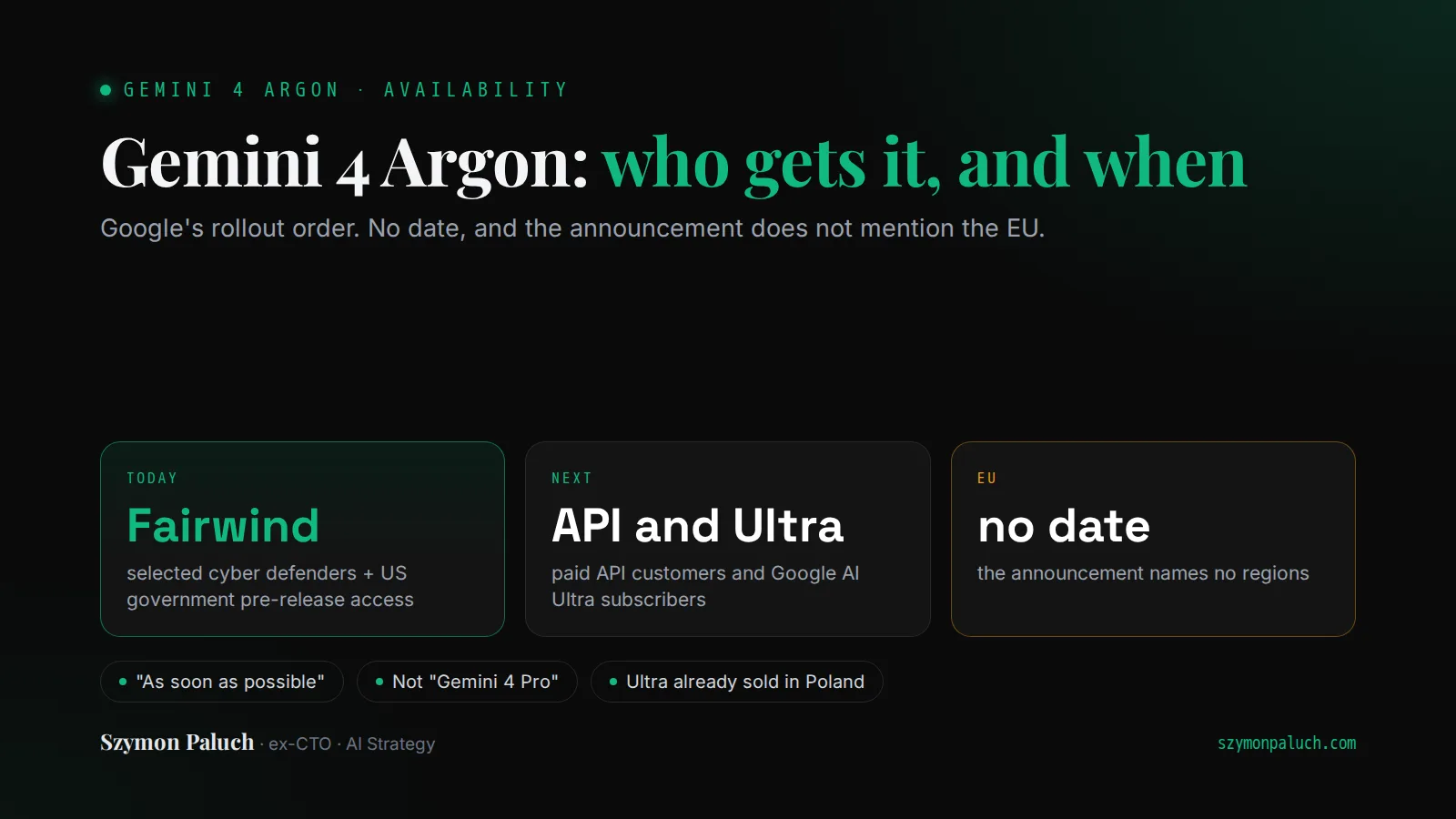
Gemini 4 Argon has no release date. Since 30 September some Fairwind Program partners, teams that defend networks against attacks, have had it. Trusted testers and the US government have it too. Paid API customers and Google AI Ultra subscribers come next. Google has announced nothing specific for Poland or the EU.
There is no Gemini 4 release date yet. Asked when it reaches developers and companies, Google offers one phrase: as soon as possible. It announced the model on 30 September at 20:00 UTC (22:00 in Poland). I have not tested it. It is not generally available yet, so this piece rests on Google's pages and Reuters' report.
The timeline, the 1M-token limit on a single answer and the test results are in my map of the whole Argon announcement, from benchmarks to Google's internal examples. Here I stay with one question. Who gets the model, and when?
When will Gemini 4 Argon be available?
Google gives no date. Before the broad release it wants to gather feedback from early testers and iterate on guardrails. The announcement and posts by Google staff on X say only "as soon as possible" or "soon". Reuters adds that Google did not provide a timeline for the public release. What Google does describe is the order.
| Stage | Who | When |
|---|---|---|
| Now | Some Fairwind Program partners ("a set of trusted cyber defenders"), trusted testers and Google's own teams | From 30 September 2026 (Google's teams earlier) |
| In parallel | The US government, through its voluntary process for pre-release model access | Google does not say |
| Broad release | Developers, enterprises and consumers, starting with paid API customers and Google AI Ultra subscribers | "As soon as possible", no date |
Inside Google the model is already at work. The announcement says thousands of Googlers use it.
How will you know it has launched? On the evening of 30 September Argon was not on the Gemini API pricing page or in its changelog. It was not in Google Cloud or in the Gemini app release notes either. Google has not published a model ID. I am waiting for a changelog entry with that ID. For me, that will be the launch signal.
What is the Fairwind Program, and who already has Argon?
Fairwind is a limited-access program for governments and trusted partners. Google launched it on 2 September with Gemini 3.8 Flash Cyber and the CodeMender tool. It has more than 650 partners worldwide. Only some of them get Argon. Google writes of "a set of" partners with exclusive access. How many? It does not say.
Google names only one company that already has Argon. It is Wiz, which uses Argon in its Scan for Good initiative to find and fix high-risk exposures in public infrastructure for free. Wiz has belonged to Google since March 2026. The Fairwind pages also show partner logos, CrowdStrike and Palo Alto Networks among them. The program started with 3.8 Flash Cyber, and Google does not say those companies have Argon.
Who can apply? Google lists three groups: governments and national cyber authorities, critical infrastructure operators from healthcare to financial networks, and core technology platforms. It runs background checks on every organization that applies. Inside an accepted organization, only internal cybersecurity, incident response and penetration testing teams may use Argon. Sharing or selling access is not allowed.
One sentence raises the most questions. Google says trusted defenders and its own teams will get Argon "without cyber guardrails", so they can use its full defensive capabilities. The announcement explains nothing more. The closest precedent is Gemini 3.8 Flash Cyber, which ships with more permissive cyber mitigations and so goes only to trusted defenders. Even Argon without guardrails has limits. Partners may run authorized threat simulation, reverse engineering and malware analysis, for defensive and academic research. Creating malware is not permitted.
Here Google settles at the model level what every company has to settle in-house: who gets full capability, for what, and under whose oversight. Inside a company, the question is about AI agents. I have written up how to give each AI agent a scope of autonomy and a threshold at which it asks a human.
The application form is on the program page. Google promises a reply to organizations that meet its criteria. It points the rest to CodeMender with publicly available models.
Who in the US government has Argon before release?
Google does not say. It writes only that it is "actively engaged in the U.S. government's voluntary process for pre-release model access". Sundar Pichai put it more briefly on X: "it's with the US gov't". Nor is it known how long the review lasts or what it found. Reuters calls it the Trump administration's voluntary process.
A US executive order of 2 June 2026 calls for a voluntary framework of this kind. Under it, a developer could give the federal government access to a model for up to 30 days before releasing it to other trusted partners. Google does not say whether that is the process it means.
This matters for companies outside the US. The example comes from Anthropic. On 12 June the US government issued an export control directive that suspended access to Claude Fable 5 and Claude Mythos 5 for any foreign national. Anthropic had to disable both models for all its customers. The controls were lifted on 30 June. None of this involves Argon. It does show that for models strong in cybersecurity, the US government can have the last word.
Paid API and Google AI Ultra: what is known about the queue?
Google starts the broad release with paid API customers and Google AI Ultra subscribers. There is no date for either group. The announcement names no surfaces either: not Google AI Studio, not Agent Platform (formerly Vertex AI), not the Gemini app. The word "paid" suggests no free tier at launch. Gemini 3.1 Pro Preview has none either.
The price is known. At launch, a million input tokens cost $2 and a million output tokens $10. After the introductory period that becomes $4 and $20, but Google does not say when. I have also listed what Argon's price list still leaves out, from the end of the promotion to the Batch API rate.
Google AI Ultra is sold in Poland. It costs PLN 469.99 a month for five times the AI Pro limits or PLN 979.99 for twenty times. In the US that is $99.99 and $199.99. The plans page sells Gemini 3.1 Pro today and does not mention Argon. Google does not say whether both Ultra tiers will get the model, or whether AI Pro subscribers get it later. I would not buy Ultra for Argon until Google lists it on the plan page.
Designing or deploying agents for clients? In our collective of AI consultants you prepare for AI vendor partner certifications and learn with other consultants. When a suitable client brief arrives, we may invite you to a project.
Is Gemini 4 Argon the same as Gemini 4 Pro?
Google does not use that name. The model is officially called Gemini 4 Argon. A Google spokesperson told Reuters that Argon is larger than Google's previous line of top-tier "Pro" models. I did not find that sentence on Google's own pages.
The Gemini 4 Pro name came from leaks. On 23 September TestingCatalog reported tests of "Gemini 4 Pro" under the codename argon. On 25 September NokiaPowerUser reported a model on Arena under the label gemini-3.8-flash, although that is also the name of a public Google model. The leaks spoke of a 256K-token output limit. The official figure is 1M. Apart from the name Argon, Google confirmed none of these reports.
Why did people expect a Pro model? According to The New Stack, Google announced plans for Gemini 3.5 Pro in May, and a series of Flash models came out instead. The New Stack calls Argon its replacement. So if you are looking for a Gemini 4 Pro release date, follow Argon. Google has announced no product called Gemini 4 Pro.
Will Gemini 4 Argon be available in Poland and the EU?
Nobody knows yet. The announcement does not mention Europe, regions or countries, and there is no Polish edition of it. The channels Argon is meant to arrive through do already work in Poland, though. The Gemini API and Google AI Studio are available in all 27 EU countries, and Ultra is on sale.
Past launches show two patterns. New models usually start everywhere at once. Gemini 3 Pro rolled out "to everyone" in the Gemini app, 3.1 Pro "globally", and the API changelog gave no regional limits for either. New features for paid plans often skip Europe, though. Gemini Spark, an AI agent for AI Pro and Ultra subscribers, works everywhere except the EEA, Nigeria, Switzerland and the UK. Personal Intelligence launched only in the US.
OpenAI did something similar the day before. I described how the Pro plan got ChatGPT's always-on agents everywhere except the EEA, Switzerland and the UK. Agent features from American companies often start in the US.
Then there is where your data is processed. On Google Cloud, Gemini 3.1 Pro Preview runs only on the global endpoint. Gemini 3.8 Flash Cyber has a global and a US endpoint. Gemini 3.8 Flash has an EU region. A regional endpoint costs 10% more.
My guess is that the API will open in Poland on the same day as in the US, as it did for Gemini 3 Pro and 3.1 Pro. Agent features in the app and an EU region on Google Cloud may come later. That is my reading of earlier launches. Google has announced nothing of the kind.
What to do this week
You cannot speed up the date. You can prepare. I would do six things.
- Collect your own tasks. Pick a few dozen real tasks and write down what a good result looks like. On launch day you can run Argon and your current model on them.
- Budget at $4 and $20. The $2 and $10 price will end, and Google has not said when.
- Check the region. If a client needs data processed in the EU, open the model's Google Cloud page on launch day and read the Supported regions section.
- Turn on billing in your API project. Google starts with paid customers, though it does not say who counts as one.
- Apply to Fairwind if you defend critical infrastructure. Governments, healthcare, telecoms and energy come first there.
- Keep a second model. The Fable 5 episode showed that a model can disappear overnight.
Start with the task list. Open a spreadsheet today and write down the first five.
The Agentic Architect
Practical patterns, case studies and AI news. Zero spam, once a week.
You'll get one email to confirm. Unsubscribe with one click. Privacy policy
Sources and fact-check date
- Google: Gemini 4 Argon announcement, rollout stages and price
- Google DeepMind: Fairwind Program, terms and FAQ
- Google: Fairwind Program launch, 2 September 2026
- Google: Gemini 3.8 Flash and 3.8 Flash Cyber
- Reuters: Google announces Gemini 4 flagship AI model, the spokesperson's words
- Sundar Pichai on X, the US government's access
- Google: AI Pro and Ultra plans in Poland, in the US and the country list
- Gemini API: available regions and changelog
- Gemini app release notes and Gemini Spark availability
- Google Cloud: regions for Gemini 3.1 Pro, 3.8 Flash Cyber and 3.8 Flash
- White House: executive order of 2 June 2026
- Anthropic: Fable 5 and Mythos 5 switched off and restored
- Google: the Wiz acquisition
- The New Stack, TestingCatalog and NokiaPowerUser, pre-launch leaks
As of 1 October 2026.
Frequently asked questions
When is the Gemini 4 Argon release date?
Google has not given a date. Since 30 September 2026 the model has gone to some Fairwind Program partners. Paid API customers and Google AI Ultra subscribers come next, as soon as possible according to Google.
Is Gemini 4 Argon the same as Gemini 4 Pro?
Google does not use the name Gemini 4 Pro. The model is called Gemini 4 Argon. A Google spokesperson told Reuters that Argon is larger than Google's previous line of Pro models. The Gemini 4 Pro name comes from leaks before the launch.
Can I use Gemini 4 Argon in Poland?
Not yet, unless your organization is one of the selected Fairwind partners. Google has announced nothing specific for Poland or the EU. The Gemini API, Google AI Studio and Google AI Ultra already work in Poland, so the channels Argon is meant to arrive through are available.
What is the Fairwind Program?
It is Google's limited-access program for governments, critical infrastructure operators and core technology platforms. It has more than 650 partners worldwide. Only some of them get Argon, in a version without cyber guardrails, for defensive work.