OpenAI Dots: ChatGPT's always-on agents, and who can use them
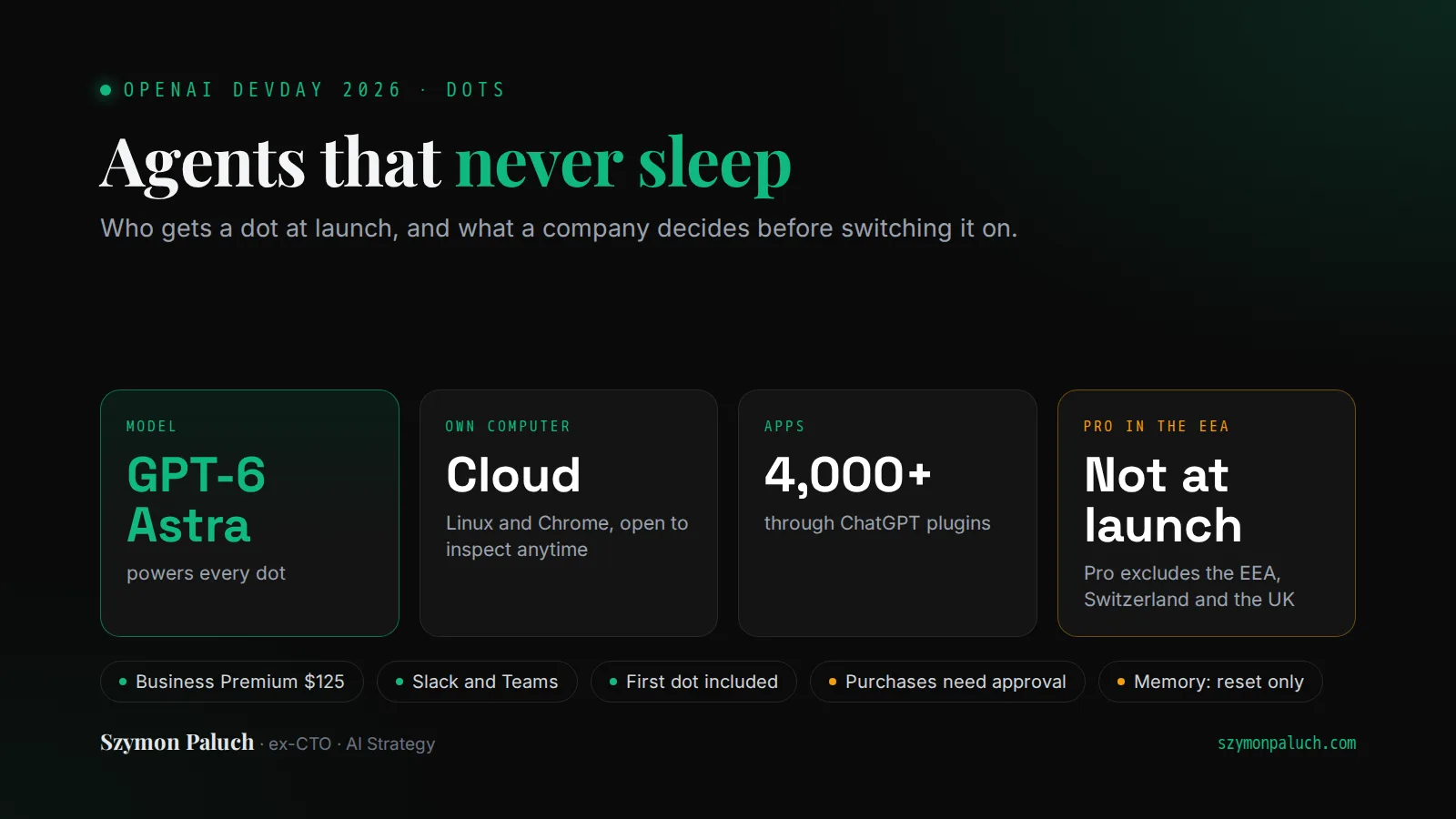
OpenAI Dots, ChatGPT's always-on agents, are open to three groups at launch: Pro subscribers outside the EEA, Switzerland and the UK, Business Premium seats in every region where ChatGPT is supported, and Enterprise, Edu and Healthcare workspaces whose admin turns on the beta. In Poland, where I work, that leaves Business Premium or Enterprise. Pro is out.
OpenAI showed dots as the first new launch of DevDay 2026, a few minutes after 10:00 PT, presenting them as agents that run without a break and take the initiative. I have not tested them yet. This piece rests on OpenAI's own pages and live coverage from the room.
The other launches, from models to Codex in the cloud, are on the full list of more than 20 announcements from the day.
Who can use OpenAI Dots, and do they work in Poland?
It depends on the plan. OpenAI's help centre says dots roll out on Pro in markets outside the European Economic Area, Switzerland and the UK. Poland is in the EEA, so Pro is out. That holds for every Pro tier, from $100 to $500 a month.
Business Premium is different. There OpenAI offers dots in every region where ChatGPT is supported, and Poland is on the official list of those countries. OpenAI does not name Poland in its dots material, so this is my inference from two help pages. Access can take several days to reach your account.
The third route is Enterprise, Edu and Healthcare. These plans get a beta. The admin has to switch it on, because it is off by default. OpenAI states no regional limits for it.
Two things can mislead you. The euro pricing page shows a dot on the Pro card, and Fortune reported that dots skip the whole EEA. I trust the help centre, which the launch post links to.
| Plan | Price per OpenAI | Dot in Poland |
|---|---|---|
| Pro 100, Pro 200, Pro 500 | $100, $200 or $500 a month | No. At launch Pro excludes the EEA, Switzerland and the UK. |
| Business, Premium seat | $125 per user per month, $100 billed annually | Yes. Premium covers every supported ChatGPT region, and Poland is on the list of supported countries. |
| Enterprise, Edu, Healthcare | OpenAI gives no price in its dots material | Beta. The admin switches it on; it is off by default. |
What is a dot, ChatGPT's always-on agent?
A dot is an agent that works in the background and does not wait for your question. It runs on GPT-6 Astra, which OpenAI calls its most aligned model. The day before, OpenAI held back GPT-6.1 Astra for failing its safety standards.
Each dot has its own cloud computer running Linux and Chrome, maintained by OpenAI, and you can look into it at any time. Through ChatGPT plugins it can connect to more than 4,000 apps. It can also start tasks in Codex cloud.
A dot gets into your laptop only if you allow it, and the option is off by default. You create a dot only on a computer, in the desktop app or a desktop browser, then message it from your phone too. People under 18 cannot use dots.
You talk to it in ChatGPT and, per the launch post, in Slack and Teams. You can call it, but it will not call you at launch. The launch post says texting is coming soon; the help centre describes a limited beta for Pro users in the US. A dot gets no email address of its own.
For teams, OpenAI showed ChatGPT Space. I wrote separately about the shared workspace where people and dots work together. With large companies OpenAI is also piloting specialist dots, each with its own identity, access and IT-provisioned hardware.
In the live demo a dot called Dottie stalled for a moment. Tibo Sottiaux of OpenAI explained afterwards that the demos suffered from rolling out all the updates at once. The press compares dots to Meta's Muse and SpaceXAI's Grok Bot.
How much does a dot cost on ChatGPT Business Premium?
Your first dot is included in a Pro plan or a Business Premium seat. Premium costs $125 per user per month, or $100 billed annually. OpenAI quotes USD and says prices may vary by country and currency.
A Business workspace needs at least two paid seats, and one Standard seat at $25 plus one Premium seat qualifies. By my arithmetic from OpenAI's price list, the cheapest company access to a dot is $150 a month, or $120 billed annually.
More dots will come later, along with options to make a dot faster or let it take on more work per month. OpenAI has not priced any of this. Engadget's live blog mentioned an option to pay for more dots; OpenAI's own text puts it in the future.
Usage limits are muddled. The launch post says dot conversations do not count toward ChatGPT limits, though tasks it starts in Codex or ChatGPT Work do. The help centre says dots usage will not count toward plan allowances for the next month, with terms to follow. I would not base a November budget on either.
Designing or deploying agents for clients? In our collective of AI consultants you prepare for AI vendor partner certifications and learn with other consultants. When a suitable client brief arrives, we may invite you to a project.
What will a dot do without your approval?
You set that in Custom Rules: allow an action, require approval, or block it. The mobile app offers four behaviours: act without asking, act if pre-approved, ask before acting, or hand off to you.
OpenAI has drawn some lines for you. Every purchase needs your approval, and the dot pays with cards already saved on the merchant's site. Advance approval must cover that specific purchase. Changing a password or transferring money always goes back to you. Permanently deleting data, installing software from an unrecognised source and granting new security-sensitive access need confirmation every time.
Auto-review sits on top: a separate system checks planned actions, such as sending an email, against your instructions and rules, and can block them. Your approval cannot override core safety requirements.
In the background, in proactive research, the dot has read-only tools. It cannot send messages or change anything. OpenAI says this is enforced in code. You follow its work in Activity View and pause it from its profile.
What should a company decide before switching dots on?
I design agents with bounded autonomy for companies. Before switching on a dot, I would settle five things.
Which apps can the dot reach, and with what rights?
Plugin permissions are shared across dots, ChatGPT, ChatGPT Work and Codex, so a plugin once connected for chat is within the dot's reach. Review those connections before launch and note, for each app, whether the dot may only read or also write.
What does the dot do without asking?
List the actions the dot will take in your apps and give each a Custom Rules behaviour. I described the method when showing how to turn an agent's limits into an action table and an escalation matrix. Dots have the approval levels built in; the table is yours to fill in.
Where can someone else's instructions get in?
A dot reads emails, documents and web pages, and a stranger can plant an instruction in any of them. OpenAI's system card describes a test on 50,000 emails, 16,600 of them attacks. None succeeded. Still, that is the vendor's test on the vendor's data.
Before you connect an inbox, sit down with your team and go through five agent risks and nine questions to settle before production. For a dot, start with two: which actions cannot be undone, and who gets the alert when the agent does something unusual?
Who watches the dot at 3 a.m.?
The dot works around the clock. Your team does not. OpenAI's monitoring can pause it, but someone on your side has to check Activity View. The system card shows why: with five intervening tasks the dot made moderate scope violations in 8.6% of runs, with ten in 19.7%, and no severe breaches. Name the person who reviews its work each morning.
What happens to the dot's memory?
Memory is the least convenient part. A dot receives memories from ChatGPT and creates its own, including from connected apps. You cannot view or delete single memories, only Reset the whole dot with its conversations, memories and scheduled tasks. Disconnecting an app does not erase what the dot learned from it. So connect only data that may stay for a long time, and decide when you reset, say when an employee changes department. Business and Enterprise content is not used for training by default. OpenAI does not say what happens when an instruction planted in a document lands in memory.
If after these questions a dot gives you too little control, there is a second route: build your own agent on the Codex harness, with the tools and gates you set yourself. You pay for that in team time and code maintenance.
Start with one sheet of paper. List the apps your company has already connected to ChatGPT and mark each one read, write or no access for the dot. Take that list to your admin before the dot is switched on.
The Agentic Architect
Practical patterns, case studies and AI news. Zero spam, once a week.
You'll get one email to confirm. Unsubscribe with one click. Privacy policy
Sources and fact-check date
- OpenAI: Introducing dots, the launch post
- OpenAI Help Center: Getting started with your dot, plans, regions and channels
- OpenAI Help Center: dots privacy, security and safety FAQs, memory and approvals
- OpenAI Help Center: ChatGPT supported countries, the country list
- OpenAI: Premium seats in ChatGPT Business, seat prices
- OpenAI: GPT-6 Astra system card, the dots evaluations
As of 29 September 2026.
Frequently asked questions
What are OpenAI Dots?
They are always-on agents in ChatGPT. Each dot runs on GPT-6 Astra and has its own cloud computer with a browser. Through plugins it can connect to more than 4,000 apps. You message it in ChatGPT and, according to OpenAI, in Slack and Teams too.
Are OpenAI Dots available in Poland?
Not on Pro, because at launch OpenAI excludes Pro in the EEA, Switzerland and the UK. Business Premium has dots in every country where ChatGPT is supported, and Poland is on that list. Enterprise, Edu and Healthcare get a beta that the admin switches on.
How much does a dot cost?
Your first dot is included in a Pro plan or a Business Premium seat. Premium costs $125 per user per month, or $100 billed annually. More dots are planned for the future. OpenAI has not published their price.
Which model powers a dot?
GPT-6 Astra. The system card says plainly that dots are powered by this model. GPT-6 Sol was only used as a comparison in the tests. OpenAI did not release GPT-6.1 Astra.
Can a dot make purchases on its own?
Not without your approval. A dot pays with cards already saved on the merchant's site, and every purchase needs your sign-off. You can approve in advance when the approval covers that specific purchase. Changing a password or transferring money always goes back to you.