GPT-6.1 Sol, Ultrafast and Pro 500: OpenAI pricing after DevDay 2026
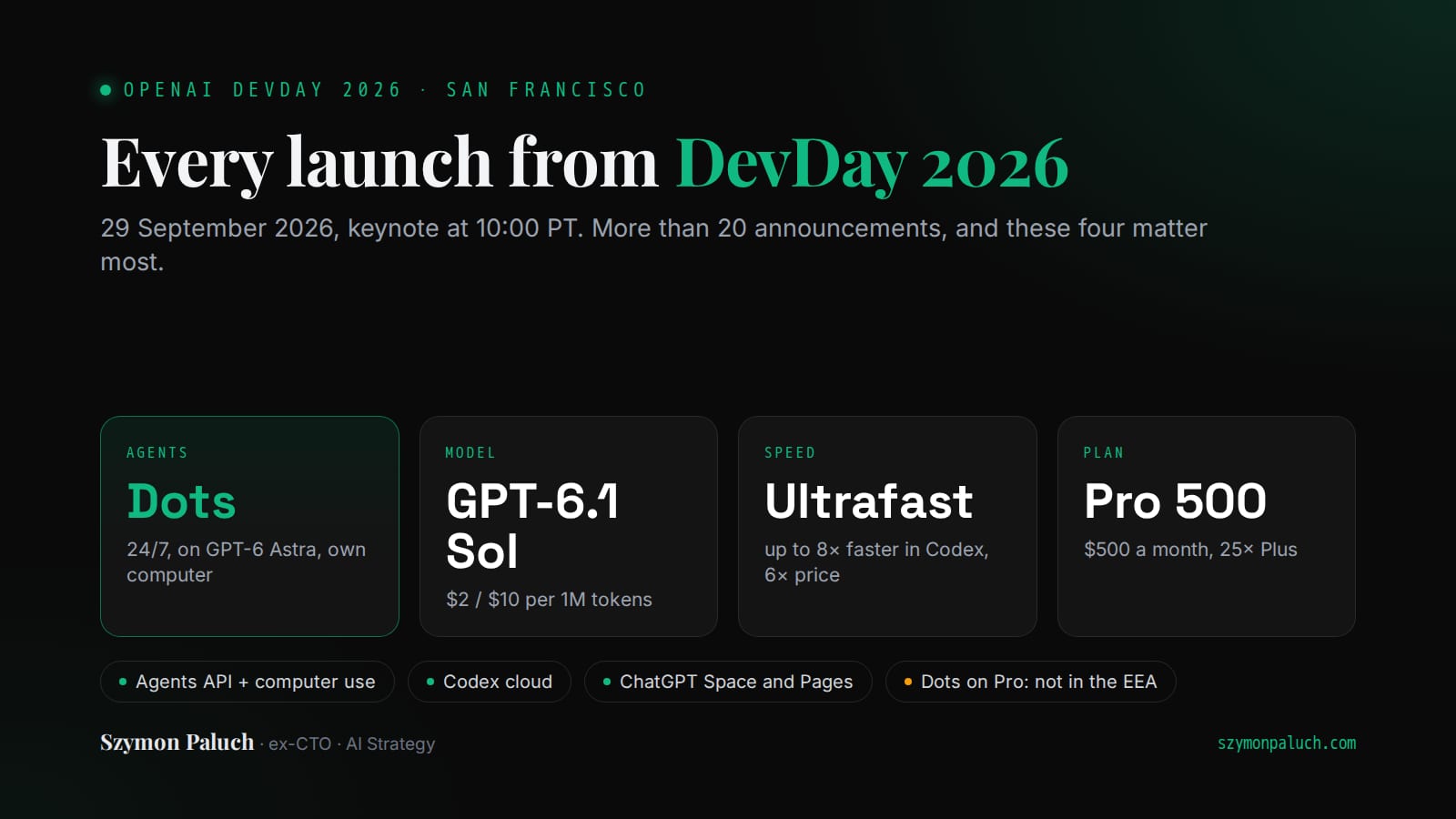
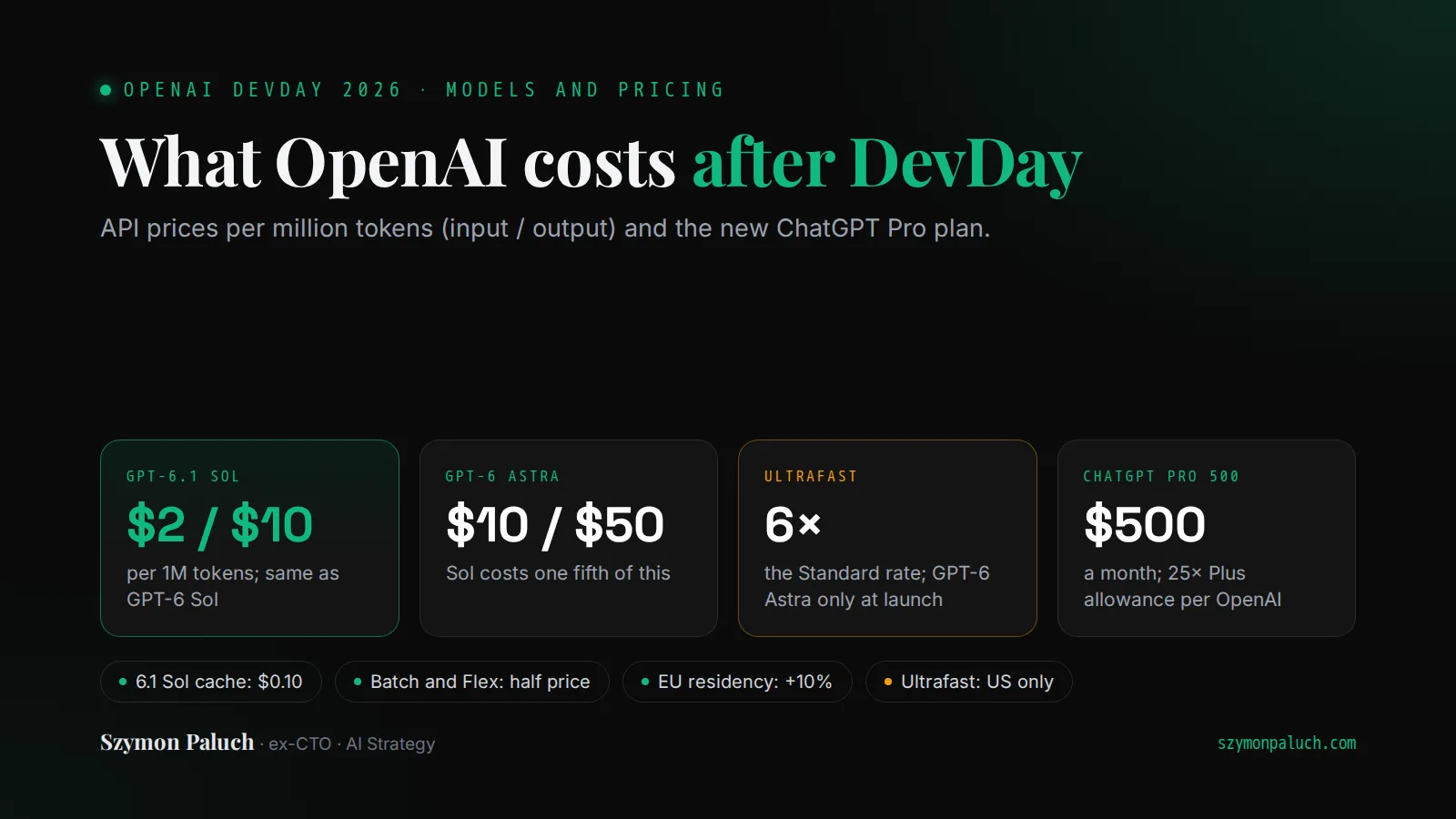
GPT-6.1 Sol costs $2 per million input tokens and $10 per million output tokens in the API. GPT-6 Sol cost the same a week ago. Only cached input got cheaper, from $0.20 to $0.10. Ultrafast costs six times the Standard price and at launch is broadly available for GPT-6 Astra only. ChatGPT Pro now has three tiers: $100, $200 and $500 a month.
I price agent projects for clients. From DevDay I want one number: the cost of a task the agent completes correctly. Here is that math.
The other announcements, including Dots agents, are in my roundup of everything new from DevDay 2026.
How much does GPT-6.1 Sol cost in the API?
The model id is gpt-6.1-sol. Input costs $2 per million tokens and output $10. Cached input costs $0.10 and cache writes $2.50. These rates apply to prompts of up to 272K tokens.
Above that, the whole request costs more: input and cache rates double, output rises by half. With a 1.05M-token context window, an agent that pastes the full case history into its prompt crosses that line easily. Fast costs twice as much and, per OpenAI, answers up to 2.5x faster.
Before migrating, check two things. GPT-6.1 Sol has no none reasoning effort; the lowest is low. An agent that ran GPT-6 Sol without reasoning will now pay for tokens it never generated. And tool calling works only through the Responses API.
One fifth of the price, compared with what?
OpenAI says GPT-6.1 Sol nearly matches GPT-6 Astra at one fifth of Astra's token prices. The price part holds. Per million input and output tokens, Astra charges $10 and $50, and Sol $2 and $10.
CNBC reported, though, that OpenAI CFO Sarah Friar touted a price drop on GPT-6.1 Sol. So compare the new model with GPT-6 Sol, released on 22 September. One rate changed. Cached input fell from $0.20 to $0.10. The rest of the price list stayed put.
Does that matter? It depends on the agent. Do you send a long, stable system prompt and the same tool definitions at every step? Then most of your tokens hit the cache and you pay less. When every request looks different, you pay what you paid last week.
| Model | Input | Cached input | Cache write | Output | Batch and Flex (input / output) | Ultrafast (input / output) |
|---|---|---|---|---|---|---|
| GPT-6 Astra | 10 | 1 | 12.50 | 50 | 5 / 25 | 60 / 300 |
| GPT-6.1 Sol | 2 | 0.10 | 2.50 | 10 | 1 / 5 | announced, no price yet |
| GPT-6 Sol | 2 | 0.20 | 2.50 | 10 | 1 / 5 | no price |
| GPT-6 Luna | 0.10 | 0.01 | 0.125 | 0.50 | 0.05 / 0.25 | no price |
OpenAI recommends Luna for high volumes of cheap requests. The new Decisions API runs on it too, with no published price yet. I cover separately the Decisions API, where Luna picks an answer from a list you define.
What do OpenAI's benchmarks say about cost per task?
These are OpenAI's own evals, so read them as vendor claims. One thing in them is useful: OpenAI reports cost per task.
On DeepSWE v1.1, OpenAI says GPT-6.1 Sol matches Astra at roughly one fifth of the cost. It beats GPT-6 Sol's best score by 6.4 percentage points, at a lower reasoning effort. On Terminal-Bench Science 0.1 at maximum reasoning effort, the average task costs $5.47 on GPT-6.1 Sol, $23.80 on Astra and $23.21 on Opus 5.5. The top score there, 68.1%, still belongs to Astra.
The takeaway? A pricier token can finish a task in fewer steps. A cheaper one may need more reasoning and retries. The price list will not tell you what a result costs.
Don't overweight this line either. In an agent's budget, model calls are usually the smallest amount. They are also the only one that grows by itself, with traffic. I broke down the six line items of an agent budget, from discovery to inference.
Designing or deploying agents for clients? In our collective of AI consultants you prepare for AI vendor partner certifications and learn with other consultants. When a suitable client brief arrives, we may invite you to a project.
What is OpenAI Ultrafast and what does it cost?
Ultrafast is OpenAI's fastest API service tier. OpenAI first showed it on 13 August, as a limited preview for GPT-5.6 Sol that ran on Cerebras hardware and generated up to 750 tokens per second.
At DevDay OpenAI made it broadly available for GPT-6 Astra. You turn it on with the service_tier parameter, but rate limits are low: tiers 1 to 3 get 500K tokens per minute. OpenAI does not say what hardware serves Astra in this mode. Cerebras has confirmed only the August preview.
How much faster is it? The DevDay announcement says up to 8x faster token generation in Codex, or 300 tokens per second, and up to 6x in the API. The Ultrafast guide in the API docs says up to 8x, though. The Codex docs add a caveat: the figure measures token speed. It says nothing about how much sooner the whole task finishes.
The price is simpler: six times Standard, in every column. In this mode Astra costs $60 per million input tokens and $300 per million output tokens. In ChatGPT and Codex, Ultrafast draws down plan limits at 8x the Standard rate and bills purchased credits at 6x. OpenAI has announced GPT-6.1 Sol Ultrafast with no date and no price. VentureBeat published figures for it, but notes that it derived them from the multiplier.
When is it worth paying 6x for speed?
When someone is waiting. A developer steers an agent in Codex and gives it the next instruction after every answer, or a consultant edits a document live with a client. Waiting for the model is then a person's working time, which usually costs more than the tokens.
Batch work gains nothing from speed. Overnight reports and archive classification can wait, so they belong on Batch or Flex at half the Standard rate. A million Astra output tokens then cost $25, against $300 on Ultrafast. That is twelve times more.
The same goes for tasks an agent runs while you are away. In a separate post I describe how Codex in the cloud keeps working on a task while your laptop is closed. You read the result in the morning, and Standard is enough.
Watch the low Ultrafast rate limits too. When an agent hits them, a simple fallback to Standard or to a cheaper model is tempting. The status stays green while the answer gets slower or worse. I have written about the fallback to a cheaper model that nobody counts in monitoring. Log every such switch as its own event.
EU data: what works with residency and what doesn't?
Client data must stay in the EU? GPT-6.1 Sol supports US and EU data residency. You pay 10% more for it: $2.20 per million input tokens and $11 per million output tokens. Fast mode is not available with EU residency. Ultrafast supports only US residency or global processing. In ChatGPT it is unavailable in workspaces whose data must be processed outside the US.
That leaves Standard with the uplift. Settle this with the client before you promise fast answers.
The Agentic Architect
Practical patterns, case studies and AI news. Zero spam, once a week.
You'll get one email to confirm. Unsubscribe with one click. Privacy policy
ChatGPT Pro 100, Pro 200 or Pro 500: which plan should you pick?
Pro now comes in three tiers: $100, $200 and $500 a month, with no annual option. Plus still costs $20.
Pro 500 is new. OpenAI says it carries 25x the Plus allowance. It is the only Pro tier with Ultrafast for GPT-6 Astra, in ChatGPT Work and in Codex. If you are on Pro 100 or Pro 200, buying credits will not unlock it.
OpenAI paused Pro 200 sign-ups on 10 September and reopened them on 29 September. The price stayed the same, but new subscribers get a lower allowance. OpenAI does not say how much lower. Engadget, Digital Trends and The Decoder report a drop from 20x to 10x the Plus allowance in Work and Codex. If you had an active Pro 200 subscription in the window OpenAI specifies, you keep the old allowance until 29 October 2026.
Pro 100 has five times the Plus allowance. Apple's Polish App Store lists it as ChatGPT Pro 5x. For companies there is Business Premium at $125 per user per month. It gives five times the usage of a Standard seat and drops the five-hour limit. DevDay did not change Business pricing. Ultrafast is not available there.
Who should pick what? Plus covers opening Codex a few times a week. Pro 100 fits daily work with an agent. Pro 500 pays off for someone who steers Astra in Codex all day and waits for answers. A team will more likely pick Business, with Premium seats for the people who work with agents all day.
My only złoty prices come from the Polish App Store. They are in-app prices including VAT: Plus PLN 99.99, Pro 5x PLN 439, Pro 200 PLN 999.99. Web prices may differ. I have not confirmed a złoty price for Pro 500.
Before you switch models, measure the cost of a completed task
Don't switch an agent on the price list alone. Take 30 to 50 real cases with known correct answers and run them on your current model and on GPT-6.1 Sol, at two reasoning efforts. For every run, record input, cached and output tokens, the number of retries and the outcome. Divide the cost of all runs by the number of tasks completed correctly. That is what a result really costs.
Test Ultrafast separately, on one loop with a human in it. Measure the time from instruction to finished result and set it against the monthly surcharge.
Sources and fact-check date
- OpenAI: Introducing GPT-6.1 Sol
- OpenAI API: model and processing tier pricing
- OpenAI API: GPT-6.1 Sol model page
- OpenAI API: Ultrafast mode guide
- OpenAI: DevDay 2026 recap
- OpenAI Help Center: About ChatGPT Pro tiers
As of 29 September 2026.
Frequently asked questions
How much does GPT-6.1 Sol cost?
In the API, $2 per million input tokens and $10 per million output tokens, for prompts of up to 272K tokens. Cached input costs $0.10. Batch and Flex cost half that rate.
What is OpenAI Ultrafast?
It is OpenAI's fastest tier for serving requests. Per the DevDay announcement, it generates tokens up to 8x faster in Codex and up to 6x faster in the API. It costs six times the Standard price. At launch it works with GPT-6 Astra.
How much does ChatGPT Pro 500 cost?
$500 a month, with no annual option. According to OpenAI, it carries 25x the Plus allowance and includes Ultrafast for GPT-6 Astra in ChatGPT Work and Codex.
Is GPT-6.1 Sol available in ChatGPT?
Yes, in ChatGPT Work and Codex, but not yet in regular Chat. OpenAI is rolling it out to Pro first, then to Plus, Business, Enterprise and Edu. Free and Go do not have it.
Does Ultrafast work with EU data?
No. Ultrafast supports only US data residency and global processing. GPT-6.1 Sol on Standard works with EU data residency, at a 10% uplift.