Updated
What an AI agent costs and what actually drives the quote
Two quotes for the same agent can differ tenfold. Three things settle it. How many systems have to be connected and what shape they are in. How much the agent does on its own. What it costs to check on it and keep it running after launch. The language model comes out cheapest on that bill.
What an AI agent costs comes down to three things, and none of them is the model. Start by counting the systems that have to be connected, then check what shape they are in. Next, settle how much the agent does without a human: propose, or execute. Finally, add what it costs to check on it and keep it running after launch. Agency price lists usually skip that last item, and over a year it can beat the build itself. That is why two vendors read the same brief and come back with numbers an order of magnitude apart. A first agent in production usually lands between $12,000 and $24,000 for the build and the rollout, before the yearly upkeep.
Price lists do not help. Ten agencies publish the same template with the same three packages. They quote to the nearest ten, before anyone has seen the scope. That precision is invented. You price an agent after a conversation about systems, data and accountability, not before it.
So let me take this bill apart. First, three things that make the difference. Then six line items in the budget. After that I convert the scope into days and pick a billing model. At the end I list what can triple the number.
What the price actually depends on
Integrations. An agent that reads a folder of documents and appends a row to a spreadsheet is a different project from an agent that reaches into ERP, CRM and a ticketing system. The count of systems says little. Their shape is what counts. A system with a documented API and a test environment costs days. A system with no documentation and no test environment costs weeks, especially when only one person in the company still remembers it. That is the single largest variable in the whole quote. In sales and marketing the list runs longest, so I wrote up separately what each funnel stage has to be handed before an agent can take it over.
Autonomy. An agent that drafts a proposal for a human can be wrong. Somebody reads it before it goes out. An agent that sends the email to the customer or changes a record in a system cannot be wrong. In that second version you grant permissions per action, set thresholds where the agent asks for approval, log every event, add a kill switch and test the failures. That can be half the engineering work. In a demo both versions look the same.
Evaluation and upkeep. Without a set of cases with correct answers you do not know whether the agent answers well. Somebody builds that set and then keeps it current. After launch vendors change APIs, new model versions land, users report edge cases and the data shifts. This work never ends, so over a year it easily beats the cost of the first launch.
The six line items a quote is made of
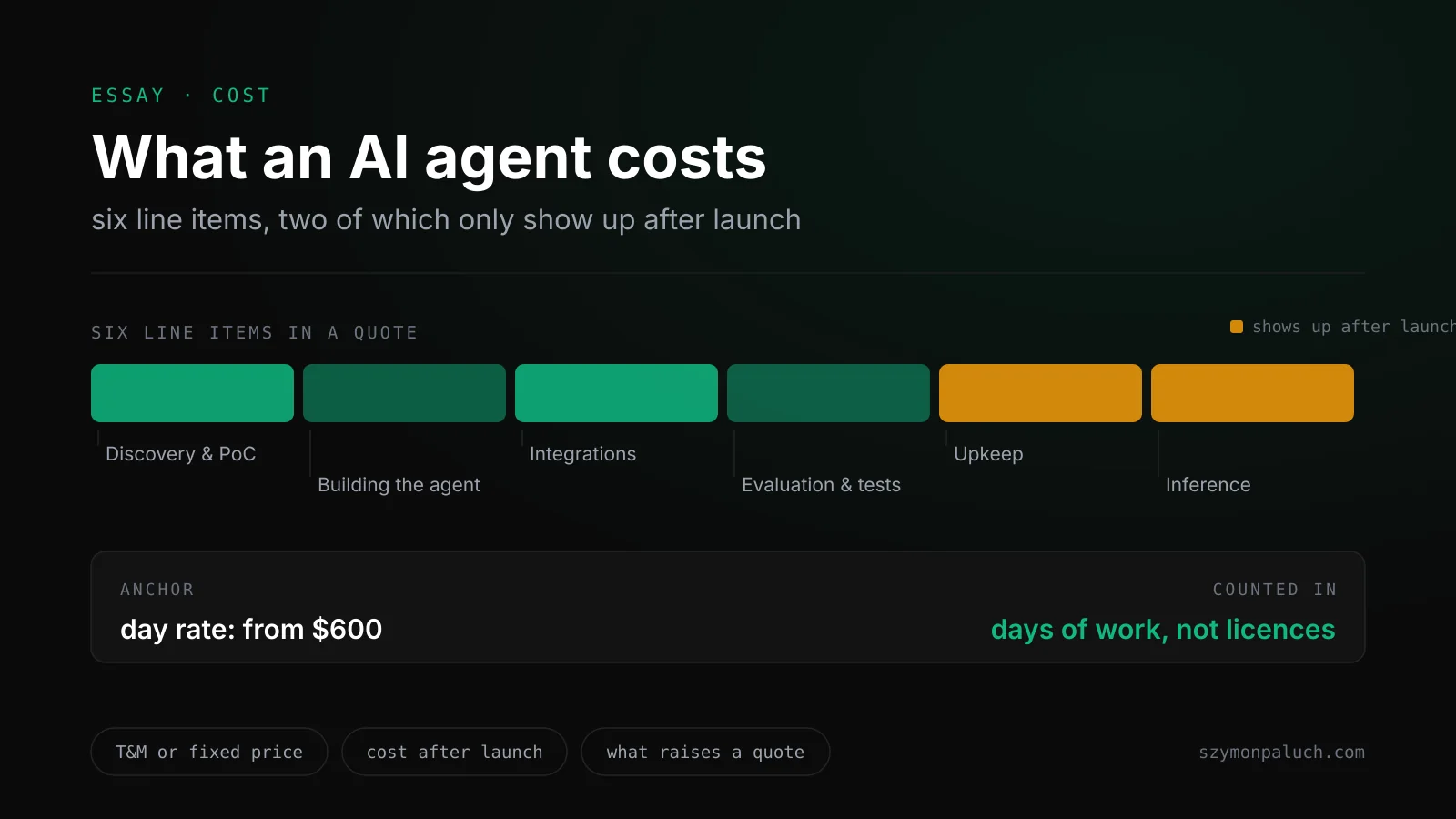
An honest quote breaks into six items. The first four end on launch day. The last two only start there, and those are the ones that usually vanish from a price list.
Discovery and PoC
Conversations with the people who do this work today, a review of data and systems, one narrow case taken all the way. This item rescues budgets more often than any other, because it kills a bad idea before it becomes a project.
Agent build
Prompts, tools, the execution loop, error handling, the screen a human works from. It grows with the number of steps and with the number of decisions the agent makes alone.
Integrations
Wiring into the systems already running in the company. The quote follows their shape, not their count. A missing test environment pushes it up the hardest.
Evaluation and testing
A set of cases with correct answers, a quality measurement, regression runs on every model or prompt change. Without it nobody knows whether the agent works.
Upkeep
Starts only after launch. API changes, new model versions, edge cases from users, prompt fixes. It bills monthly, not once.
Inference
The cost of model calls. Also starts after launch and scales with traffic, not with the project. Usually the smallest number in the table and the only one that grows on its own.
Those last two items settle whether the project survives its first year. The second half of the budget lives on the road between a pilot and a system that carries real traffic. What changes along that road is written up in my notes on taking an agent from pilot into production.
This is what I do hands-on: advising on AI strategy and building agents that survive the demo.
Count it in days, not in licences
An agent has no list price, because it does not sit on a shelf. It costs as many days as the people who build it will work. That unit you can check and compare across quotes.
My rate starts from $600 per day. The minimum is a quarter of a full-time load, roughly five days a month. I do not take single hours on a deployment, because half of that time goes into digging into context.
Convert the scope into days and you get a range instead of a promise. A first production agent, with two integrations and a human approving decisions, usually lands between twenty and forty days of work. The low end of that range is 20 days × $600, so $12,000. The high end is 40 days × $600, so $24,000. Both figures cover building and shipping it, not the yearly upkeep and not the inference bill. Every further system and every action without a human moves you up that scale. That is how I estimate this scope. It is not a line in a price list.
The inference bill depends on the model and the speed tier, and after DevDay 2026 the gaps in OpenAI's price list are wide. I compared when a cheaper model is enough and when a faster tier is worth paying for.
Not everything has to be built at once. A security audit of agents already running costs from 4,000 USD, runs two to three weeks and ends in a report and a session. A two-day workshop for a team of up to twelve people starts from 4,800 USD online, or 6,400 USD on-site with travel included, and is often a cheaper start than a project. Fractional CAIO runs from 3,200 USD a month, with a three-month minimum and roughly one day a week. For a single advisory session I charge from 300 USD per hour.
How much of that comes back is a separate calculation. Some metrics show the value of a deployment, others only pretend to. I worked the difference through in the post on counting the return on a deployment without fooling yourself.
The Agentic Architect
Practical patterns, case studies and AI news. Zero spam, once a week.
You'll get one email to confirm. Unsubscribe with one click. Privacy policy
Time and Materials or fixed price
The billing model moves the risk of an unknown scope from one side to the other. On Time and Materials you pay for the days worked. You reprioritise as you go. On a fixed price you pay an amount agreed up front for a written scope. The vendor carries the overrun risk.
The choice is easy once you tell yourself the truth about scope. Scope still moving? Then a fixed price carries a buffer for your uncertainty, and you pay for that buffer either way. Scope closed and written down? Then a fixed price gives you predictability that day-based billing cannot.
In practice I usually split it in two. Discovery and PoC run on days worked, because scope is still forming there. The build runs on a fixed price, because after the PoC everyone knows what is being made. Both models are laid out together with the rate and the minimum commitment on the deployments page.
What can triple the quote
Five things turn a sensible budget into a project with no end. I have seen every one of them, and every one can be caught before anyone signs a contract.
Unclear scope. "A customer support agent" is not a scope. A scope is the list of cases the agent closes on its own and the list it hands to a human. Without it each side prices something different, and then both are surprised.
Data that does not exist yet. The knowledge sits in people's heads or in mailboxes. Somebody has to write it down before the agent can do anything with it. That work is on your side and it takes weeks, while the team on the other side waits.
No owner on the client side. A project needs one person who decides and has time for it in the calendar. When a decision waits two weeks for a committee, the team bills that calendar anyway.
"Let us also add". Every new case dropped in mid-build reshuffles work that was already done. Collect those ideas on a separate list and run them in a second round, after the first version is live.
Compliance discovered late. Personal data, the AI Act, industry requirements. When they surface at handover, you rewrite the architecture. When they surface in discovery, they are one design decision and cost a day.
All five come out in one well-run conversation before the quote. The short list of things worth settling before anyone gives you a number is in the piece on what to nail down before a deployment starts.
Before you ask for a quote, write three things on one page. The systems to connect, noting whether each has an API and a test environment. The actions the agent is meant to perform without a human. The person on your side who decides. With that page you get quotes you can actually compare.
Frequently asked questions
What does an AI agent cost for a company?
It depends on the number of integrations and on whether the agent executes actions itself or only proposes them. A first production agent with two integrations and a human approving decisions usually lands between twenty and forty days of work. My rate starts from $600 per day. An agent that reads one source and only drafts answers is cheaper, because it needs no permission layer and no event log.
What should an AI agent deployment quote contain?
Six items: discovery and PoC, the agent build, integrations with systems, evaluation and testing, upkeep and the cost of model calls. The first four end on launch day. Upkeep and inference only start there and bill on a monthly cycle. If a quote does not list them, ask who covers them.
Is fixed price or day-based billing better?
Fixed price wins when the scope is closed and written down, because it gives budget certainty without a large buffer. Day-based billing wins while the scope still moves, because you are not paying for someone else's reserve against uncertainty. A common arrangement looks like this: you bill discovery and PoC by the day, and the build at a fixed price. After the PoC everyone knows what is being made.
What does it cost to maintain an agent after launch?
Upkeep is counted monthly and covers vendor API changes, new model versions, prompt fixes and edge cases reported by users. On top of that comes the cost of model calls, which grows with traffic. Over a year that sum can exceed the cost of the build, so settle it in the contract rather than after the first outage.