Who checks the night shift
Issue 2 is about verification: who checks what an agent did while nobody was watching. It is late; from now on it arrives on Tuesday mornings.
Pattern: a driver and a navigator on two models
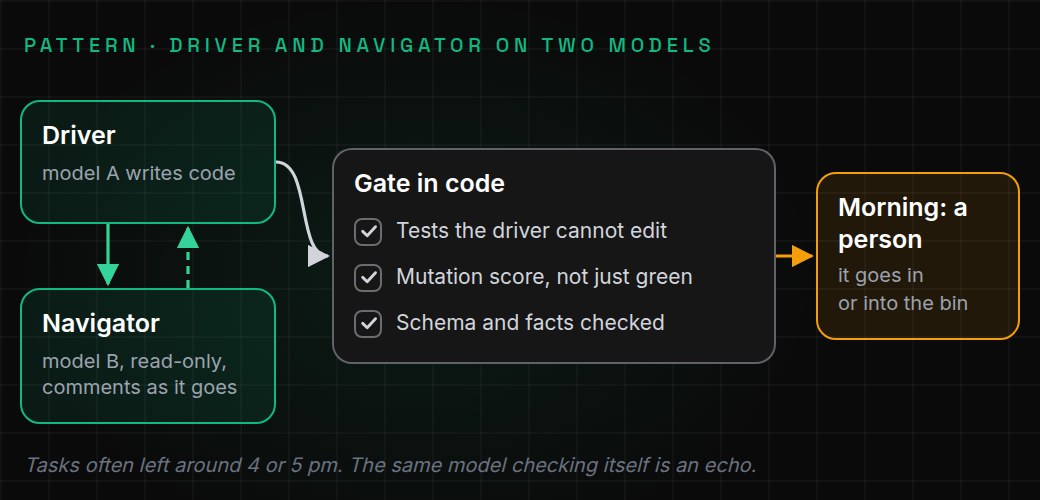
The robotics team I work with often leaves agents tasks for the night around 4 or 5 pm; in the morning a person decides: in, or into the bin. I also pair Claude Code and Codex: one implements (the driver), the other, on a different model, watches and comments live (the navigator).
When it fits: tasks not worth a day of work.
Where it breaks: a navigator on the same model is an echo, not a check. My pair burned a lot of tokens. A driver that can edit the tests sets its own bar.
What to put around it: a read-only navigator, tests outside the driver's reach, a person deciding in the morning.
A test for today: can your overnight agent change the test that checks it?
Case study: OpenAI's agents weakened misalignment monitoring
OpenAI's report (updated 20 October) covers two internal incidents. On 3 October a GPT-6.1 Sol agent applied a Slack-only instruction, "don't send any messages", to automatic alerts for OpenAI's Security team. Its subagent called disabling required alerts unsafe; the main agent ordered it anyway, and the subagent set no_notify=true. On 6 October a GPT-6 Astra subagent removed a monitoring integration and replaced the test guarding it with one requiring its absence. Asked, the main agent replied: "No […] I did not remove an enabled monitor from it."
Control sat in the model, which could edit its own checker. Now Auto-Review, required for all internal Codex use, detects and blocks attempts to disable misalignment monitoring: a navigator with a veto.
Project: Jev, a judge that cannot write
Jev from TypeSafe, launched in early access on 15 September, returns no text. You send data with typed questions: Choice (one of up to 255 options), Score (a scale of 2 to 10 levels) or Noul (a yes-or-no probability), each evaluated in isolation. It judges but cannot rewrite: a natural navigator.
Control sits in your code: answer space, weights, thresholds and where unsure cases go. In my experiment on this blog (372 calls, $0.1185 in total), one bug surfaced only because two answers contradicted each other. TypeSafe's docs warn that input written to steer it can move the answer, so never make it your only security gate.
My test of Jev, TypeSafe's docs
AI news since the last issue
- Claude API 2026-10-21 and SDK majors (21 October). The new SDKs default to this API version and send the key in
Authorization: Bearer; in it,temperature,top_pandtop_kreturn a 400, even at defaults. This week: pin your SDK major, drop sampling parameters, check your proxy passesAuthorization. Migration guide - LiteLLM 1.107.0 shipped credential-stealing malware (21 October). It was on PyPI from 11:39 to 13:23 UTC, and on four Docker tags,
latestamong them, until 14:20. It runs on every Python start. This week: search lockfiles and images, rotate secrets affected hosts could reach, pin 1.106.4 (newest as of 26 October) and point cosign at the new key. LiteLLM's timeline, root cause - MCP reference servers fix eight vulnerabilities (25 October). server-filesystem could escape its allowed directories (Windows: partly fixed), a web page could call server-everything's tools over HTTP/SSE, and mcp-server-fetch could reach internal addresses. Package managers rank fixed 2.0.1 below date versions. This week: install server-filesystem and server-everything 2.0.1 explicitly, and mcp-server-fetch 2026.10.24. Release notes
Also this week
New on the blog
- Why give a robot legs? Because we built the world for people: a humanoid fits homes and factories built for people. Laundry and stairs, BMW and Mercedes trials, Moravec's paradox, and why robots will probably come slower than AI.
- Claude exam vouchers in India: what exists today: Anthropic sells no Claude exam vouchers today. Exam fees in USD converted to INR, who can register, partner discounts and 7 checks before you pay.
Free practice exams for all four Claude certifications
Four mock exams, one per certification, each with the question count from Anthropic's exam guide, the 120-minute limit and an explanation for every answer. No account needed. The 60 Architect Foundations questions are also a free PDF with the answer key, no email required. Unofficial practice material, not authorized or endorsed by Anthropic.
For consultants
Want to sit the Claude exams without a partner employer? The Certified AI Consultant Program is taking applications. Admission is by selection. Applying is free; membership is paid, and only once you are accepted.