Updated
Why 90% of AI strategies end up in a drawer
47 pages, 12 charts, 0 deployments. The anatomy of a document that never stood a chance.
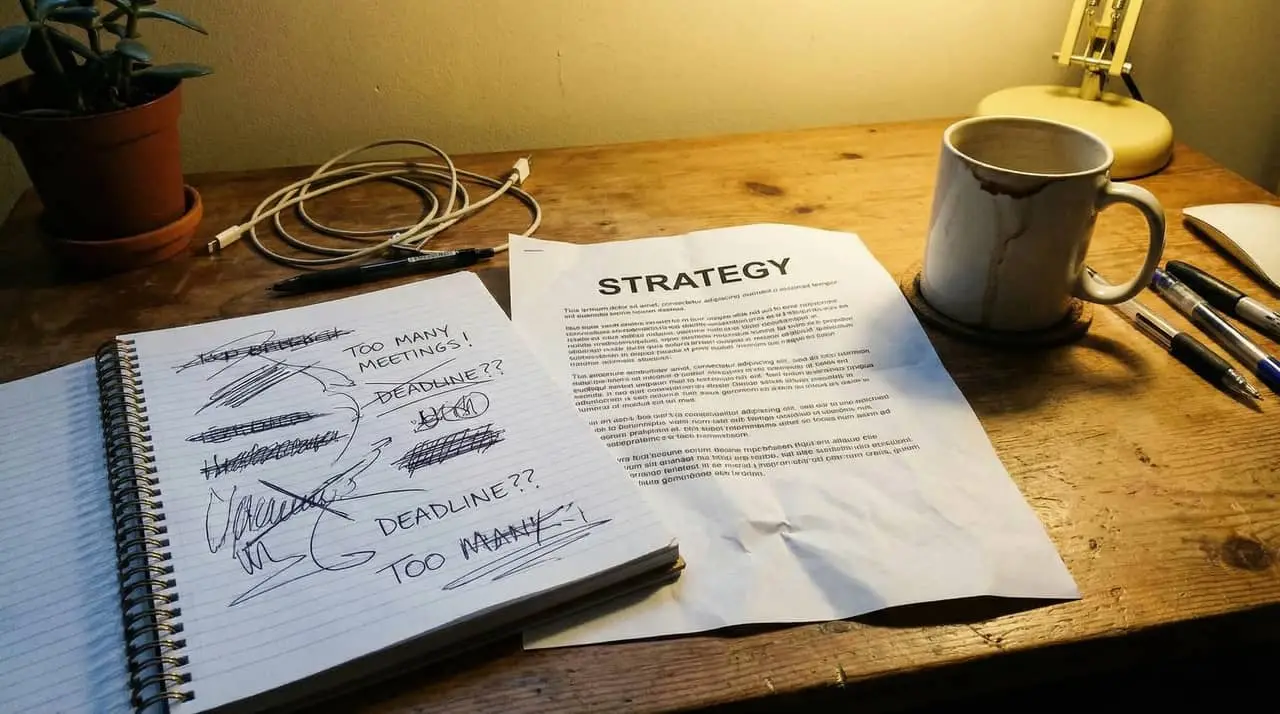
I just closed a PDF titled "AI Strategy 2026." Some company paid as much for it as you'd pay for a small apartment. Does it look impressive? Yes. Will it change anything in the business? Absolutely not. McKinsey confirms it: only 7% of companies have fully deployed AI across the whole organization. The rest are stuck in permanent "pilot mode."
Let's say it plainly: PowerPoint is not a strategy. Excel is not a plan. A document is not a deployment.
Anatomy of a dead document
The typical "AI Strategy" looks the same at every company. 47 pages of buzzwords, 12 Gartner charts, and zero concrete steps that anyone will actually take on Monday morning.
It's all show. The board sleeps soundly with its "we have a plan!", while the team still copies data out of PDFs into Excel by hand.
TYPICAL ELEMENTS OF A DEAD STRATEGY
- ✗ "AI Vision 2030": a goal so distant that nobody feels accountable
- ✗ "100 use cases": a wish list with no priorities
- ✗ "AI Center of Excellence": a new department with no mandate
- ✗ "Transformation roadmap": a Gantt chart nobody ever updates
This is what I do hands-on: advising on AI strategy and building agents that survive the demo.
Why does this happen?
Because companies treat AI as an IT project, not a business change. They hire consultants who write beautiful documents but have no mandate to deploy them.
"It's like a GPS that only shows the destination ('We'll be the market leader!') but never shows the route. Nice to know you want to reach Rome. In reality you're stuck in traffic outside Radom."
What works instead?
A strategy that actually works doesn't run 50 pages. It fits on a single sheet of A4:
STRATEGY ON 1 PAGE
- 1. Find the bottleneck: the one burning money RIGHT NOW
- 2. Build an ugly prototype: in 2 weeks, not 2 years
- 3. Measure the result: a concrete business metric
- 4. Decide: works → scale it, doesn't work → trash it
The rest is business fiction.
Point one takes the longest, because it means naming one process instead of a whole vision. How to find that bottleneck and what you can't skip along the way: five questions before you deploy.
Point three has a different problem: time saved shows up in a spreadsheet right away, so most companies stop there. Which metric is worth picking: ROI from AI.
The Agentic Architect
Practical patterns, case studies and AI news. Zero spam, once a week.
You'll get one email to confirm. Unsubscribe with one click. Privacy policy
What does it look like in practice?
Instead of "we're deploying AI in marketing," you get: "We're cutting content creation time from 4h to 30min." Instead of "digital transformation," you get: "We're automating process X that costs us Y a month."
Specifics. A measurable result. A deadline that keeps people on edge.
Do this on Monday
Close that PDF. Pick one problem that costs you real money and solve it in two weeks. One result like that beats 100 pages of future visions.